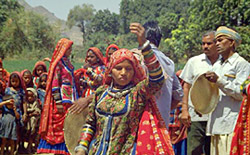
The Paite Tribe resides in the north eastern and central part of Aizawl district of Mizoram. This group hails from the Tibeto-Burman family. Some of them also inhabited the middle part of the district of Lunglei. Many of them also reside in other places like Churachandpur district of Manipur, Tripura and Chin State of Burma. The Paites are a recognised scheduled tribe in Manipur as well as in Mizoram. All ethnic Paites pursues Christianity, chiefly Protestant coinages like Baptists, Lutherans, Penticostal, Church of Christ though there are a good percentage of Roman Catholics as well. They adopted Christianity in the 19th century with the intrusion of British missionaries. The word paite means "a group of people marching ".
Location of Paite Tribe in India
The Paites are one of the constituting tribes of the populate India, Burma and Bangladesh. The Paites are home-grown tribes of Mizoram under the Greater Assam state since 1300 AD. The Paite are not an immigrant, they are the original inhabitants of Mizoram.
Language of Paite Tribe in India
Paite is a language spoken by the Paite people. There are diverse Paite dialects. The language displays communal simplicity with the other dialects of the area including Thadou, Hmar, Vaiphei, Simte, Kom, Gangte and other languages.

History of Paite Tribe in India
Paite Tribe"s main livelihood is cultivation though they have attained much at the different offices of the Federal India. The Paites are one of the most educationally highly developed ethnic groups in India. Usually people of the Paite tribe in Mizoram have the letter P before their given name which is more or less the only way to distinguish Paite-Mizo from non Paite-Mizo. They believed in supreme god Pathian and believed to have originated from a cave or Khul. The Paite people have a long history of Non Violence movements in Mizoram since a long time.
In the year 1950, few scholars of Paite founded the Mizoram Paite Federation (MPF). They demanded for Regional Council under the 6th Schedule of the Indian constitution within the Mizo district. But the movement failed due to the anti chieftainship demonstration of the Mizo Union (MU) movement. The movement was again revived in 1960s under the banner of Paite National Council (PNC).The movement again failed due to the Mizo National Front(MNF) prohibited revolution movement since 1966.
Costumes of Paite Tribe in India
The Paites dresses are similar to the Lushai people. Women dress in a more colourful manner in comparison to the men. Women wear blouse or jacket and a colourful garment which is well decorated. They also tie a cloth round their waist to ankle like that of a Lushai lady but they do not put on huge and heavy ivory earrings
Culture of Paite Tribe in India
Two types of marriages are prevalent among them viz. marriage by negotiation and marriage by choice. There is a peculiarity about their system of marriage. Among them, a young Paite boy at first live together with his future wife for a time period of three years. During this tenure, if no child is born to the couple or the wife does not conceive the couple gets separated. On the other hand, if within that period of time the woman conceives a child the marriage is to be completed and on the birth of the baby, bride price is to be paid to the father of the child. Inter-marriage is rarely practiced by them. According to another rule, the son of a Chief is supposed to marry his first cousin. The eldest son generally inherits the house of his father and he is entrusted with the duty to look after his parents.
Dance, songs, tales, all linked to every day chores of the life of these Paite tribes, thus ennobling the tradition and culture of Paite community. Zangtalam is a popular dance style performed by this community. Both Paite males and female folks actively take part in it. Rice is the staple food of the Paites. They practice jhum (shifting) cultivation.
By nature the Paite tribes are timid, recluse people who are truly committed to whatever they do. Although the Paite tribes are mainly agriculturists, many of them have achieved remarkable fetes. Today some of them occupy respectable posts and position in the `mainstream governance` of Indian subcontinent as well. The Paites usually do not have guest houses. The youth of the village usually sleep in the verandah of their Chief. They also have village Headman whose office is hereditary. There is Village Council headed by some elder members.