


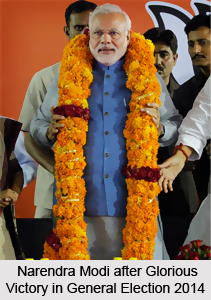
 Narendra Damodardas Modi better known as Narendra Modi, is the 15th Prime Minister of India and he was the 14th Chief Minister of Gujarat. Later he resigned from the position as a Chief Minister of Gujarat, as he was elected as a Prime Minister of India, after the huge victory in Indian General Election 2014. Narendra Damodardas Modi better known as Narendra Modi, is the 15th Prime Minister of India and he was the 14th Chief Minister of Gujarat. Later he resigned from the position as a Chief Minister of Gujarat, as he was elected as a Prime Minister of India, after the huge victory in Indian General Election 2014.
Narendra Modi is a member of the political party named Bharatiya Janata Party (BJP). He was the successful candidate for the designation of Prime Minister of the National Democratic Alliance led by the Bharatiya Janata Party (BJP), for the Indian general elections of 2014. Early Life of Narendra Modi Narendra Modi was born on 17th September 1950, to a middle class family of grocers in Vadnagar in the Mehsana district of Gujarat. Damodardas Mulchand Modi was his father, while the name of his mother is Heeraben. Narendra Modi worked in his family tea stall along with his brother, which was located near a bus terminus. He finished his schooling in Vadnagar, where he is said to have been an intelligent debater. He commenced working in Gujarat State Transport Corporation's canteen, wherein he was a propagandist or 'Pracharak' of the Rashtriya Swayamsevak Sangha (RSS) during 1974. After he received TSS training in Nagpur, he was made the supervisor of Akhil Bharatiya Vidyarthi Parishad or ABVP in Gujarat. During his student life, he displayed influential leadership qualities, and this was clearly seen when he successfully set up a new chapter of Akhil Bharatiya Vidyarthi Parishad which was a powerful national student body. 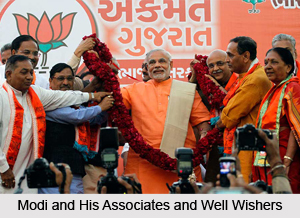 After post-graduating in political science, he entered social life right at the beginning of his career, in the early 1970s. After that he became a full-time worker and organiser for it. During his engagement with Rashtriya Swayamsevak Sangha, he plunged into the anti-corruption movement. In the early1980s, he joined the Bharatiya Janata Party. He was the bridge between the Rashtriya Swayamsevak Sangha and the Bharatiya Janata Party. He had completed his master's degree from Gujarat University in the field of Political Science.
Political Career of Narendra Modi Modi was absorbed into BJP in the year 1987, thanks to the efforts of the RSS. Narendra Modi's organization of the 'Journey Of Unity' or 'Ekta Yatra' earned him higher recognition in the Indian political arena, as compared to Keshubhai Patel and Shankarsingh Vaghela. During this time, he was appointed as the General Secretary of the BJP and he was shifted to Delhi, as he was entrusted the responsibility of managing the actions of the party in Himachal Pradesh and Haryana. He was promoted to BJP's National Secretary in the year 1998. Narendra Modi played a crucial role in the Gujarat state elections of 1995 and 1998 and also in the general elections of 2009 and 2014. He became Gujarat's Chief Minister in October 2001 when his predecessor Keshubhai Patel resigned. Since 7th October 2001, Modi has been the Chief Minister of Gujarat. He was promoted to the office following the defeat of the BJP in the elections. Narendra Modi was termed as the 'Longest Serving Chief Minister' in the political history of Gujarat as he had rendered his services for 2, 063 days. He has often been appreciated for his economic policies which have proved their dexterity in enhancing the economic growth in the western Indian state of Gujarat. Career of Narendra Modi as Gujarat Chief Minister Narendra Modi was made the Chief Minister of Gujarat on 7th October, 2001 and his duty was to organise the BJP for the purpose of the elections which were to take place in December, 2002. During his tenure as Gujarat's Chief Minister, his concepts included the idea of small government and privatisation. In December 2002, Narendra Modi won re-election as Chief Minister with 126 seats in the 182-member assembly. During his second term as Chief Minister (2002 to 2007), Narendra Modi 's policies transitioned to initiating the growth of Gujarat from the principles of Hindutva. The changes he incorporated during this point of time made Gujarat an ideal investment destination. During the period from 2007 to 2008, Modi ordered for the execution of Afzal Guru, a Pakistani Jihadist who was accused of terrorism in the Parliament attack, 2001. 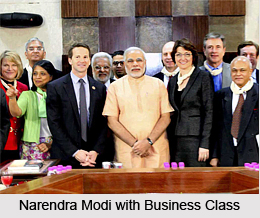
In order to compensate for economic losses, Modi re-organised the Government's administrative structure. It was during his headship, Gujarat registered the highest growth rate among all the states in India with a GDP growth rate of over 10%. Narendra Modi was credited by the Gujarat Government for reducing the fiscal deficiency of the state treasury by 50% and reducing the losses of the Gujarat State Electricity Board. It was his initiative with which the availability of electricity in many parts of rural Gujarat was increased in over 5,000 villages. Successful rising of the height of the Narmada Dam from 95 to 110.64 metres is one of the most substantial accomplishments of his government that has been resulted in increased irrigation, water supplies and hydroelectric power generations. After being elected as Prime Minister Candidate, Narendra Modi resigned from the post of Chief Minister of Gujarat on 21st May 2014 and placed Anandiben Patel as the next Chief Minister of Gujarat. Developmental Projects under Narendra Modi The government under Narendra Modi and also the successive BJP governments strongly supported NGOs in the development of infrastructure projects which aimed to conserve groundwater. By 2008, 50,000 structures were finished, out of which 1, 13, 738 were check dams. By the year 2010, the groundwater levels of Gujarat increased to a large extent, which benefited the cultivation of cotton which could presently be irrigated utilizing tube-wells. The growth rate of Gujarat witnessed an escalation by 9.6% during 2001 to 2007. During the years 2001 to 2010, Gujarat's growth rate rose to 10.97%. Under Modi government, the scenario of electricity in several rural portions of Gujarat improved drastically. The 'Jyotigram Yojana' scheme was undertaken, which was inspired by the concepts of the International Water Management Institute. Sadbhavna Mission Narendra Modi started a series of fasts during 2011 and 2012 to represent the Sadbhavna Mission or Goodwill Mission, whose goal was to bring a positive impact to the Muslim community in Gujarat. He felt his fasts would go a long way to strengthen the ambience of harmony and peace within the state. 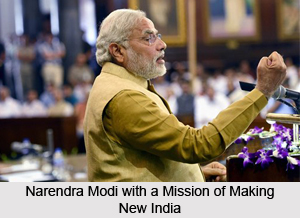 The mission had commenced on 17th September, 2011 in the area of Ahmedabad, and the very first fast continued for three days. Modi is said to have observed 36 fasts in 8 cities and 26 districts. The mission had commenced on 17th September, 2011 in the area of Ahmedabad, and the very first fast continued for three days. Modi is said to have observed 36 fasts in 8 cities and 26 districts.
Awards Received by Narendra Modi Narendra Modi has been awarded by India Today as the Best Chief Minister twice in 3 years, after a country-wide survey organised in 2006. Modi is considered front-runner in party's leadership among the next generation of politicians. He was conferred with The Asian Winner of the FDI Personality of the Year Award in 2009 by FDI Magazine. The award was however withdrawn and awarded to the Gujarat state instead. Modi was awarded the 'Gujarat Ratna' at Ganesh Kala Krida Manch by Shri Poona Gujarati Bandhu Samaj and "e-Ratna" by the Computer Society of India. |
| |||



Narendra Modi
| Narendra Modi is the 15th Prime Minister of India belonging to the Bharatiya Janata Party. He is a member of Rashtriya Swayamsevak Sangha also. He came into the limelight from Ekta Yatra and later he carried out several development projects in Gujarat, while he was the Chief Minister of that state. |
| ||||||||||||||||||||||||||||

