
 Banjara Tribe is a significant caste amongst the innumerable tribes who have thronged various places of eastern India. They are considered the caste of carriers. They constitute the "smallest" tribal population in Jharkhand and these tribes are grouped under the "scheduled tribes" group of the state. They are the typical nomads who wander from one place to another thus leading a life in their own terms and condition. Thus, their way of living is quite thrilling and full of adventures. They are skilled weavers and make mats, baskets, trays, brooms, etc. from grass growing wild in the forest.
Banjara Tribe
Banjara Tribe of Jharkhand holds an important place among all India tribal communities. They have their own rich culture and costume. They are followers of Hinduism.
Introduction
Banjara Tribe is a significant caste amongst the innumerable tribes who have thronged various places of eastern India. They are considered the caste of carriers. They constitute the "smallest" tribal population in Jharkhand and these tribes are grouped under the "scheduled tribes" group of the state. They are the typical nomads who wander from one place to another thus leading a life in their own terms and condition. Thus, their way of living is quite thrilling and full of adventures. They are skilled weavers and make mats, baskets, trays, brooms, etc. from grass growing wild in the forest.Origin of Banjara Tribe
The origin of the Banjara tribes is quite interesting. According to scholars, the first mention of the Banjaras is found in the history of Sikandar Lodi"s attack on Dholpur in 1504 AD. They came to the Deccan following the invasion by the armies of Aurangzeb. According to some authorities, the actual Banjara lineage goes back to some 2000 years. After setting down in Rajasthan, Banjaras began to travel down to the South in the 14th century. A local dialect namely, Kutni too is popular amongst a section of Banjara tribes.
Divisions of Banjara Tribe
Banjara tribes have four main divisions in Berar, namely, Mathurias, Dharis, Charans and Labhanas. The name Charan basically means wanderer. Charans have five clans - Panwar, Puri, Rathor, Jadon and Chauhan. These are the names of leading Rajput clans. Each clan of Banjara tribe has several sub-clans. Members within the same clan do intermarry. There are other divisions apart from these four main divisions. There are two Muhammadan sections in this caste namely Mukeri and Turkia.
Society of Banjara Tribe
The society of the Banjara tribe in Jharkhand is a recognized part of the tribal community. The Banjaras are very small tribe. They are mostly found in the Rajmahal sub-division of Sahebganj District of Jharkhand. The people of Banjaras lead an organised life. The Banjara women uphold the culture of the family. They exercise a significant role in socialising their children. They impose discipline in the household and also assist her husband in his work. They are skilled in handicraft works hence they engage in making mat, basket, broom, tray from the leaves and grasses in the forest. They also play the role of a family doctor as they have knowledge of the medicinal values of the plants and different herbs available. The Banjara children do not go to school instead they help their parents in the household works. The Banjara youth move from door to door performing in different villages. During off season they engage in collecting, hunting and other agricultural work. On the other hand, the aged people rest back at home training the young the art of dancing, singing and playing instruments. Thus the whole family organization of the Banjaras is well structured.
Family of Banjara Tribe
The Banjara family is patriarchal. Father is considered as head of the family and all the authority is vested in him. They have the nuclear family structure which consists of husband, wife and their un-married children. After marriage, the daughter leaves her father`s house and goes to live in the house of husband. The sons usually establish separate houses after their marriage but sometimes the married sons continue to stay with their parents to look after them. They even share the property of their father.
Marriage of Banjara Tribe
Among the Banjaras the usual form of marriage is monogamy. Dowry practise is prevalent among the Banjaras. Bigamy and Widow re-marriage is also practised. The Banjaras practice tribe endogamy and clan and village exogamy. Cousin marriages are strictly prohibited. .The marriage rituals of Banjara Tribe are observed and carried out by the kins and relatives of the bride and the groom.
Kinship of Banjara Tribe
The kinship system of the Banjara Tribe is based on two types of relationships; they are blood relationship and marriage relationship. The blood ties are continued for generations together. All ascendants and descendants are kins who are united through blood. Marriage transmits blood relation through reproduction. Blood relation is established between the husband, wife and their children. Marriage binds not only the couple but also the kins on either side through the bond of kinship. Even the husband and the wife establish relationship with either family through kinship. Thus marriage binds together families under the kinship structure.
The Banjaras use classificatory and descriptive kinship terms to denote their relatives. Classificatory terms are used in case of designating relatives while relations between two persons are denoted with descriptive kinship terms. The Banjaras are divided into clans, Kaslogapa and Garga. Clans share the same blood hence inter clan marriages are prohibited.
The means of conduct and behaviour among the Banjaras are also denoted with Kinship usages. Kinship usages like avoidance, joking, takenonymy are applied while kins meet up with each other. Banjaras follow the patrilineal descent in regards to inheritance of property.
Family of Banjara Tribe
The Banjara family is patriarchal. Father is considered as head of the family and all the authority is vested in him. They have the nuclear family structure which consists of husband, wife and their un-married children. After marriage, the daughter leaves her father`s house and goes to live in the house of husband. The sons usually establish separate houses after their marriage but sometimes the married sons continue to stay with their parents to look after them. They even share the property of their father.
Marriage of Banjara Tribe
Among the Banjaras the usual form of marriage is monogamy. Dowry practise is prevalent among the Banjaras. Bigamy and Widow re-marriage is also practised. The Banjaras practice tribe endogamy and clan and village exogamy. Cousin marriages are strictly prohibited. .The marriage rituals of Banjara Tribe are observed and carried out by the kins and relatives of the bride and the groom.
Kinship of Banjara Tribe
The kinship system of the Banjara Tribe is based on two types of relationships; they are blood relationship and marriage relationship. The blood ties are continued for generations together. All ascendants and descendants are kins who are united through blood. Marriage transmits blood relation through reproduction. Blood relation is established between the husband, wife and their children. Marriage binds not only the couple but also the kins on either side through the bond of kinship. Even the husband and the wife establish relationship with either family through kinship. Thus marriage binds together families under the kinship structure.
The Banjaras use classificatory and descriptive kinship terms to denote their relatives. Classificatory terms are used in case of designating relatives while relations between two persons are denoted with descriptive kinship terms. The Banjaras are divided into clans, Kaslogapa and Garga. Clans share the same blood hence inter clan marriages are prohibited.
The means of conduct and behaviour among the Banjaras are also denoted with Kinship usages. Kinship usages like avoidance, joking, takenonymy are applied while kins meet up with each other. Banjaras follow the patrilineal descent in regards to inheritance of property.
Culture of Banjara Tribe
Culture of the Bajara Tribe reflects different shades of their rituals, customs and traditions that are followed. The Banjara Tribe belonging to the states of Jharkhand are found in the districts of Rajmahal, Godda and Santhal Pargana. In the year 1956 on the recommendation of the Backward Class Commission Government of India they were included in the list of scheduled in the list of scheduled tribe.
Material Culture of Banjara Tribe
The Banjara villages are located near the hills of the forest. They live with other castes in their villages. Their houses are rectangular in shape and are made of mud walls with bamboo rafters and tiles on the roof. The house is divided into two to three rooms with the help of mud walls. The Banjaras are usually nomadic people who keep moving from one village to another. The household items of the Banjaras include aluminium pots and pans, earthen pots and knives made of iron. They make mat, basket, broom tray from the grass available in the forest. They use Lathi, Bhala, Bher, Khanti and axe as their weapon for various uses. The Banjaras are Del players who wander from village to village singing prayer songs on various occasions like that of the birth of a child. They also use instruments like Dol and Table to accompany their songs. Along with singing they also perform dance sequences in the courtyard of the houses of the new born child`s parents.
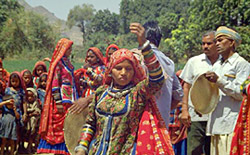
The Banjaras carry pack buffaloes. They have a liking towards dresses and ornaments. The women usually adorn themselves with Lalianga and Chunari where as the men wear Dhoti, Lungi, Kamij and Muretha. The children dress themselves in Ganji and pants. Women wear ornaments made of elephant teeth, steel, brass, glass, thread bead and many others. They also decorate themselves with ornaments made of gold and silver which they usually receive as gifts. The Banjaras use lota, thali and glass made up of glass and bronze. They buy these from the nearby local Haat.
Birth and Death Rituals of Banjara Tribe
The birth of a child in the house of a Banjara is considered to be very auspicious as it confirms the fertility of the couple. If a baby boy is born then he will carry the name of the family and inherit the property of the parents. If a girl child is born then she will be exchanged during the time of marriage for the continuity of the race. The birth of a child among the Banjaras is celebrated with much joy and happiness. The Banjaras give equal status to both the sexes and hence they celebrate the birth of both the girl and the boy child. The Banjaras celebrate the birth of a child by singing and dancing on the occasion. All the males and females of the community gather together and dance and sing during the occasion.
After the birth of the child the mother and her baby is considered to be impure. Hence after five days the mother and the child take a purificatory bath. The house id also washed and purified with mud, cowdung and water. After the purification ceremony the mother and the child visits the shrine of the family deity and then takes the blessings of the elder members of the community. Birth feast is also given to the community members.
Death rituals among the Banjara tribes are also prevalent. They view a difference in the deaths of various people. The death of aged people are considered to be a good sign as they believe that they either get transformed into new bodies or they get salvation. Premature deaths occurring out of various reasons like accident, suicide, murder, burning, drowning is not considered as a good sign. They think that these unsatisfied souls are malevolent spirits who cause harm to pregnant women, children, bride and groom. Among the Banjaras the dead ones are buried. They consider that death causes impurities hence purification rituals are conducted on the tenth day after the death all clothes and houses are washed. The male members shave their heads, beard and moustache. Thereafter a purification feast is also organised among the community members.
Material Culture of Banjara Tribe
The Banjara villages are located near the hills of the forest. They live with other castes in their villages. Their houses are rectangular in shape and are made of mud walls with bamboo rafters and tiles on the roof. The house is divided into two to three rooms with the help of mud walls. The Banjaras are usually nomadic people who keep moving from one village to another. The household items of the Banjaras include aluminium pots and pans, earthen pots and knives made of iron. They make mat, basket, broom tray from the grass available in the forest. They use Lathi, Bhala, Bher, Khanti and axe as their weapon for various uses. The Banjaras are Del players who wander from village to village singing prayer songs on various occasions like that of the birth of a child. They also use instruments like Dol and Table to accompany their songs. Along with singing they also perform dance sequences in the courtyard of the houses of the new born child`s parents.
The Banjaras carry pack buffaloes. They have a liking towards dresses and ornaments. The women usually adorn themselves with Lalianga and Chunari where as the men wear Dhoti, Lungi, Kamij and Muretha. The children dress themselves in Ganji and pants. Women wear ornaments made of elephant teeth, steel, brass, glass, thread bead and many others. They also decorate themselves with ornaments made of gold and silver which they usually receive as gifts. The Banjaras use lota, thali and glass made up of glass and bronze. They buy these from the nearby local Haat.
Birth and Death Rituals of Banjara Tribe
The birth of a child in the house of a Banjara is considered to be very auspicious as it confirms the fertility of the couple. If a baby boy is born then he will carry the name of the family and inherit the property of the parents. If a girl child is born then she will be exchanged during the time of marriage for the continuity of the race. The birth of a child among the Banjaras is celebrated with much joy and happiness. The Banjaras give equal status to both the sexes and hence they celebrate the birth of both the girl and the boy child. The Banjaras celebrate the birth of a child by singing and dancing on the occasion. All the males and females of the community gather together and dance and sing during the occasion.
After the birth of the child the mother and her baby is considered to be impure. Hence after five days the mother and the child take a purificatory bath. The house id also washed and purified with mud, cowdung and water. After the purification ceremony the mother and the child visits the shrine of the family deity and then takes the blessings of the elder members of the community. Birth feast is also given to the community members.
Death rituals among the Banjara tribes are also prevalent. They view a difference in the deaths of various people. The death of aged people are considered to be a good sign as they believe that they either get transformed into new bodies or they get salvation. Premature deaths occurring out of various reasons like accident, suicide, murder, burning, drowning is not considered as a good sign. They think that these unsatisfied souls are malevolent spirits who cause harm to pregnant women, children, bride and groom. Among the Banjaras the dead ones are buried. They consider that death causes impurities hence purification rituals are conducted on the tenth day after the death all clothes and houses are washed. The male members shave their heads, beard and moustache. Thereafter a purification feast is also organised among the community members.
Marriage Rituals of Banjara Tribe
 The Banjara Tribe follow the monogamy system of marriage. For the marriage the boy`s father approaches the father of the girl. Sometimes the Banjaras also follow Bigamy. Dowry practise is prevalent among the Banjaras. Levirate, Sororate and Widow re-marriage is also prevalent. The Banjaras practice tribe endogamy and clan and village exogamy. Marriage between mates should not take place if they happen to be relatives up to three generations from either the father`s or mother`s side as in such cases they are considered as brother and sisters. Cousin marriages are also strictly prohibited. .For the marriage, bride price is paid but the amount is very nominal. The amount varies between rupees 5 to 15 and also the dress of the bride.
For the wedding the height, looks, colour and beauty of the bride and the groom is sought after. Once the date of the marriage is fixed the news is communicated to the community members. The date of the marriage is fixed consulting the village priest. On the day of the marriage the groom after taking the purification bath wears new clothes. All the male kins accompany the groom to the bride`s place where the marriage will take place. Earlier the groom used to reach the place in a palki (palmqueen) but now they usually ride bicycles, rickshaws or bullockcart. When the Barat party reach the village of the bride, they are heartily welcomed by the male kins of the groom. The members of the Barat party are gifted beads of leaves and flowers by the Sarat party. A suitable place is organised for the Barat party to rest. They are offered foods like Dalmot or other salty mixtures, lakatho or gaja sweets, nimki and hamdia or mahua liquor. Subsequently both the parties perform dance sequences. Meanwhile the bride is brought in the courtyard for marriage. A seat is decorated and placed in the middle of the courtyard for the purpose of marriage. All the relatives of the bride sing songs during the marriage ceremony. The groom puts vermillion on the forehead of the bride and the couple move seven times around a fire tank. This marks the end of the marriage ceremony. After the completion of the marriage ceremony all the members enjoy the marriage feast and then go off to sleep. The next day in the morning the ceremony of vidai of the bride takes place. Before leaving the Bharat party are offered breakfast also.
The groom along with the bride when reaches his village, all the relatives give them a warm welcome. The newly wed couple is taken to the family deity to seek blessings. The elder members of the family also bless the couple for a happy and long lasting marriage. All the kins and the community members of the bride are invited for a feast. After the feast is over the kins return to their village.
The bride after her marriage stays in the father in law`s house for a week and then goes to stay in her father`s house. After a year an effective marriage is held again. The groom along with his friends goes to receive the bride. They couple now establish their own household and live together.
Religion of Banjara Tribe
The religion of the Banjara Tribe is based on Hindu and Muslim forms of worship. Their most important deity is the Banjari Devi whose shrine is located in the forest. The shire is represented by a heap of top and on top of it a large heap of stone is placed. The big stone on top is decorated with vermillion, oil and ghee. This tone is worshipped as the Banjara Devi. When a Banjara passes through the shrine he places a stone over the heap as a sign of offering prayer to the deity. It is believed that the Devi helps him during his time of distress and trouble. The Banjaras also worship Shiva Bhaia. These two deities are mostly worshipped by the Banjaras and are believed to be responsible for all the activities occurring within their community.
The Banjaras believe in ancestral spirits who are benevolent. They think that the souls of the people who meet a natural death get united with the ancestral spirits who also at times incarnate in the form of birth of children. They command respect and worship from their descendants. It is thought that if they are unhappy they cause a couple to be barren.
The Banjara Devi, the Shiv Baia and the ancestral spirits are worshipped and offered sacrifices. They are worshipped on occasions like birth, marriage and death. All these worships are accomplished with the help of the Banjara priest. Animals like goats, cocks, hens, pigeon, ducks, and eggs are offered for sacrifice. Later the meat of the sacrificed animal is shared by the priest and the other community people.
The Banjaras are strong believers of witchcraft, spirits and ghosts. They believe that the people who meet unnatural death turn to become ghosts and their roam about as they are unsatisfied souls. They become malevolent spirits who attack pregnant children, children, bride and groom to go to a lonely place. They have Ojhas who by canting mantras can neutralize the attack of the spirits. The Banjaras also believe in witchcraft and magic. It is assumed that a woman acquires the art of witchcraft by sacrificing the life of her husband or son. She then possesses the spirit of the sacrificed person in her witchcraft and becomes a `Dain.` The Dain is then assumed to create pain and miseries to the people of the community. The Banjaras have Guni or Witchdoctor who have the ability to ward off the black magic of the witch.
The Banjaras also celebrate many festivals like the Holi, Diwali and Durga Puja.
The Banjaras believe in ancestral spirits who are benevolent. They think that the souls of the people who meet a natural death get united with the ancestral spirits who also at times incarnate in the form of birth of children. They command respect and worship from their descendants. It is thought that if they are unhappy they cause a couple to be barren.
The Banjara Devi, the Shiv Baia and the ancestral spirits are worshipped and offered sacrifices. They are worshipped on occasions like birth, marriage and death. All these worships are accomplished with the help of the Banjara priest. Animals like goats, cocks, hens, pigeon, ducks, and eggs are offered for sacrifice. Later the meat of the sacrificed animal is shared by the priest and the other community people.
The Banjaras are strong believers of witchcraft, spirits and ghosts. They believe that the people who meet unnatural death turn to become ghosts and their roam about as they are unsatisfied souls. They become malevolent spirits who attack pregnant children, children, bride and groom to go to a lonely place. They have Ojhas who by canting mantras can neutralize the attack of the spirits. The Banjaras also believe in witchcraft and magic. It is assumed that a woman acquires the art of witchcraft by sacrificing the life of her husband or son. She then possesses the spirit of the sacrificed person in her witchcraft and becomes a `Dain.` The Dain is then assumed to create pain and miseries to the people of the community. The Banjaras have Guni or Witchdoctor who have the ability to ward off the black magic of the witch.
The Banjaras also celebrate many festivals like the Holi, Diwali and Durga Puja.
Costume of Banjara Tribe
The costumes of Banjara tribe are very colourful. A Banjara woman`s mode of dressing is regarded to be the most colourful as well as elaborate amongst all other tribal communities of India. A woman of Banjara tribes is quite accustomed to the costume ghagra-lehenga-choli. Jewelleries become an integral part of the body. Long silver earrings are very common things to wear and also patterned cowries adorn the hairs plaits of a Banjara woman.
Festivals of Banjara Tribe
Festivals are part and parcel of Banjara tribal community. Apart from celebrating few popular festivals of India like Holi, Dussehra, they too fete some of their folk festivals in great enthusiasm and vigour. For these pious Banjara, religious festivals too are very popular. Family deities are revered to a great extent.
Recently updated articles in Tribes of India
Arakh Tribe
Arakh Tribe is one of the ancient tribes located in several parts of central India. Their origin dates back to the Tughlaq era. Arakh tribe appears to...
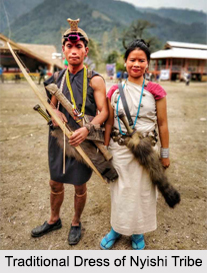
Traditional Dress of Nyishi Tribe
Traditional Dress of Nyishi Tribe is worn during festivals and social gathering. Men wear a cane helmet surmounted with the beak of the great Indian H...
Pasi Community
Pasi is an aboriginal race of India and are mainly distributed over the northern region of the country. The traditional occupation of Pasi is the extr...

Bhojas
Bhojas have been described as a very important tribe in the Aitareya Brahmana. Historical records have said that the Bhojas were settled towards the s...
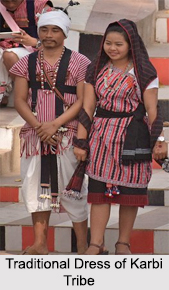
Traditional Dress of Karbi Tribe
Traditional Dress of Karbi Tribe can be easily recognized by the artistic designs inherited from their forefathers. Karbis have their own traditional...
Related articles in Tribes of India
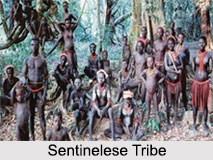
Sentinelese Tribe
Sentinelese tribal community is one of the most isolated and secluded tribes that are found in the whole world.
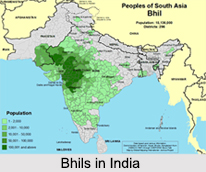
Bhil Tribe
The people of the Bhil tribe are the most widely distributed tribal groups in India.
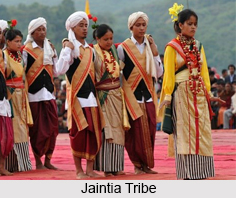
Jaintia Tribe
Jaintia Tribes are located in the Jaintia Hills of Meghalaya. They are also called the Pnars. They are famous for weaving of carpet, making of musical...
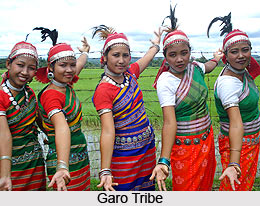
Garo Tribes
Garo Tribes are one of the matrilineal tribes of North-East India who reside in the Garo hills of Meghalaya. Historically, the tribe originated in Tib...
Garasia Tribe
The Garasia tribal community holds a significant position within Indian culture, renowned for their distinctive way of life and rich cultural heritage...