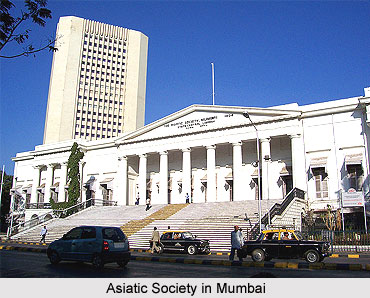
 The Asiatic Society of Mumbai was founded by Sir James Mackintosh. He was a distinguished lawyer, jurist and public figure in England who became the Recorder or the King`s Judge for Bombay. He was known as a member of Literary Society of Bombay.
The Literary Society purchased the collections of the Medical and Literary Library, a private library founded in 1789. This formed the nucleus of the Library of Asiatic Society. In 1826, the Literary Society merged with the recently established Royal Society of Great Britain and Ireland (RAS) as its Bombay Branch of the Royal Asiatic Society (BBRAS). In 1830, it moved into the Town Hall Building, towards the construction of Asiatic Society in Mumbai.
In 1841, the Asiatic Society started publishing a journal titled `Journal of the Bombay Branch of the Royal Asiatic Society` which continues to be published under the name `The Journal of the Asiatic Society of Mumbai` That was also the year the Society began admitting Indians as members. In 1954, it became separate from RAS and renamed itself as `The Asiatic Society of Bombay". Now it is recently named as `The Asiatic Society of Mumbai.
Location of Asiatic Society
The Asiatic Society is strategically located in Mumbai, the capital of Maharashtra. However, prior to the change of name from Bombay into Mumbai, the guild was respected as The Asiatic Society of Bombay. The institution traces its illustrious origin to the Literary Society of Bombay, which had first met on November 26, 1804 and was consequently established by Sir James Mackintosh.
The Asiatic Society of Mumbai is however not just restricted to its historical glory and wonder; the guild stretches its extraordinary performance in present times, by organising lectures under eminent scholars from several countries whenever they stopover the city of Mumbai. Lectures dedicated to current topics are also organised from time to time, together with unique in itself curriculum like endowment lectures, special lectures, cultural activities, Shakespeare Day, book releases and the likes. Besides these stellar activities held from the guild, it also functions in various arenas, for instance, research and public interpretation.
The library of the Asiatic Society of Mumbai indeed works for these endeavours to its fullest, with donations being received from individuals and institutions from the domains of periodicals and newspapers. The library possesses more than a hundred thousand books out of which 15,000 are classified as rare and valuable. The legendary "Divine Comedy" owned by the society, penned by Dante Alighieri in the 14th century. This is one of only two known surviving original manuscripts. Asiatic Society in Mumbai also possesses priceless articles comprising more than 3000 ancient manuscripts in Persian, Sanskrit and Prakrit langauge. Among the rare works are the Vasupujyacharita, the Shahnama of Firdausi (1853), the Aranyakaparvan and others.
Within an interruption of three years, the Asiatic Society of Mumbai bestows Honorary Fellowship upon eminent scholars and awards medals to distinguished scholars. Some of the most stellar and most illustrious of the lot can be stated as under:
A. Honorary Fellowships
The Asiatic Society of Mumbai distinguishes extraordinary individuals who have contributed to the encouragement of the objective of the Society by electing them as Honorary Fellows. This practice was commenced first in 1815. Scholars and notables like Monier Williams, R.G. Bhandarkar, Father Heras, Sarvapalli Radhakrishnan, Maulana Abul Kalam Azad, Satyajit Ray and M.N. Srinivas were among the foremost Honorary Fellows. Present Honorary Fellows incorporate distinguished personas like Jayant Narlikar, Mahashweta Devi, I.G. Patel and Kapila Vatsyayan.
B. Award of Medals
Asiatic Society of Mumbai has brought out 3 medals for excellence in diverse fields, which are awarded every 3 years. These three awards include - Campbell Memorial Gold Medal instituted in 1907, awarded in acknowledgment of remarkable services on the subject of Oriental History, Folklore or Ethnology, to promote the objects of the Society, specifically the investigation and encouragement of Oriental Arts, Sciences and Literature. MM. Dr. P.V.Kane Gold Medal founded in 1946, awarded for the priceless research work on Vedic Studies or in Classical Sanskrit, with reference to Dharma Shastra and Poetics. The Society`s Silver Medal presented to a member of the Society who has penned a book pronounced as the best in the given 3 year period.
C. Annual Research Fellowships
In order to persuade and indorse young researchers in Indology, History of India and other social sciences, Asiatic Society of Mumbai has, commencing from 1991, established annual fellowship for scholars. The domain can always include Ph.D. research scholars, but is not only confined to these luminaries. One Fellowship is awarded by the Society itself and the remaining have been endowed by umpteen other individuals and institutions. Fellows are required to put forward a research paper at the end of their tenure and several of these are released in the journal.
The most selected and hand-picked of the most noted publications published by the Asiatic Society in Mumbai has included classical instances of reviews and journals by scholars, as stated above upon topics of ancient historical canonical texts and topics of sublime national interest. Besides these mentioned above, the Society has published its Journal since 1841. This is a prestigious publication and contains sets of scholarly articles and book reviews.
The Asiatic Society of Mumbai is perhaps the most legendary and talked-about in its regard of its indeed invaluable collection of manuscripts, artefacts, relics, gold coins and maps and rarest of the rare books from ancient, prehistoric to historical India and the world. The Society`s holdings comprise over 3000 manuscripts in Sanskrit, Arabic, Persian, Urdu and Prakrit from all over India and Nepal. They are predominantly done on paper, but some are on palm leaf. They incorporate technical literature on linguistics, medicine, astronomy, Jain and other Brahmanical literature ( Brahmanical Sources of Ancient History ) in Sanskrit, an appendix on Buddhist manuscripts, Jain literature and manuscripts in Gujarati, Hindi and Marathi.
The Asiatic Society Mumbai`s collection includes the renowned Sopara relics, the legendary excavation site in Nala Sopara, acknowledged to have celebrated associations with the Mauryan Empire, Gautama Buddha and Ashoka the Great. The discovery of the Sopara relics had stimulated a great stir in all of India and Europe. The Mumbai Government had presented the Sopara relics to the Asiatic Society of Mumbai and it is one of its most prized antiquities. The Society further, only to add to its details of more elevated prestige, owns its priceless collection of 11,829 coins. To such a list was supplied many more valuable gold, silver and copper coins. These include a 5th century gold coin of Kumargupta I, a very rare gold mohur of Emperor Akbar and coins issued by Shivaji. The Library of the Asiatic Society from Mumbai possesses an assemblage of almost 1400 maps, some of which date back to 18th century, such as Map of West Coast.
The Literary Society owns a unique album of 47 miniatures painted about the 1860s and portraying rulers, significant places and craftsmen and acrobats from Punjab. In the compilation of the rare books collection within Asiatic Society, the books witnessed are not only starkly rare, but numerous also bear an underlying historical significance. Aldus Manutius, esteemed to be the greatest printer-publisher of his time, had begun printing in 1495. The Asiatic Society of Mumbai possesses the very first title printed under `Aldus Print`, a Greek Grammar of Constantine Lascares.