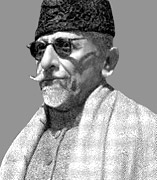
 Maulana Abul Kalam Azad was born on November 11, 1888 in Mecca. He belonged to an orthodox Muslim scholar family. The original name of Maulana Abul Kalam Azad was Abul Kalam Ghulam Muhiyuddin. His ancestors came to India from Afghanistan. His mother was an Arab and his father Maulana Khairuddin, was a Bengali Muslim of Afghan origin. Maulana Khairuddin shifted to Mecca in 1857. He returned to India in 1890 and started living in Calcutta. His mother died when he was only 11 years old. Initially Maulana Abul Kalam Azad received the traditional Islamic education at home. After that he was taught Arabic, Persian, philosophy, geometry, mathematics and algebra by some great teachers. He also acquired huge knowledge in English, history, politics and general science.
After completing education, Maulana Abul Kalam Azad started writing new articles reinterpreting and analyzing the Qur`an, the Hadith, and the rules of Fiqh and Kalam. He rejected the orthodoxy of Taqliq and accepted the modern principles of Tajdid. At that time he was influenced by Pan- Islamic views of Jamaluddin Afghani and the Aligarh thought of Sir Syed Ahmed Khan. Maulana Abul Kalam Azad was also deeply inspired by modernism and Western philosophy. He visited Iraq and met the revolutionary nationalist who opposed the imperialism. He also went to Egypt and met Shaikh Muhammad Abduh ,Saeed Pasha and other revolutionary leaders of the Arab world. Maulana Abul Kalam Azad was moved by the idea of anti-imperialism.
He came back to India and joined the Indian freedom movement.He protested against the racial discrimination of the British Government and opposed the views of Muslim politicians who were more interested in the communal issues than national interest. Maulana Abul Kalam Azad also opposed the communal separatism of All India Muslim League. In 1905 he criticised the partition of Bengal.During that time Maulana Abul Kalam Azad met revolutionary leader Sri Aurobindo and Shyam Sundar Chakravarthy and started working with them. He established many secret revolutionary centers all over north India and Bombay. He persuaded the Muslim leaders to join the revolutionary activities.
In 1912 Maulana Abul Kalam Azad started publishing a weekly journal in Urdu named Al Hilal to propagate revolutionary ideas amongst the Muslims. He also wrote many articles in this journal to promote communal harmony. In 1914 British Government banned Azad`s Al-Hilal for spreading extremist views. After that he started a new journal, the Al-Balagh. Maulana Abul Kalam Azad again srarted propagating revolutionary ideas and nationalism through this paper. During that time he supported the Khilafat movement. In 1916 The government banned Al-Balagh under Defence of India Regulations Act. He was arrested and imprisoned in Ranchi.In 1920 he was released from the jail. After that he joined the National congress and played a crucial role in Non-Cooperation Movement. In 1923 Maulana Abul Kalam Azad was nominated as the President of the special session of the Congress in Delhi. In 1930 participated in Gandhiji`s Salt Satyagraha. He was again arrested and sent to the Meerut jail. He was released after a year. Maulana Abul Kalam Azad was selected as the president of Congress in Ramgarh session. In his presidential speech he clearly stated that ignoring the idea of religious separatism is very important. His speech thus still stands as the insignia of communal harmony. He held this post till the year 1946. He wanted unified nation and opposed the partition as well as Jinnah`s Two-Nation Theory.
After independence Maulana Abul Kalam Azad became Minister of Education in Pandit Jawaharlal Nehru`s cabinet. He was the member of Constituent Assembly, which was responsible for drafting the constitution of India. Maulana Abul Kalam Azad wanted to spread education among the common people of the country. In 1956 he was selected as the President of the UNESCO General Conference in Delhi. In 1957 his famous book India Wins Freedom was published.
He left the mortal coil on February 22nd, 1958. Maulana Abul Kalam Azad was posthumously awarded India`s highest civilian honour, Bharat Ratna in 1992.