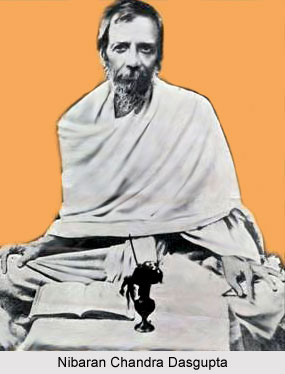
All Congress activities of Manbhum district had the unique
distinction of association with "Shilpashram". The foremost Indian
political leaders and freedom fighters like Mahatma Gandhi, Netaji Subhas Chandra Bose and Dr.
Rajendra Prasad paid several visits to "Shilpashram". He
was also the founder as well as the editor of "Mukti" the first Bengali bi-weekly
from Manbhum district. The bi weekly journal created havoc amidst the lengths
and breadths of captivated India. The biweekly even acted like a catalyst in
the independence
movement and fueled the "Language Agitation` or Bhasha Andolan.
After India gained independence from British rule,
Nibaran Chandra Dasgupta continued his social service for the people of Bengal.
On January 1956, Chief Minister
of West Bengal Bidhan Chandra Roy
and Chief
Minister of Bihar Shri Krishna Singh
proposed to merge both West Bengal and Bihar to form a new state called
"Purba Pradesh." Nibaran Chandra along with Atul Chandra Ghosh and
another famous Gandhian freedom fighter
of the time Labanya
Prabha Ghosh led the Manbhum march on April 1956 where thousands of
people walked. The march was in favor of joining Manbhum with West Bengal and
against the formation of "Purba Pradesh." The march reached Kolkata via
different places of Bengal such as Bankura, Beliatore, Sonamukhi,
Patsair, Khandhghosh, Burdwan,
Pandua, Magra, Chunchura, Chandannagar, Srirampur and Howrah.
After the agitation created by the march, a commission named
"State Reorganization Commission" was set up by the Central
government on December 23, 1953. Eventually, the proposal of forming "Purba
Pradesh" was dropped. Nibaran Chandra Dasgupta played a crucial role in
setting up the Lok Sevak Sangh, a Gandhian movement that worked for Swaraj
and social reform. The movement challenged caste hierarchies, preaching to Adivasis and Dalits to
participate in social and political life on equal terms with upper caste. The
movement actively fought against caste discrimination of the time.
Like a true patriot Nibaran Chandra dedicated his life for
the betterment of his countrymen fighting for a cause and dwelling amidst a
belief that he counted to be ideal. He breathed his last at
"Shilpashram" on 17 July 1935.