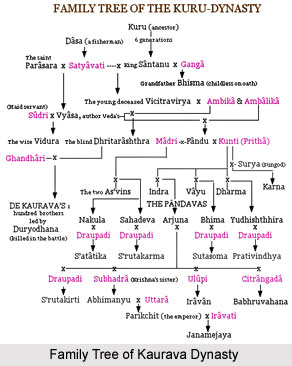
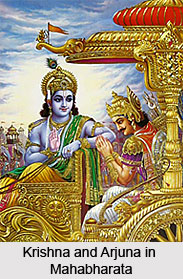
 Regarding the origin of the Mahabharata, there can be only conjectures which may be made as there is no certainty regarding the history of the times. There is probably justification for the belief, even though there is only the authority of the Mahabharata itself for it, that a change of dynasty did actually once take place in the North-West of India as the result of a great war, and that these quasi-historical events form the foundation of the epic itself. Starting out from this, it may have been that the original heroic songs dealing with the fight between the hostile cousins were sung among the bards who were still near Duryodhana himself or the house of the Kauravas.
In the course of time, as the rule of the victorious Pandavas was more and more firmly established, these songs were transmitted to bards who were in the employ of the new ruling race. In the mouths of these bards those alterations were then undertaken which made the Pandavas appear in a favourable light and the Kauravas in an unfavourable one, without its being possible to eradicate completely the original tendency of the songs. The political and religious development which is reflected in those songs of the Mahabharata which refer to the great fight, mainly the passing of power from the Kauravas to the Pandavas and the deification of Lord Krishna, presupposes a long period of time. Therefore it is unthinkable that all these songs originated only with one poet. Such an assumption becomes still more impossible if we consider the countless contradictions which occur in the details of the principal narrative. What is termed as the actual epic, as it has come down to us, is certainly not the work of one poet. Everything indicates that the Mahabharata is not the work of one single author or of one time, but consists of earlier and later portions which belong to different centuries.
In the whole of Vedic Literature there is no mention of a Mahabharata, though in Brahmanas and Upanishad there is frequent talk of Akhyana, Itihasa, Purana and Gatha Narasamsi. Even of the great, and probably historical, event which constitutes the central point of the epic, the battle in the Kuru field, the Veda says not a word. However, this same Kuru field is so often mentioned as a place where gods and mortals celebrated great sacrificial feasts that if this event had already taken place it would most certainly have been mentioned. True, Janamejaya, the son of Pariksit, and Bharata, son of Dushyanta and of Sakuntala, already appear in the Brahmanas, and already in a Kuntapa-song of the Atharva Veda, Pariksit is praised as a peace-loving king under whose rule the land of the Kurus prospered. 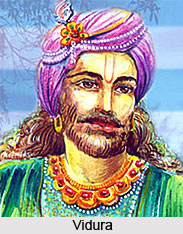 Even in the works belonging to the Yajur Veda there is frequent mention of Kurus and Pancalas or Kurupancalas. On the other hand, nowhere in the whole Veda is the name of Pandu or of his sons, the Pandavas, to be found, nowhere do such names as Duryodhana, Duhsasana, Karna etc., appear. The name Arjuna does, it is true, occur in a Brahmana, but as a secret name of the god Indra.
The Sankhayana Srautasutra is the first place where we find mention of a war in Kurukshetra which was disastrous for the Kauravas. Bharata and Mahabharata are mentioned in a list of teachers and sacred books which are honoured by libations at the end of the study of the Veda. Panini teaches the formation of the names "Yudhisthira," "Bhima" and "Vidura," and the accent of the compound word "Mahabharata." Patanjali, however, is the first to make definite allusions to the story of the battle between the Kauravas and the Pandavas.
As regards Buddhist Literature, in the Tripitaka, the Pali Canon of the Buddhists, the Mahabharata is not mentioned. On the other hand, it is seen in the oldest texts of the Tripitaka, poems after the style of the Akhyanas. The Jatakas, whose metrical portions (the Gathas) belong to the Tripitaka, show a familiarity with the Krishna legend but not with the Harivamsa and the Musala Parva of the Mahabharata. The names occurring in the Jataka book, Pandava, Dhananjaya (in the Mahabharata an ordinary epithet of Arjuna), Yudhitthila (Pali for of Yudhisthira), Dhatarattha (Pali form of Dhritarastra Vidhura or Vidhura (the Vidura of the Mahabharata), and even the narrative, appearing in this work, of the self-choice a husband and the five-husband marriage of Draupadi, bear testimony only to slight acquaintance with the Mahabharata.
From these facts we must conclude that, before the conclusion of the Veda, there could not have existed an epic Mahabharata, i.e. an epic poem which dealt with the war with the Kauravas and Pandavas and the battle on the Kuru field, and bore the title "Bharata " or " Mahabharata". On the other hand, such a poem must have existed already in the 4th century B. C, as the Sutra works of Sankhayana, Asvalayana and Panini can scarcely be later.
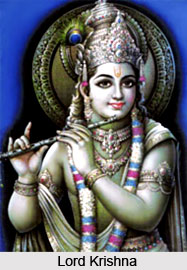 Finally, it must still be mentioned, that not only the events described in the epic, but also the innumerable names of kings and royal races, however historical some of the events and many names may appear, do not belong to Indian history in the true sense of the word. It is true that the Indians set the reign of Yudhisthira and the great war of the Mahabharata at the beginning of the Kali Yuga, or Iron Age, i.e. 3102 B.C.; but this date for the beginning of the Kali Yuga is based upon the artificial calculation of Indian astronomers, and the association of this date with the conflict of the Kauravas and Pandavas is, of course, quite arbitrary. The political history of India commences with the kings Bimbisara and Ajatashatru of Magadha, who are known as contemporaries of Lord Buddha. With the great King Chandragupta Maurya the founder of the Maurya Empire, firm historical ground is established in India. Of all these historical personalities there is no trace to be found in the Mahabharata. This "prehistoric" character of the narrative and of the heroes certainly indicates the great antiquity of the epic.
Contents and form alike confirm the fact that some parts of the Mahabharata reach back to the times of the Veda, while others must be synchronous with the late productions of the Purana literature. While single myths and legends and poems which are included in the Mahabharata, reach back to the time of the Veda, an epic "Bharata" or "Mahabharata" did not exist in the Vedic period. Many moral narratives and sayings which the Mahabharata contains belong to the ascetic-poetry, which was drawn upon, from the 6th century B. C. onwards, also by Buddhists and Jains. The compilation of the Mahabharata into its present form took place between the 4th century B.C. and the 4th century A.D.