Hypnotherapy - Informative & researched article on Hypnotherapy
  Indianetzone: Largest Free Encyclopedia of India with thousand of articles Meditation


in  
Art & Culture | Entertainment | Health | Reference | Sports | Society | Travel
Forum  | Free E-magazine
Meditation : Meditation l Types of Meditation l Benefits Of Meditation l Meditation Techniques l Transcendental meditation l Meditation Centres In India l Diet for Meditation l Health for Meditation l Obstacles to Meditation l Meditation and Diseases l Vipassana Meditation l Mantras in Meditation l Meditation For Children l Meditation for Women l Yoga Meditation
Home > Health > Meditation > Meditation > Hypnosis > Benefits of Hypnosis > Hypnotherapy
Hypnotherapy
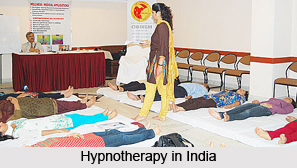
Hypnotherapy refers to the method where the process of hypnosis is used as a therapeutic cure. It has proved useful in curing a number of ailments ranging from pathological to psychological.

Hypnotherapy -  State of relaxation used by the therapist in order to try and help the patient to uncover and explore memories, emotions and past events which may affect a person`s conscious mindHypnotherapy is the application of hypnosis for therapeutic purposes. The process of hypnotherapy leads to a direct interaction with inner consciousness in order to probe into the core issues and find the causes of problems in a person`s life. During hypnotherapy, the hypnotist can examine the beliefs and thought processes that give rise to emotional, mental, physical and spiritual problems and make changes at the core level which will bring about a change in the outer behaviour and manifestation.

Process of Hypnotherapy
Different states of relaxation are used by the therapist in order to try and help the patient to uncover and explore memories, emotions and past events which may affect a person`s conscious mind. The state of deep hypnosis is similar in many ways to the kind of profound trance experience of the expert practitioners of Yoga and Meditation. The experience of hypnotherapy is different for different people. For most people, however, it is a pleasant state of deep inner calm and physical relaxation.

Kinds of Hypnotherapy
Hypnotherapy has taken different forms down the ages and has integrated elements from as well as influenced other psychotherapeutic traditions throughout history. The different kinds of hypnotherapy are discussed below.

Traditional Hypnotherapy- The traditional form of hypnotherapy was utilised by most of the Victorian hypnotists, such as James Braid and Hippolyte Bernheim. They used direct suggestion of symptom removal along with therapeutic relaxation. This was one of the simplest forms of hypnotherapy and involved rather direct methods with few theoretical assumptions. Traditional hypnotherapy continues to influence the later stages of hypnotherapy.

Hypnoanalysis- Hypnoanalysis was another method of hypnosis used in psychotherapy. This was a form of Subsequent Regression Therapy also known as "hypnoanalysis", "analytic hypnotherapy", or "psychodynamic hypnotherapy." This work influenced many hypnotherapists after Sigmund Freud. Hypnoanalysis was greatly used during the time of both the World Wars where it was used by the military psychiatrists as a quicker alternative to psychoanalysis in the treatment of shellshock.

Ericksonian Hypnotherapy - Milton H. Erickson in one of his SessionEricksonian Hypnotherapy- It was developed by Milton H. Erickson, one of the greatest hypnotists of the 20th century. He developed an approach to hypnotism which was radically different from the ones which were in use. He employed an informal, conversational approach with many clients and used complex language patterns and therapeutic strategies. His work continues to be a major force in the practice of modern hypnotherapy.

Cognitive Behavioural Hypnotherapy (CBH) - It is a kind of integrated psychological therapy which employs clinical hypnosis and cognitive behavioural therapy (CBT). Theodore Barber introduced the term "cognitive-behavioural" to describe the non-state theory of hypnotism, and discussed its application to behaviour therapy. There was a growing use of the application of cognitive and behavioural psychological theories and concepts in explaining hypnosis and this paved the way for a closer integration of hypnotherapy with various cognitive and behavioural therapies. Modern cognitive therapy mainly differs from earlier hypnotherapy approaches as it places greater emphasis on the direct Socratic disputation of negative beliefs. However, cognitive-behavioural hypnotherapists have assimilated this technique alongside their use of hypnosis.

Benefits of Hypnotherapy
Hypnotherapy has proved greatly beneficial mostly in the field of medicine. It was used as far back as the nineteenth century by noted physicians such as James Esdaile in India and John Elliotson in England, to relieve pain and distress and during surgery. The founder of hypnotherapy, James Braid was a surgeon himself, specialising in muscular conditions, and has reported many cases of minor surgery using hypnotism. Today, hypnotherapy is used to cure a number of ailments. Even though it cannot cure terminal diseases like Cancer, it has proved extremely beneficial in controlling the pain and other bodily symptoms related to the diseases. It even finds use in childbirth where a mother is prepared during pregnancy for delivery and hypnotherapy helps to reduce anxiety, discomfort and pain. The psychologists and psychiatrists use hypnosis mainly for the treatment of dissociative disorders, habit changes, phobias, depression and posttraumatic syndromes. It is also used to help the subjects in cessation of smoking, aid of weight loss etc.

Hypnotherapy, as can be seen fro the foregoing discussion, is a very useful method that may be employed for curing a number of disease conditions and alleviating situations of stress and habit disorders.

(Last Updated on : 1/12/2010)
Recently Updated Articles in Meditation
  • Yoga Meditation
    The continuation of the mental effort (dharna) to concentrate on a fixed point is yoga meditation or dhyana.
  •  
  • Japa Meditation
    Japa meditation is the process of uttering repeated Mantra, for the serenity of mind.
  •  
     
  • History of Hypnotism
    History of Hypnotism can be traced back to ancient times and its earliest known instance is found in the Egyptian paintings which depict a form of hypnotism or trance. Later on it came to be developed as a scientific discipline in the west in the 18th century.
  •  
  • Techniques Of Vipassana Meditation
  •  
  • Benefits of Hypnosis
    Benefits of Hypnosis are countless. Hypnosis has proved beneficial in a number of different fields ranging from medicine, sports, and education to even forensics.
  •  
    E-mail this Article | Post a Comment
    RSS Feeds
    Forum
    Forum on Meditation

    Free E-magazine
    Subscribe to Free
    E-Magazine on Indian Crafts
     
     
    Hypnotherapy - Informative & researched article on Hypnotherapy
    Sitemap
    Contact Us   |   RSS Feeds
    Copyright © 2008 Jupiter Infomedia Pvt. Ltd. All rights reserved including the right to reproduce the contents in whole or in part in any form or medium without the express written permission of Jupiter Infomedia Pvt. Ltd.