The Kushanas were a tribe who exercised their power on the North-West region of the ancient India. Vima Kadphises was said to be the founder of the Kushana Empire and under him grew the Kushana Empire. It reached its height of prosperity in the due course. Their empire extended till the Ganges river valley in northern India. The most important centers of the Kushana Empire were Purushapura, near modern Peshawar, and Mathura. The Kushanas have a lot of Greek influences in their culture as well as language.
Origin of Kushana Empire
The Kushanas are generally regarded as a branch of the nomadic Yue-chi tribe. In the early part of second century B.C. The Yue-chi lived in the west of the Huang-ho river in the provinces of Kan-su, Ning-hsia, and Western China. The name "Kushan" is derived from the Chinese term Guishang, which was used in historical writings to describe one branch of the Yuezhi. The Yuezhi was a loose confederation of Indo-European people who had been living in northwestern China until they were driven out in 176-160 B.C. The Kushans built a strong territory encompassing huge tracts of land in the foreign region as well. Especially under Kanishka, there was an extensive cultural exchange with foreign countries, not only in terms of language, culture but also religious developments. Myths have it that the Kushana Empire represented a `dystopian` demonic empire.
Kushana Emperors
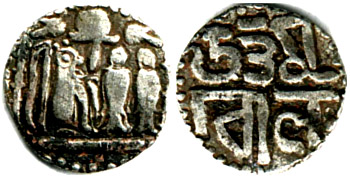
Kujula Kadphises (30-80 AD) established the Kushana dynasty in 78 AD by taking advantage of the feud existing between Pahalava (Parthian) and Scytho-Parthians. His origins are pretty obscure, though it is considered that he was a descendant of the Kushan ruler Heraios. He shares his name with some of the last Indo-Scythian rulers, such as Liaka Kusulaka or his son Patika Kusulaka. A family connection might be possible. During Kujula`s reign coins with hellenistic tendencies have been discovered. Representations of Greek demi-god Heracles along with the name of Kujala are pretty common. In the later years, he had been referred to as "Maharaja"or "Great King" in the coins. Some of the Kujala coins can also be traced to the Roman origins.
There is uncertainty about Kanishka`s rising to power, or accession to the throne. His reign is believed to have lasted 23 years in the Kushana Empire. Kanishka`s kingdom consisted of inheritance and some his own conquests, that extensively covered an area extending from Bukhara in the west to Patna in the Ganges Valley in the east, and from the Pamirs in the north to central India in the south. Kanishka set up his capital at Purusapura. It might be considered that he had crossed the Pamir Knot and subdued the kings of the city-states of Khotan, Kashgar, and Yarkand who had previously been tributaries of the Hun emperors of China. This exchange with the foreign lands precipitated the transference of Buddhism for the first time in China in 2nd century under Kanishka. Kanishka was a devotee and a follower of Lord Buddha and he convened the fourth great Buddhist council in Kashmir that marked the beginnings of Mahayana Buddhism. Here the commentaries on the Buddhist canon were prepared and engraved on copper plates. The coins discovered show the prevalence of Zoroastrian, Greek, and Brahmanic deities along with the Buddha. The Saka era that was a system of dating, is believed to have been initiated by Kanishka.
 Administration of Kushana Empire
The Kushana Empire was one of the most powerful Empires in ancient India. Kushanas were turbulent tribes, who established their Empire in ancient India after confronting several obstacles. The Kushanas were mighty conquerors and the Kushana Empire stretched to a vast extent including the entire parts of Northern and northwestern India. Kushana Empire not only extended within the limits of India, But also to the countries of Central Asia. A chain of vibrant rulers belonging to the Kushana dynasty ruled ancient India and during their time India attained a thriving progress in the fields of art, architecture, literature and sciences.
The Kushana kings generally used exalted titles like Maharajati-raja (king of kings), Daivaputra (son of heaven), Soter (Saviour) and Kaisara (Caesar). The rulers of the Kushana Empire were given the status which was almost parallel to that of a deity.
As per as the governance of the rulers are concerned, although they had an extensive territories they did not ruled in an imperialistic manner. The pattern of rule differed from one place to another. Some places were directly governed by the Kushana rulers while others were under the control of the local satraps. Some of the Kushana territory was also ruled by existing rulers who had accepted Kushana supremacy.
Society, Religion and Economy of Kushana Empire
The Kushana rulers had initiated the spirit of political unity in India. They induced multi-ethnicity by breaking the isolated character of Indian politics. Consolidating their supremacy in Northern India, the Kushanas established close political and commercial relationship with China, Central Asia and Roman Empire in Western Asia. Epigraphic and numismatics evidences of the Kushana Age, testifies the fact that the Indian merchants during the time of the Kushanas carried brisk trade with the countries of Western and Central Asia. Historians have opined that the first Kushana king Kadphises II had issued gold coins perhaps due to the influx of Roman gold in India. Besides bringing about major political as well as commercial changes in the Indian sub-continent, the Kushana rulers had also closely influenced the dressing style and food habits of the people. Dhoti and chaddar was replaced with tightly sewn garments and onion and garlic made an important place in Indian dishes.
Kushana religious pantheon is widely expanded. It includes more than 30 different deities belonging to the Hellenistic, the Iranian, the Greek and the Indian order. As a whole it can be said that the entire religious and spiritual life of the Indians were influenced by the alien Saka-Kushanas. As per as religious belief is concerned, Kushanas were believed to have been Zoroastrian in the beginning but Buddhism took them over later on. There are even undertones of associations of earliest Kushan Kings with Shaivism.
Even economic developments were at its heights during the Kushana rule. Trade along the silk route brought immense wealth and prosperity to India and helped in socio-cultural exchanges in the Kushana Empire.
Art of Kushana Empire
India made rapid progress in the fields of art and sculpture during the Kushana age. Four schools of art namely--Sarnath, Mathura, Amaravati and Gandhara developed during this period. However, the most flourishing one was the Gandhara art. It was during the time of Kushana that Buddha for the first time was shown in human form because previously. He had been represented either in the form of lotus or footsteps. The trend of assimilating and harmonising the Buddhist and Hellenistic ideas with the native and original indigenous material or concept was considered the principal sculptural idiom of Gandhara art. The headless statue of Kanishka was the epitome of it. Various images of Buddha belonging to the Mathura School of Art, which have been excavated till date, represent the blending of Hellenistic style with Indian concept.

Decline of Kushana Empire
Finally, the Kushana Empire declined due to the weak successors of Kanishka or the later Kushanas. After the death of Vasudeva, forces of disintegration set within the Kushana Empire, which was already in the verge of downfall. The Kushana Empire was succeeded by the Sassanians.
Hence, it can be concluded saying that the Kushana Empire had brought about a lot of positive changes in the Indian sub-continent but finally the glory of the Kushana dynasty declined due to an ineffective governance.