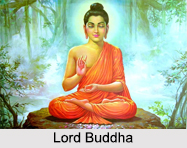
 Buddhism evolved from Kapilavastu, the birth place of Gautama Buddha and later from early India. The spreading of Buddhism dates back to 6th century B.C. Buddhism is a religious canon that propagates religious tolerance. Buddhism is a path of practice and spiritual development leading to Insight into the true nature of reality. An enlightened being sees the nature of reality absolutely clearly, just as it is, and lives fully and naturally in accordance with that vision. This is the goal of the Buddhist spiritual life, representing the end of suffering for anyone who attains it.
Concept of Buddhism
The concept of Buddhism leads the human mind to the process of attaining enlightenment through kindness, love and wisdom. This religion largely covers the practices, traditions and beliefs based on Gautama Buddha"s teachings. It promotes the concepts of Anicca, Anatta and dependent origination.
Significance of Buddhism
Buddhism is important for an individual to rise above the mundane attachments to attain salvation. The ways to attain it are laid down by the founder of this path; Gautama Buddha. It is widely believed that his principles, teachings and philosophy are the ways through which one can be liberated. However, various Buddhist schools differ on the accurate nature of the path to liberation, the importance of the several teachings as well as scriptures and their particular practices.
 Foundation of Buddhism
Lord Buddha, the founder of Buddhism, was the one who was responsible for propagating the doctrines of Buddhism. Born at Lumbini, in the territory of the Sakya republic, Lord Buddha went forth "from home into the homeless life" at the age of 29. He attained supreme enlightenment at Bodh Gaya at the age of 42 years and passed away at Kushinagar at the age of 80. During his lifetime, his teaching spread throughout the kingdoms of Magadha and Kosala. He is also known as "Shakyamuni" and his birth, teachings, death and the rules for the Sangha are to be found in the Buddhist canons.
Teachings of Lord Buddha
The teachings of Buddha, steeped in spiritual aura are a step-by-step way towards lasting happiness. The Four Noble Truths and the Noble Eight Fold Paths which are the cornerstone of Buddhism and also the fundamental idea of Buddha"s teachings are the simplest ways to understand the very essence of Buddhism. These are the principles which Gautama Buddha realised while he was meditating.
The Four Noble Truths comprise the Nature of suffering, the Origin of Suffering or Samudaya, the Cessation of Suffering or Nirodha and the Way that leads to the Cessation of Suffering. The doctrine of the noble eightfold truth contours the very foundation on which the later philosophies of Buddhism evolved. Buddha preached that if one follows these principles then he would definitely attain enlightenment.
 Dharma in Buddhism
Dharma in Buddhism is the sermons of Lord Buddha and his teachings pointed toward the true nature of the universe. The monks had been authorised to learn and teach the Buddha"s message in their own dialects, meant that the Dharma was from the beginning extant in a number of linguistic forms. So that when finally it did come to be written down, this was done not in one language only, but in many. Thus, it is said, the Canon of the Mahasanghikas was in Prakrit, that of the Sthaviravadins in Paisaci, that of the Pudgalavadins in Apabhramsa, and that of the Sarvastivadins in Sanskrit language.
Buddhism Pilgrimage Centres in India
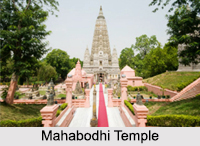
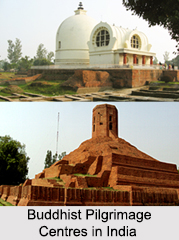
There are several Buddhist pilgrimage centres in India as well as in other Asian countries. Starting from his birth town to the place where he attained Parinirvana, all the important places involving the life of Lord Buddha are vital religious centres for the Buddhists. While some are crucial because Buddha had visited there, others are important because of the Buddhist temples or because of Buddha"s disciples. The most important Buddhist pilgrimage centres in India are Champanagar, Pragbodhi, Sankasya, Don, Kusinara, Ghosrawan, Jethian, Kesariya, Gurpa, Hajipur Cave, Indasala Cave, Kosambi, Kurkihar, Lauria Nandangarh, Prabhosa, Savatthi, Vikramshila, Lumbini, Khandagiri and many other places in India.
Buddhism
Buddhism is a religion and a philosophy that encompasses a wide variety of beliefs, practices and traditions that are chiefly based on the teachings of Gautama Buddha and its later disciples.