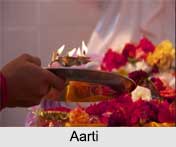
 Aarti is a Hindu ritual which is a short prayer sung in reverence of a deity or a Guru. It is a Hindu ritual in which light from wicks soaked in ghee or camphor is offered to the Gods and Goddesses.
Etymology of Aarti
The concept is believed to come from the Vedic concept of fire rituals or Homa. The word Aarti comes from Sanskrit word "Aa" means "towards" and "Rati" means "the highest love for God" and thus is performed to develop the highest love for God.
Symbolism of Aarti
Aarti is a small flame which is burnt on a wick which is rotated round the deity. The flame is symbolic of the cosmos that revolves round God, thereby bowing to him. One should burn their desires and by burning the flame at night one is reminded of the above philosophy. One hopes that their desires are burnt away along with the flame as one goes through the rhythmic movement of Aarti.
Significance of Aarti
Aarti is performed to ward off "evil eye" or malevolent influence of negative powers. It is performed on people of high social and economic status, small children in various rituals, people going or coming back from a long journey or going to perform some important works or a bride and bridegroom when they first enter the house after marriage and in many other cases. It is also performed when a property is newly acquired or before an important task. It is also believed that the idol of God is also susceptible to the "evil eye" and needs regular Aarti.
Performing of Aarti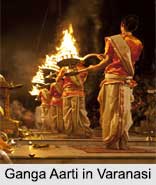
Aarti is performed in the morning and the evening. It is performed 2 or 5 times daily at the end of Puja. It is conducted during almost all Hindu ceremonies and occasions. It involves the circulating of an "Aarti plate" around an idol and is generally accompanied by the singing of songs in praise. The plate used for it is generally made of metal like silver, bronze or copper. On that plate there is a lamp made of kneaded flour, mud or metal which is filled with oil or ghee that serves as illuminant. Sometimes a cotton wick is dipped into the oil and burnt and sometimes camphor is used instead. The plate also contains flowers, incense and so on.
Steps to Perform Aarti
The rituals in the performance of Aarti vary from place to place but almost every performance includes the following steps:
•The priest first purifies his hands taking water from the sacred cup.
•After washing hands he sprinkles three spoons of water over a conch and then blows it thrice.
•Following this he lights three or more incense sticks from a ghee lamp standing beside the altar.
•The priest then rings a small bell and waves it seven times around the Gods and Goddesses.
•He then lights a five-wick ghee lamp from the large lamp and circles around the deities` feet 4 times, 2 to 3 times around their navel, 3 times to their face and lastly 7 times around their whole bodies.
•Then he gives the lamp to all the devotees in the temple room.
•After this the priest takes a smaller conch and fills it completely with sacred water. He then waves it 3 times around the deity"s head and 7 times around their bodies.
•He then pours the whole water into a shaker and gives it to a devotee who takes it round the room and makes it sure that everyone has touched the water.
•The priest then offers a cloth 7 times around the deities.
•After that the priest takes a plate of flowers and offers to the rest of the devotees who one by one sniffs the flower.
Aarti in Hindu Temples
In the Hindu temples, the priests perform Aarti on a daily basis. The first Aarti takes place in the morning and is known as the "Mangala Aarti", the next one in the afternoon and the last one in the evening after the sunset. During the Aarti ceremony, all the devotees accumulate in the temple premises and sing various types of "bhajans" and "kirtans".