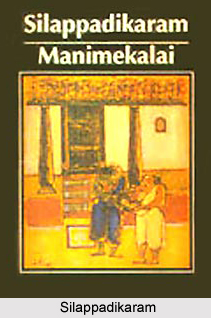
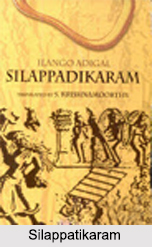
 Silappatikaram is one of the three surviving oldest epics in the world which was written during the end of the third primeval epoch of Tamil literature, the Sangam Age. The writer of Silappatikaram was Ilango Adigal, King Cheran Chenguttuvan"s brother. Silappatikaram is an elaborate poetic interpretation of Tamil culture, its diverse religions, its towns and cities, the arts of music and dance and the blend of Arab, Greek and Tamil people. As a literary work, Silappatikaram is held in high regard by the Tamil people.
Silappatikaram, which literally means "Lay of the Anklet". It is narrative in nature and contains a moralistic undercurrent. The story of the epic revolves around the legendary Kannaki who set out to avenge the death of her husband Kovalan at the hands of a Pandya king. The story includes the 3 Tamil kingdoms of the ancient era, the Chola, the Chera and the Pandya.
Chapters of Silappatikaram
Silappatikaram contains three chapters and a total of 5270 lines of poetry. The three chapters are as follows:
•Puharkkandam", which deals with the affairs in the Chola, city of Puhar, where Kannagi and Kovalan started their married life and Kovalan leaves his wife for the courtesan Madavi. This contains 10 divisions.
•Maduraikkandam", is located in Madurai in the Pandya kingdom where Kovalan lost his life and wrongly blamed for the theft of the queen`s anklet. This contains 13 divisions.
•Vanchikkandam", contains 7 divisions, and each of them is made of several sub-divisions called kaathais (story sections of the chapters).
Story of Silappatikaram
The central characters of Silappatikaram are "Kovilan" and "Kannaki" and the epic gives an account of their tragic and beautiful story. Kannaki volitionally accepts her husband who had previously deserted her because of a dancer by the name of Madhavi and got ruined in due course. This literary epoch narrates the couple visiting Madurai in pursuit of their fortune. Kannaki provides her precious "silambu" or anklets to Kovilan so that he can sell it and get some money. But Kovilan is misunderstood for the person who has stolen the anklets of the queen and is thus put to death. Furious Kannaki storms into the court of the king and upon the floor breaks the left over anklet to show that the anklets belonging to her were made of pearls, not gems, thus demonstrating before the king and others that her husband was innocent.
Afterwards, she burns up the whole Madurai city in the fires of her anger. This story portrays `pativratas` in a powerful light through Kannaki and she is considered to be the avatar or incarnation of the Devi or Goddess Parvati. The priceless moral lessons taught by Silappatikaram are that the law of divinity steps in the figure of death at the time when a king becomes extremely negligent of his duties, a faithful wife needs to be collectively respected, fate does its work in a fully mysterious manner and all the activities are honoured as per their nature.
Main Characters of Silappatikaram
Following are the main characters of Silappatikaram:
•Kovalan - Son of a wealthy merchant in Puhar.
•Kannaki - Wife of Kovalan.
•Masattuvan - A wealthy grain merchant and the father of Kovalan.
•Madhavi - A beautiful courtesan dancer.
•Chitravathi - Madhavi"s Mother.
•Vasavadaththai - Madhavi"s female friend.
•Kosigan - Madhavi"s messenger to Kovalan.
•Madalan - A Brahmin visitor to Madurai from Puhar.
•Kavunthi Adigal - A Jain nun.
•Neduncheliyan - Pandya king.
•Kopperundevi - Pandya Queen.
Silappatikaram is not only the first identified Tamil epic poem, but it is also very significant for its contributions in literary innovations. Silappatikaram has introduced the merger of prose with poetry, which was not commonly seen in earlier Tamil literary works.