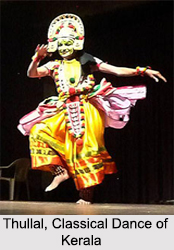
 Thullal is one of the popular performing art forms of Kerala that emerged in the 18th century. This classical art form has gained popularity because of its simplistic performance and expressive way of presentation. Thullal is performed with songs and the performer, with his or her dancing pose and gestures expresses the meaning of the verses. The songs are composed keeping in mind the basics principles of the treatise, Natyashastra. In this performance, the actor is supported by a singer who repeats his lines; a drummer and a cymbalist. The narration is accompanied by dancing. Jawaharlal Nehru, the first Prime Minister of India had once remarked that Thullal was a `poor man`s Kathakali`. The term `Thullal` is amongst the many Dravidian languages and it implies `jumping`. It can also used to mean `to leap about`. Historians are of the view that Thullal had originated over 200 years ago.
Origin of Thullal
The origin of Thullal is attributed to Kunjan Nambiar, a veritable genius and one of the foremost Malayalam poets of Kerala, in the 18th century. Though based on classic principles of Natyashastra the technique of this art is not rigid. The songs are written in simple Malayalam language and provide a direct appeal to every day life. This aspect made Thullal very popular. The word "Thullal" connotes jumping and it is said that in Malayalam, it is a genre of poem. According to a popular legend, Nambiar who was playing a musical instrument known as `mizhavu` for Chakyar Koothu had fallen asleep during the live performance. Therefore the Chayar began to ridicule Nambiar. Nambiar was then annoyed and promised to invent an alternative to Chakyar Koothu. He displayed an `Ottamthullal` or Thullal performance which was aimed at making sarcasm at the existent socio-political scenario of the area.
Mythological History of Thullal
There is a mythological account which traces the development of the art form of Thullal. A particular extract from the epic Mahabharata, known as `Kallyana Sougandhikam` asserts that Bhima had once travelled in order to seek a rare flower named `Kallyana Sougandhikam`. On his way, he met Hanuman, who was his brother. However, due to some reason he was unable to recognize his brother and entered into a lengthy conversation with Hanuman. This was the very first language heard by the people, which was devoid of any trace of Sanskrit. They were impressed by the communication which was done in simple language that resembled the ordinary and plain language used daily by them. While playing for Chakyar Koothu, Kunjan Nambiar liberally employed the similes to ridicule the landlords and several other renowned personalities during that time, imitating the image of Bhima, who was depicted as arrogant. Though Nambiar`s audience greatly admired his performance, the Chakyar was not amused and he complained to the king of Chembakassery against Kunjan Nambiar. It infuriated the king who declared thereafter that Ottamthullal performances would be banned inside the premises of Ambalapuza Temple. This royal order is followed even presently. No Ottamthullal show is permitted inside this temple. However, the king had not banned the performance of this art form as a whole, and the lyrics of Ottamthullal gained popularity amidst the regional people of Kerala. Today, this art form is widely exhibited in numerous local temples, except Ambalapuzha Temple.
 Classification of Thullal
Thullal is classified into three different categories according to the rhythm and metre of the songs. They are `Seethankan Thullal`, `Ottan Thullal`, and `Parayan Thullal`. The costumes and dances of Thullal vary from one kind to another.
Seethankan Thullal
This is one of the three major thullal forms. Seenthankan Thullal is performed in a very slow tempo. It places more importance to gestures than vocal actions. Usually Seethankan Thullal is performed at midnight. Minimum three persons should be needed for performing this art form, one for staging the performance and others for playing musical instruments. The performer will be dressed in a special costume. They put yellow coloured powder on face. Usually Kakali is the metre used in this dance form.
Ottan Thullal
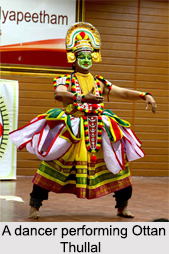
In Ottan Thullal, the performer is accompanied by a mridangam or an idakka (drum and cymbal). In this type of Thullal, there is a solo performer with green makeup on his face, and a colourful costume (decorated with a red and white band along with other wooden ornaments). The performer acts and dances while reciting Thullal lyrics. Nowadays Ottan thullal is being performed with a solo female actor and an ensemble cast. Ottan thullal was often performed in Malayalam. This pleased local audiences.
Parayan Thullal
This form of Thullal is performed in the morning. The Sanskrit metre Mallika is used in this art form. Among the three forms of Thullals, Parayan Thullal is said to be the slowest in tempo. In this dance form the dancer with his expressive gestures defines the meanings of the verses. Usually the stories of Parayan thullal are regarding spiritual matters. Basically the dancer enacts this performance by standing erect and sometimes adds minimal movements. A conical crown is worn by the dancer and the hood of a serpent is placed on the top of the crown. Bold eye highlights are done to make the expression of the dancer clear to the audience. The body of the performer is smeared with sandal paste and red cloth covers the legs and a white cloth is tied over it. Ornaments like ankle-bells, necklace, etc. are used to deck up the dancer. The costume of Parayan thullal resembles Shesha or the Sheshnaga (Nagaraj). List of some Parayan Thullal are as follows:
•Sabhapravesham
•Thripuradahanam
•Kumbhakarnavadham
•Dakshayagam
•Keechakavadham
•Pulindeemoksham
•Harichandracharitham
Apart from these three Thullal dances there are other forms like `Kolam Thullal` and `Thumbi Thullal`. These dances are performed during temple festivals and Onam in Kerala. Though these are considered as forms of Thullals, basically these are folk dances. The main instruments used in Thullal performance are `maddalam` and the cymbals. The cymbal player, who tunes the rhythm, also assists the actor or the dancer (Thullakaran) in singing. The dancers of Thullals, before the performances, follow the set sequence of preludes of decorative dances with skilful footpaces such as `Ganapati`, `Pallivattam`, `Mannarang` and `Bhoopathi`. The `Shloka` is chanted before and after the performances.