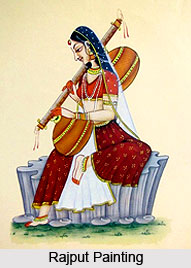
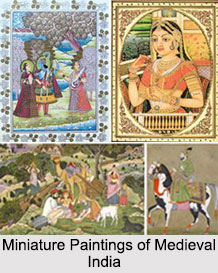
Pahari painting refers to a painting from the mountainous regions and was developed in the independent states of the Himalayan foothills in India. It is one of the types of Indian paintings which are generally done in the miniature style. Pahari painting is the name given to Rajput paintings, made in Himachal Pradesh and Jammu and Kashmir states of India.
Origin of Pahari Painting
Pahari paintings developed and flourished during the period of 17th to 19th century. It was flourished in Basohli, Jammu, Garhwal, Chamba, Kangra, Guler and Mandi in the hilly areas in the northwest has been termed the Pahari School and was influenced to some extent by the Mughal painting of Aurangzeb"s period. Pahari paintings have been extensively influenced by the Rajput paintings, because of the family relations of the Pahari Rajas with the royal court at Rajasthan. There is strong influence of the Gujarat and Deccan paintings. With the appearance of Bhakti movement, new themes for Indian Pahari paintings came into practice. The "Shaiva-Shakta" themes were increased by dialect poetry and folk songs of Lord Krishna and Lord Rama. At the same time, the themes of the paintings revolved around love and dedication also. There was also illustration of great epics, puranas, etc. The depiction of Devi Mahatmya manuscript painted at Kangra, in 1552, has been much acclaimed.
Types of Pahari Paintings
Following are the different types of Pahari Painting:
Basohli Paintings: Basohli town is situated on the bank of the Ravi River in Himachal which has produced splendid Devi series, magnificent series of the manifestations of the Supreme Goddess. Artist Devidasa painted it under the patronage of Raja Kirpal Pal. Gita Govinda of 1730 is also believed to have Basohli origin. Geometrical patterns, bright colours and glossy enamel characterize Basohli paintings.
Bilaspur Paintings: Bilaspur town of Himachal witnessed the growth of the Pahari paintings around the mid-17th century. Apart from the illustrations of the Bhagavata Purana, Ramayana and Ragamala series, artists also made paintings on rumal (coverlets) for rituals and ceremonies.
Chamba Paintings: These are quite related in appearance to Mughal style of paintings, which strongly influences the Deccan and Gujarat style too. The late 17th century witnessed Chamba paintings of Himachal being dominated by Basohli style, which ultimately gave way to Guler painting tradition.
Garhwal Paintings: Garhwal Paintings originated in Himachal and were first dominated by the Mughal style. Later, it started reflecting the cruder version of Kangra traditions.
Guler Kangra Style Paintings: It was a more naturalized version of painting, with visible difference in the treatment of eyes and modelling of the face. Landscapes were also usually used as themes and with that, this style also emphasized the stylishness and grace of Indian women.
Jammu Paintings: Jammu paintings of the late 18th and early 19th century bear a striking similarity to the Kangra style. Shangri Ramayana of the late 17th and early 18th century was produced in Jammu itself.
Jasrota Paintings: These paintings are mostly found in Jammu and Kashmir and spin around court landscapes, events from the life of the kings, allegorical scenes, etc.
Kulu Paintings: The paintings of Kulu style consist of the Bhagavata Purana, two Madhumalati manuscripts, etc.
Mandi Paintings: Mandi, located in Himachal witnessed the development of a new style under Raja Sidh Sen. During that time, the portraits portrayed the sovereign as a huge figure with overstated huge heads, hands and feet. Other works were characterized by geometric compositions and subtle naturalistic features.
Mankot Paintings: Mankot paintings of Jammu and Kashmir bear a similarity to the Basohli type, with vivid colours and bold subjects. In the mid-17th century, portraitures became a common theme. With time, the emphasis shifted to naturalism and subdued colours.
Nurpur Paintings: Nurpur paintings of Himachal Pradesh generally employ bright colours and flat backgrounds. However, in the later periods, the dazzling colours were replaced by muted ones.
Schools of Pahari painting
Following are the different schools of Pahari painting:
•Guler School
•Kangra School
•Basohli School
•Chamba School
•Garhwal School
Pahari paintings of India can be divided into two distinct categories, on the basis of their geographical range namely:
•Basohli and Kulu Style (Influenced by Chaurpanchasika style)
•Guler and Kangra Style (Based on cooler colours and refinement)