 India is a land of diversity and a significant chunk of its rich history pertains to the northern region of the country. The ornate lavish monuments of North India are actually regarded as a part of the country"s cultural and traditional heritage. The monuments of North India comprise of some of the most unique and exquisite pieces of art and show the exemplary craftsmanship of the artisans from the bygone era. The states in the North India include Delhi, Himachal Pradesh, Jammu and Kashmir, Haryana, Punjab, Uttar Pradesh and Uttarakhand.
Architecture of Monuments of North India
The architecture of the monuments of North India are a reminiscent of the Nagara style, the monuments lack a regular sophisticated boundary walls or gateways. The Nagara style temple architecture can be divided into 3 categories based on their shikhara type- Latina or Rekha Prasada, Phamsana and Valabhi. Among the places in North India, Buddhist architecture is prevalent in the Ladakh and Leh region of Jammu and Kashmir as the Lamayuru Monastery and the Rizong Monastery.
 Types of Monuments of North India
The monuments of North India are of different types and they exhibit the various styles and blends of Indian ancient architecture and cultures. The heritage sites of India can be divided into various categories like historical monuments, religious monuments, archaeological monuments and it can also be classified according to different states of northern region of India. Listed below is a list of monuments of North India.
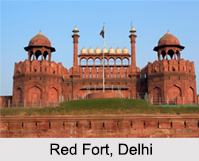
Red Fort: Built by Mughal Emperor Shah Jahan in the mid-17thcentury and is now one of the major tourist attractions of Delhi.This historic fort is a famous monument of North India and is built from red sandstone and is also commonly known as the Lal Quila. Among the most famous structures of the complex are the Hall of Public Audience also known as Diwan-i-Am, which has 60 red sandstone pillars supporting a flat roof, and the Hall of Private Audience or Diwan-i-Khas, which is smaller, with a pavilion of white marble.
Qutub Minar: Known to be the second tallest brick minaret in the world, the development of the Qutub Minar ranged over a span of few decades starting from the time of Qutab-ud-din Aibak to Firoz Shah Tughlaq"s. The tower has 5 distinct storeys, the first 3 storeys are made of red sandstone; the fourth and fifth storeys are of marble and sandstone. At the foot of the tower is the Quwwat-ul-Islam Mosque, the first mosque to be built in India. Located in the capital city, this brick minaret is a popular tourist attraction.
Jama Masjid: The Jama Masjid of Delhi is known to be one of the largest mosques in India and is a fine example of Mughal architecture. Built near the Red Fort, the mosque was constructed by a crew of about 5,000 workers and the prime construction material was red sandstone, along with some white marble. This great mosque has a courtyard capable of holding 25,000 devotees.
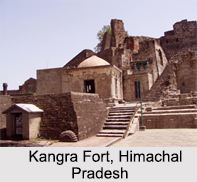
Kangra Fort: Situated in Himachal Pradesh, the Kangra Fort is a famous monument of North India. It was constructed by the royal Rajput family of Kangra, known as the Katoch dynasty. The origin of this dynasty can be traced to the ancient Trigarta Kingdom which finds its mention in the Indian epic Mahabharata.
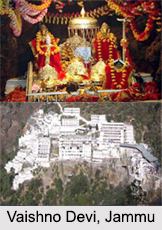 Vaishno Devi Temple: One of the most sacred holy shrines in India, the Vaishno Devi Temple is located in the state of Jammu and Kashmir. One of the most celebrated monuments of North India. Nestled in the Trikuta Mountain, the Hindu pilgrimage of Vaishno Devi stands at an elevation of about 5,200 ft above sea level.
Shobha Sarovar: Built during the 18th century, the Shobha Sarovar is one the monuments of Haryana whose architecture is based on the principle of conservation of water. Based in the city of Narnaul, it was built by Rai Bal Mukund Das, who served as a superintendent of Mughal Emperor Shah Jahan. The sarovar has an elegant entry and a flight of steps that lead to the water.
Buddha Stupa: Built in the 3rd century BC, the Buddha Stupa in Chaneti, Haryana was constructed under the reign of the Mauryan Emperor Ashoka. This stupa is built on similar lines to the Shahpur and Dharamrajika stupas of Taxila. It is situated at a distance of about 3 km northwest of Sugh.
Firoz Shah Palace Complex: Located in Hisar, Haryana, the Firoz Shah Palace Complex was built by Firoz Shah for his wife Gujri. The palace houses a mosque by the name of Latki Masjid. It is built of sandstone pillar and stands at about 20 ft high. The complex also has underground apartments and also a Diwan-e-Aam. There is also another palace by the name of Gujri Mahal which is located nearby to this palace complex.
Golden Temple: Known to be a part of the biggest cultural heritage of the Sikh community, the Golden Temple in Amritsar is the seat of the sacred Guru Granth Sahib. The Golden Temple is commonly known for its community kitchen called the Guru ka Langar. The temple has a free hostel, known as Guru Ram Das Niwas and has about 228 rooms and 18 halls. It further includes some other places, like, Dukh Bhanjani Ber - Jujube tree, Thara Sahib, Ber Baba Budhaji, Gurudwara Ilachi Ber, Ath Sath Tirath and Gurudwara Shaheed Bunga Baba Deep Singh.
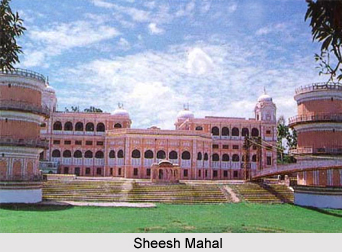
Sheesh Mahal: The Sheesh Mahal or the "Palace of Mirrors" in Patiala was built by Maharaja Narinder Singh between 1845-1862 behind the main Moti Bagh Palace. The Sheesh Mahal was built in a forest with terraces, gardens, fountains along with an artificial lake.
Quila Mubarak: Constructed during the Kushana period, the Quila Mubarak stands in the heart of Bathinda and was built under the initiative of King Kanishka. Also known as the Bathinda Fort, it is here where the first lady to hold the throne of Delhi, Razia Sultana, was imprisoned. The fort has 2 segments: Quila Androon and Quila Mubarak.
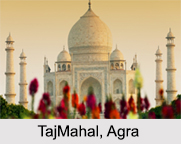 Taj Mahal: Located on the south bank of the Yamuna River, the Taj Mahal is a world heritage site and a best example of Mughal architecture in India. It attracts a large number of tourists and is known to be one of the most visited historical monuments in Uttar Pradesh.
Fatehpur Sikri: The ancient fortified city of Fatehpur Sikri was founded by Mughal emperor Akbar and is built with lavish red sandstone. It has a complex of monuments and temples namely the Buland Darwaza, Jama Masjid, the Tomb of Salim Chisti, Ibadat Khana, Mariam-uz-Zamani"s Palace, Panch Mahal, etc. It is another very famous monument of North India.
Badrinath Temple: One of the famous sites of Char-Dham yatra in Uttarakhand, this monument of North India, called the Badrinath Temple is a Hindu temple dedicated to Lord Vishnu. The Badrinath Temple has 3 structures- the Garbagriha, the Darshan Mandap and the Sabha Mandap.
Other than these, there are a number of more temples and monuments in North India. Like the Jageshwar Temples, Kedarnath Temple, Humayun"s Tomb, Jantar Mantar, Safdarjung Tomb, the Nanda Devi Temple and the Sun Temple of Almora, Rambagh Palace, Gobindgarh Fort, the Phillaur Fort, Hari Parbat Fort and Bahu Fort of Jammu and Kashmir, Pari Mahal, Thiksey Gompa, Jama Masjid, Martand Temple, Amar Mahal, Ram Nagar Palace, Palace of Sengge Namgyal. Then there are the Ashokan pillars and stupas of Sarnath, Uttar Pradesh like the Dhamek Stupa, Chaukhandi Stupa, along with the Buddhist statue and the Sarnath Museum. These are few of the most popular monuments of North India which represent the cultural tradition and heritage of our country and are also a major tourist attraction.