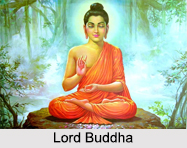
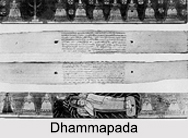
 Dhammapada is a Buddhist scripture that is considered to be the manual of Buddhist teaching. Besides the followers of Buddha, Dhammapada has gained importance in the non-Buddhist countries as well because of its doctrines. Dhammapada contains the moral and philosophical teachings of Lord Buddha and it is believed that it is compiled by Buddha himself. Apart from its philosophical importance, Dhammapada is a significant part of Buddhist literature that belongs to the Theravada school. According to this canon, the verses included in Dhammapada were originally spoken by Lord Buddha himself.
Etymology of Dhammapada
The title of the book, "Dhammapada" consists of two words "Dhamma" and "Pada". The title of this book Dhammapada means the "Virtuous Path According to Lord Buddha".
Content of Dhammapada
Compiled in the Pali language, this Buddhist scripture contains 423 verses which are divided into 26 chapters. These chapters are as follows:
Yamaka Vagga Buddha Vagga
Appamada Vagga Sukha Vagga
Citta Vagga Piya Vagga
Puppha Vagga Kodha Vagga
Bala Vagga Mala Vagga
Pandita Vagga Dhammattha Vagga
Arhanta Vagga Magga Vagga
Sahasa Vagga Pakinnaka Vagga
Papa Vagga Niraya Vagga
Danda Vagga Naga Vagga
Jara Vagga Tanha Vagga
Atta Vagga Bhikkhu Vagga
Loka Vagga Brahmana Vagga
The teachings of Lord Buddha had been closely influenced by the philosophies of Upanishads and Vedas. Rather it can be said that Dhammapada is a close reflection of his philosophical insights. The concept of ascetism, Bhakti and Jnana also finds reflection in Buddhist Philosophy. Thus it can be said that Lord Buddha had developed his school of thought based on some of the important philosophical tenets of the Upanishads and the Vedas.
According to Dhammapada an individual who follows the path of Buddha is a wise person and only such a wise person gets rid of all kinds of cravings. All impurities are removed from him and he gradually moves towards the path of sainthood. It has been stated in the Dhammapada that perfection is the main goal of Buddha.
Divisions of Dhammapada
The three main parts of Dhammapada are namely;
1. Karma Yoga or the Philosophy of Action
2. Sadhana or the Spiritual Training
3. Nistha or the Faith
Karma Yoga: The first part or the Philosophy of Action contains all the essential gradients helpful for the attainment of Nirvana. According to the Dhammapada, the Karma yoga has emphasised on non-enmity, virtue, company of the righteous and the consequence of actions, ethics and non-slandering.
 Sadhana: The second part or Sadhana consists of six main things. It has been said in the text that in order to achieve a good life, it is absolutely necessary to undergo spiritual training. In fact, it has been claimed that a proper spiritual training makes the path towards Nirvana easier. The chief components of Sadhana according to Dhammapada are self-control, transitoriness of the body, vigilance, self-purification, wisdom and eradication of craving.
Nistha: The third part or the section dealing with Nistha or Faith has also incorporated six chief elements. They are the Buddha and his followers, the Dhamma, the Wise, the Bhikku, the Arahant and the Brahmin. The text of Dhammapada has said that an individual who transforms himself as the follower of Buddha and also follows the commandments laid down by Lord Buddha can achieve salvation much easily.
Thus, the essential tenets of Lord Buddha"s teachings included the code of morality, disapproval of superstitious rites and practices and degrading of ascetic practices. Dhammapada has thrown light to the philosophy and teachings of Gautama Buddha and the essence of his teachings say "Commit no sin; cultivate good and purify the mind".