 Aivarnaatakam is one of the famous rural dramas and a renowned art form practiced in the Kerala state of India. This art form is also known as Pandavar kali and Aivarkali i.e. the play of the great Pandavas. This act is performed by the Viswakarmas that include the communities like Kalthachan (Mason), Kollan (Blacksmith), Muusaari (Brassmith), Aasaari (Carpenter) and Tattaan (Goldsmith). Besides central Kerala, this ancient art form is also executed in temples situated in different parts of Kerala.
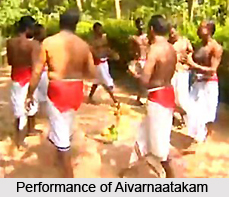
Performance of Aivarnaatakam
The Aivarnaatakam is generally performed during the night. The performers of the Aivarnaatakam take ritualistic bath before the performance. They assemble together around the lamp with their sticks that are decked with bells tied on one end. After offering prayer to their Gods and the Ganapati Puja, they start their dances with devotional songs.
Vattakkali, Parichamuttukali and Kolkali are three parts of Aivarnaatakam. Vattakkali is the circular dance that is performed round the Nilavilakku. Another part of the art form is Parichamuttukali in which the performers use shield and sword. With various songs, the performance becomes more interesting. In the third part, the dancers keep accurate steps with their sticks, being Ponthi as the musical accompaniment. After this performance, the dancers perform `Kavithams` that are the explanations of the songs. The summery of the play is given by the Aasaan. After the enactment, puja is held.
The dance of Aivarnaatakam is evocative of a legend related to Mahabharata. Bhadrakaali determined to destroy the Pandavas after hearing that they had killed Karna who was her devotee. Lord Krishna, on hearing that suggested the Pandavas to sing praises of Bhadrakaali to appease her. As per the legend, Lord Krishna was transformed into a lamp and told the Pandavas to praise the Goddess. Finally the goddess was pleased.
Costume of Aivarnaatakam
The performers apply sandal paste on their forehead, upper arms and chests and dress in white dhoti and towel which is wrapped on their head.
Platform for Aivarnaatakam
The platform for Aivarnaatakam is basically a raised one and the centre of the pandal is embellished with bell metal lamps called Nilavilakku. Both sides of tara or the raised platform is decked with the plantain trees or Kulaavazha. In some villages, permanent platforms are also found.
Aivarnaatakam is reckoned as an effective medium through which the morals of the epics and the famous stories are conveyed to the mass.