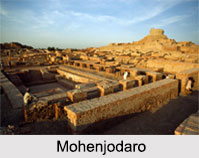
 Mohenjodaro or the `mound of the dead` was one the significant city settlements in Indus Valley Civilisation. This ancient city was first excavated in 1920-21, and then between 1922 and 1931. Built around 2600 BC, the site of Mohenjodaro was rediscovered by Rakhaldas Bandopadhyay, an officer at Archaeological Survey of India. The excavations have established this Indus valley city as well planned and a significant centre for trade and farming.
Location of Mohenjodaro
The Indus Valley Civilisation included much of Pakistan, western India, and north eastern Afghanistan; extending from Pakistani Balochistan in the west to Uttar Pradesh in the east, north eastern Afghanistan to the north and Maharashtra to the south.
Social Structure of Mohenjodaro
The social conditions of the citizens of Mohenjodaro were similar to those in Sumeria and higher to the modern-day Babylonians and Egyptians. These cities exhibit a well-planned urbanization structure. Business and artistic associations have been recorded in Sumerian documents, where Mohenjodaro people are referred to as "Meluhhaites" and the Indus valley has been called "Meluhha".
Mohenjodaro Civilization had a writing system which at present is a mystery. All efforts to decode it have failed. Examples of this writing system have been found in pottery, amulets, carved stamp seals, and even in weights and copper tablets.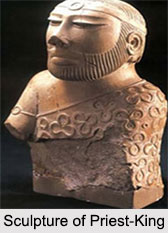
Trade and Transportation of Mohenjodaro
Mohenjodaro"s financial system appears to have depended considerably on trade, which was aided by the foremost advances in transport technology. It was the first civilization to use wheeled transport. Most of the boats were perhaps small and flat-bottomed expertise. Archaeologists have discovered a huge, dredged canal too. The trade networks of Mohenjodaro were mixed with a vast area, including portions of Afghanistan, the coastal regions of Persia, northern and western India and Mesopotamia.
Agriculture of Mohenjodaro
The nature of the Mohenjodaro civilization`s agricultural system is still largely a matter of speculation because of the limited amount of information surviving through the ages. Wheat and barley were cultivated. The severe agricultural production required dams and canals and the rice farmers generated considerable agricultural spares from terraced, hillside rice paddies. It is well-known that Mohenjodaro civilization people practiced rainfall harvesting.
Costumes of Mohenjodaro
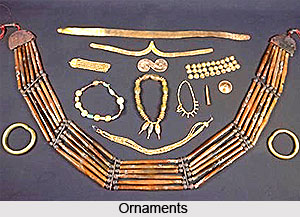
Men and women dressed in colourful wraps. Women wore jewellery of gold and expensive stone. The fundamental costume of Mohenjodaro was a length of cloth wrapped around the lower part of the body, and a loose fitting piece of clothing for the upper body, which was generally another length of fabric. A headdress was also worn, primarily by the men. Women in Vedic society wore a mixture of garments like a skirt type garment with a blouse and scarf, saree. Although there was also a wealth of silver and precious gems but gold is being the preferred choice by the people of Mohenjodaro.
Art and Culture of Mohenjodaro
 Indus Valley civilization was larger than the earliest civilizations of Egypt and Mesopotamia combined. It is at least 8,000 years old and not 5,500 years old as earlier held. Some of the major architectural works of Mohenjodaro:
The Great Bath of Mohenjodaro: It is a firm pool, landed on top of a mound of dirt, is surrounded within the walls of baked bricks. This bathing pool recommends that people of Mohenjodaro valued about cleanliness. There are even small changing rooms surrounding the Great Bath, with an attached bath area in each room.
Great Granaries of Harappa: These are massive buildings with solid brick foundations and sockets for wooden superstructures. These have been found in mines of Mohenjodaro. The Great Granary at Harappa also had a series of working platforms with round bricks.
An Undeciphered Script: It is one of the most intriguing of all undeciphered scripts in the world. The Indus script is made up of partly pictographic signs and different human and animal motifs that consist of a puzzling "unicorn". These have been found decorated on miniature steatite seals, terracotta tablets and irregularly on metal.
Fire Altars of Kalibangan: It lies along with the left bank of the dried-up bed of river Ghaggar in Rajasthan. Other than giving the proof of the earliest ploughed agricultural field ever exposed during an excavation, Kalibangan also has several fire altars, which imply that people of Mohenjodaro believed in the ritualistic worship of fire.
World"s Earliest recognized Dockyard at Lothal: It had the world"s earliest well-known harbour, spanning an area of 37 meters from the east to west and nearly 22 meters from north to south. It was connected with the city to an earliest course of the Sabarmati River, which was the trade route between Mohenjodaro and the Saurashtra peninsula.
Town Arrangement: Mohenjodaro is also well known for its well planned roads. A well-planned street grid and highly structured drainage system hint that the inhabitants of the ancient Indus civilization cities were skilful urban planners who gave meaning to the management of water. Wells have also been found all over the city, and nearly every house contains a clearly demarked bathing area and a covered drainage system.
Figurines: Terracotta, steatite and metal figurines of girls in dancing poses demonstrate the existence of some dance form as well as experienced craftsmanship. The most interesting and famous figurines recovered from Indus Valley excavations are the bronze Dancing Girl, the steatite Bearded Priest King and the terracotta Wheel Cart.
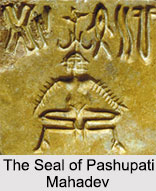
The Seal of Pashupati Mahadev: It is a famous seal that exhibits a figure seated in a posture, indicative of the lotus place and surrounded by animals. It portrays a sacred deity of the Indus culture, Pashupati Mahadev, who is considered to be the ancestor to the Vedic God Shiva.
Priest-King: It is a sculpture of 17.5 centimetres tall, and explains a carefully bearded man with pierced earlobes with combed back hair. He wears an armband, and a cloak with drilled trefoil, single circle and double circle motifs, which demonstrate the traces of red.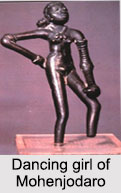
Seven-Stranded Necklace: The necklace has an S-shaped clutch with seven strands, each over 4 feet long, of bronze-metal bead-like nuggets which connect each arm of the "S" in filigree. The necklace weighs about 250 grams in total, and is now held in a private collection in India.
Stupa: A Buddhist stupa of the early centuries AD was found at Mohenjodaro. This was built on top of an artificially constructed mud and mud-brick platform which measured approximately 400 X 200 m. in addition to these there are traces of salient or projections on the wall situated on the south-west and the west units.
Musical instruments of Mohenjodaro include the Sarangi, Sitar, Tabla, Tambora, and Tanpura. The paintings commonly give a picture of animals, in scenes such as hunting. Human figures are also exposed with bows and arrows, and swords and shields.
Decline of Mohenjodaro
By 1800 BCE, Mohenjodaro saw the beginning of its decline. Writing started to fade away, standardized weights and measures used for trade and taxation purposes fell out of use, the relationship with the Near East was disrupted, and some cities were little by little forsaken. It is believed that the drying up of the Saraswati River was the main reason for the decline of Mohenjodaro. Around 1500 BCE, Aryans crossed the Hindu Kush Mountain and came in contact with the Mohenjodaro Civilization. This was a huge immigration and used to be seen as an incursion, which was thought to be the cause for the fall down of Mohenjodaro Civilization. It"s more likely that the cities of Indus Valley civilization collapsed after natural disasters or after rivers like Indus and Ghaghra-Hakkar changed their routes.