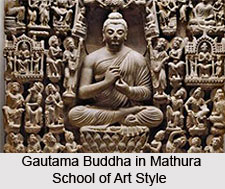
 The Mathura school of art is renowned worldwide for its vivacity and assimilative character of Indian themes, a tradition it has maintained till date. Creation of the images of the Buddha was a conspicuous feature of the Mathura School of Art. Mathura school of art is regarded as an outgrowth of ancient Indian school that flourished as centres of religious art back in 200B.C. The magnificence of Mathura school of art coincided with the rule of the Kushanas under the reign of Kanishka and his successors. The city of Mathura gained prominence under the supremacy of the Kushanas. The fervour of Brahmanism, Jainism and Buddhism is very well distinguished in the paintings of Mathura School of Art.
The sculptures of Mathura deserve recognition for creating the earliest, exclusively Indian representations of Lord Buddha. Mathura school of art draws inspiration from the ancient Indian arts of Bharhut and Sanchi.
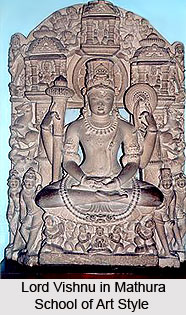 Features of Mathura School of Art
The head of the Buddha from Mathura is consistent in the sculptor`s self-imposed abstraction. The individual features are integrated into the essentially spheroid mass of the head, and no lingering over precision of anatomical aspect interferes with the key concern for the presentation of the solid volume of the whole. The faces of the statue from the Kushana school at Mathura are characterized by an open, beaming expression, the eyes are fully open, the cheeks round and full, the mouth ample, with lips drawn into a slight smile. This smile is probably the earliest appearance of the only possible device by which the Indian sculptor could indicate the inner contentment and repose of the Buddha`s nature.
For instance, in the Sarnath statue, although the individual curls are not shown, the hair is indicated as cut short and forming a sort of cap on the skull; the lion-shaped torso, the tapering arms and legs, all correspond to the textual descriptions of the Buddha`s superhuman anatomy. In most Mathura images, like the seated figure from Katra, the carvers scrupulously represent the marks of the wheel, `trisula`, etc. on the palms and soles. The general impression given by the Sarnath statue that is extravagant, weighty and yet characterized by a certain athletic flexibility, marks the steady improvement of the Indian ideal of physical beauty. The exquisite feminine figures created by the artists of Mathura bear a hallmark of elegance, charm and sophistication. Both in the relation of Jataka stories and events from the life of Buddha the sculptors of Mathura evolved in the manner of presentation, in which the various episodes are stripped of all details of action and setting, so that the event is often typified only by the figure of the Buddha in characteristic pose and mudra.
The artists of Mathura used spotted red sandstone as the material for making images and statues. The early images of the Buddha and the Bodhisattva are happy, fleshy figures with little spirituality about them. Statues of Jain Tirthankaras and Brahmanical gods and goddesses were also made. Secular themes were also worked upon.
Famous Sculptures of Mathura School of Art
One of the very first images of Buddha to be carved at Mathura is a life-size standing figure found at Sarnath. The statue embodies Sakyamuni standing erect, his feet firmly planted, the right hand raised in the gesture of assurance and the left is on the hip supporting the folds of his robe. It has been suggested that he is shown as a Bodhisattva, rather than Buddha, since the figure is nude to the waist and wears the characteristic Indian dhoti. The gigantic proportions of this and related figures of the similar kind, its implication of weight and unrestrained volume, as well as the dress, clearly link it to the colossal yaksha statues of the Maurya Period.
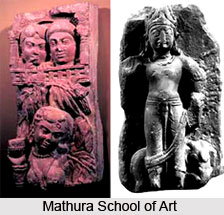 The Indian type of seated Lord Buddha is found in numerous early examples from Mathura, such as a specimen from Katra in the Archaeological Museum at Muttra. The treatment of the body in broadly conceived planes, with the suggestion of the pneumatic expansion through `prana`, is at once apparent. The face is characterized by its warm and friendly appearance. Again, as in the standing images, it is obvious that the sculptor has translated into stone the various metaphors and he is very careful to signify the distinctive magic-marks on the hands and feet. Another motivating feature of this relief is that it appears to be an early instance of the trinity in Indian art; the attendants most probably may be identified as Indra and Lord Brahma, who later are replaced by Bodhisattvas. It is to be noted that both in the standing figure and the seated examples, the Buddha is represented clad only in a dhoti. It is only in the Kushana reliefs, apparently under Gandharan influence that Sakyamuni is depicted with the monastic robe covering the body; in these the drapery, conceived as a series of string-like ridges is an evident imitation of the classical drapery of the Gandhara School.
A Yakshi is portrayed nude with globular breasts perpetually covered; smooth thighs and the lower garments either revealed as transparent or suggestively parted. The flamboyant and sensuous representations of the Yakshis surpassed anything known in the arts of earlier periods. The provocative portrayal of the beauties bears a similarity to the carvings at Sanchi and Bharhut.
Another instance comes from Kosam (Kaushambi) installed in the second year of Kanishka`s reign. Two such images dedicated by Friar Bala in the third year of Kanishka`s reign come from Sarnath and Sahet- Mahet (Shravasti).