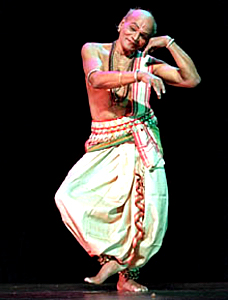
 Guru Kelucharan Mahapatra is not only a master in the domain of Odissi dance, but also a legend in his respective field. With passing decades, the name of this undisputable dancer have become synonymous with the Odissi dance style throughout the world.
Guru Kelucharan Mahapatra was born into a family of chitrakaras or painters. He was born in Raghurajpur on August 1, 1925. As a child, he loved the jatras, open air roving theatres of Orissa. His father was a khola (drum) player in these theatres and thus instilled in him the love of rhythm. The sound of the drums, along with the nature`s music with the universe around him, the stars, the fields, the colourful land of Orissa captivated the child. Guru Kelucharan Mahapatra in his young age also watched the akhadapilas (boys of the gymnasia) closely and imitated them as they danced. He drummed out the rhythm of the mardala on the sides of his thighs.
Guru Kelucharan Mahapatra eventually got involved in the effeminate art of gotipua dancing. His father, Chintamani Mohapatra, himself a painter and a "Mrudanga" player, did not actually encourage his son`s interest in the effeminate art of "Gotipua" dance. However, he finally permitted him to attain training under Balabhadra Sahu and finally let him to dance with Guru Sri Mohan Sundar Goswami and his Rasa party, which was basically a theatre troupe. At the Rasa Party , Guru Kelucharan Mahapatra learnt not only the arts of acting, singing, and dancing, but also the intricate requirements of stagecraft, make-up, and choreography. Above all, he received training in both the mardala and the tabla under masters. The working day started early in morning with training in singing and rhythm and closed with lessons in the communicative art of "Abhinaya" in the evening. During the day the students, who lived together, also did the household chores together, like cooking and cleaning, and dedicated themselves to various "Sevas" for the Guru.
The theatre group toured six to seven months throughout the year and rehearsed the remaining months. The shows of this group were an amalgam of song. Histrionics were woven around the theme of Krishna-Leela or episodes gathered from the Puranas. Guru Mohan Goswami played a vital role in Guru Kelucharan Mahapatra`s life. The Guru was a father and a protector to him.
Finally, he left the Rasa theatre party after twelve years. He made his living by rolling bidis (indigenous cigarettes), watering betel groves, and carrying sand. After few days he joined Kavichandra Kali Chandra Pattnaik`s Annapurna Theatre in Cuttack and earned Rs.7 a month for setting the stage, acting occasionally and playing percussion, under Harihar Rao. During this time, he received training in khola from Agadhu Moharana and in tabla from Kshetramohan Kar and Harihar Rao. He also learnt Uday Shankar`s dance techniques and the use of hand gestures from Guru Dayal Saran.
Initially Guru Kelucharan Mahapatra signed a contract as an accompanist for only a month but he stayed with the Annapurna `B` theatre for about five years from 1946 to 1952, thus distinguishing himself as a dancer, percussionist and choreographer. Life continued smoothly for the young Kelucharan Mahapatra until the real break came when a solo piece in a dance-drama on "Devi Bhasmasura" came in front of him. This incident brought Kelucharan into the limelight. His brilliant performance as the "Nataraja" under the direction of Guru Pankaj Charan Das recognised him as a mature soloist. In that dance piece the role of Mohini was played by Laxmipriya who later became his wife. The pair later became famous for their performances of the "Dashavtaara" dance, under the guidance of Guru Pankaj Charan Das and Guru Durlav Chandra Singh. This performance was later dovetailed into the legendary drama- "Sadhaba Jhia" in 1947.
After a few more dance dramas, the young dancer, Kelucharan left with Laxmi Priya for Puri. There he practised and researched some more time and then returned to Cuttack at the age of 30 as a dance teacher at Kala Vikash Kendra. He remained there as an Odissi dance teacher for fifteen years, laying the foundation of what is now known as Odissi dance. Besides working in the Kendra, He also imparted lessons privately to some disciples like Sanjukta Panigrahi, Minati Mishra and Priyambada Hejmadi and was taking dance classes in some schools and colleges of general education. During these years he choreographed a series of dance-dramas in Odissi style, including "Krushna Gatha", "Panchapuspa", "Geeta Govinda", "Krushna Leela", "Urbashi", "Sakhigopal", "Konark" and "Sri Kshetra". Supported by the Kendra, he also executed research on various folk and tribal dances of Orissa and enriched his foundation of Odissi dance poses through further study of temple sculptures especially those found on the Parshurameswara, Bramheswara, and Konark temples.
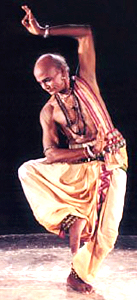 Guru Kelucharan Mahapatra also provided brilliant and honeyed percussion accompaniment, both on Tabla and Mardala, for many musical broadcasts by All India Radio Station, Cuttack. In the eighties, after leaving the Kala Vikas Kendra, Guru Kelucharan Mahapatra travelled to different cities of India and spread the charm of Odissi dance, as far and wide as possible. He slowly became a regular visiting teacher for the Gandharva Mahavidyalaya in Delhi, in the National Centre for the Performing Arts in Mumbai and for the Padatik Dance Centre in Kolkata. The number of students under Guru Kelucharan Mahapatra kept on multiplying.
Eventually, Guru Kelucharan Mahapatra started to appear on stage as a solo performer and to leave the audience spellbound by the corporeal beauty and naturalness of his interpretations of the character of Radha from the "Geeta Govinda", of the fisherman " Kaibarta " from the "Ramayan" and of "Krushna" from countless Oriya songs. Guru Kelucharan Mahapatra had danced not only in India but also all over the world, participating in the festivals of India in London, Russia, Germany, France, America and Japan. His famous compositions in raga Khamaj, Bagesri, Kirwani, are remarkable for their intricate rhythmic structures, which speak expressively of his choreographic ability as well as his expertise over "Mardala" (Pakhawaj) playing.
For ten long years, Guru Kelucharan Mahapatra was closely associated with Odissi Research Centre in Bhubaneshwar and made priceless contributions to the work of Odissi style, which was the directive of the institution. After leaving the Centre in 1995, Guru Kelucharan Mahapatra fully concentrated on developing " Srjan "- the dance academy (established by him and his wife and directed by his son Ratikant).
Guru Kelucharan Mahapatra was awarded the Sangeet Natak Akademi award in 1966, the title of Padmashree in January 1972, honorary doctorate in January 1982. He won the Kalidas Samman, awarded by the Madhya Pradesh Government in 1987 and also the title of Padma Bhusan in March 1988. In March 2000 he was commemorated with the honorary title Padmabibhushan. Guru Kelucharan Mahapatra worked on some of his masterpieces with Pandit Bhubaneswar Misra as his music composer. The demands for his dances also led to the establishment of training centres in metropolitan cities like Delhi, Kolkata, and Mumbai.
This Odissi exponent, Guru Kelucharan Mahapatra passed away on April 7, 2004 in Bhubaneshwar, Orissa, leaving behind an association of Odissi dancers to continue the legacy started by him. He is credited for the revival of the Indian classical dance form in the 20th century. Guru Kelucharan Mahapatra has taken Odissi dance to new and dizzying heights, which has become a universally admired art form through which this great soul has, modestly and genuinely paid his committed service to divinity.
Awards received by Guru Kelucharan Mahapatra -
•Sangeet Natak Akademi Award, 1966
•Padma Shri, 1972
•Padma Bhushan, 1989
•Sangeet Natak Akademi Fellowship, 1991
•Padma Vibhushan, 2000
•Kalidas Samman from Madhya Pradesh government