Ladakh has a rich landscape, peopled with different ethnic groups. Situated in the eastern part of Kashmir, Ladakh covers about 45000 sq mi and includes the western Himalayan Ladakh Range, the Karakoram range and the upper Indus river valley.The source of the Indus is in Tibet and it enters into Ladakh through Chantang, the region of the Changpah nomads. These are fiercely independent people, proud of their wanderings in th e Himalayas. Most of them are Tibetan refugees, living on the raising of yaks, sheep and particularly goats whose wool, treated in a special manner, takes on the magic conjured by the name pashmina, also called Cashmere. This precious article is sold in Leh, in the Indus valley where the, inhabitants, belonging to the Tibeto-Mongoloid race have been sedentary since 13 centuries. Continuing this journey along the Indus, we meet with the Zanskar, coming down from the heart of the Himalayas. It is the valley marking the border between Ladakh and Kashmir. Further to the west, the land of the Drogpahs (Dards) opens up its doors. These Aryans come f rom Baltistan and they belonged to the kingdom of Gilgit. Just five Dard v illages belong to Ladakh; they present to our eyes an extraordinary world, which gives one a feeling of living through a meeting with the story of humanity.
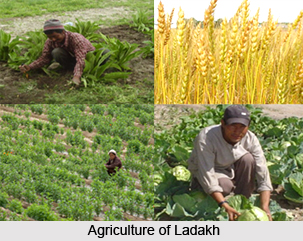
"Ladakh is truly a self-sufficient land, producing all that it needs except tea", says Major Gompertz in Magic Ladakh. This self-sufficiency is based essentially on an economy of small agricultural communities dependent on glacial torrents which, in wild and joyous tumult, come and meet the large Himalayan rivers. Desert conditions have forced the farmers of these celestial lands to develop unique irrigation systems. Canals draw water from far inside the mountains to guide them towards the fields which have been terraced to facilitate the work of the precious liquid. They sink into the rock, forming labyrinths stretching over several kilometres, a challenge to man, taken up 1500 years ago. The Ladakhis cannot develop the production of yak cheese as i s done in Nepal for their herds are too small. Products made from fresh milk are therefore important. Each family owns some goats, cows and dzos (yak-cow). The herds follow the mountain paths and return in the evening to the quiet villages, or they mov e to new pastures for a summer between sky and earth. Its capital is Leh. India ans Pakistan fought over it before peace negotiations in 1949 gave its southern portion to India and the rest to Pakistan. In the Sino-Indian War of 1962 China gained a portion of northeastern Ladakh. The region`s boundaries are still in dispute.
Adventures & Sports
Ladakh offers many options for undertaking adventure activities amidst landscapes of spectacular, rugged beauty. These mainly include river rafting, mountaineering and trekking.
The Festival
Many of the annual festivals of the Gompas take place in winter, which is a relatively idle time for majority of the people. These take the form of dance-dramas in the gompa courtyards. Lamas, attired in colourful robes and wearing masks, perform mimes symbolising various aspects of the religion such as the progress of the individual soul and its purification or the triumph of good over evil. Local people flock from near and far to these events.
The biggest and most famous of the monastic festivals is that of Hemis, which falls in late June or early July, and is dedicated to Padmasambhava. Every 12 years, the gompa`s greatest treasures, a huge Thangka, is ritually exhibited. Its next unveiling is due to take place in A.D 2004. Other monasteries, which have summer festivals, are Lamayuru (early July), Phyang (late July/ early August), Tak-thok (after Phyang) and Karsha in Zanskar (after Phyang). Like Hemis, the Phyang festival too involves the unveiling of a gigantic thangka, though here it is done every third year.
Hemis Festival
The courtyard of Hemis Gompa - the biggest Buddhist monastery in Ladakh, is the stage for the famous `Hemis` festival, that celebrates the birth anniversary of Guru Padmasambhava. The colourful two day pageant falls on the 10th day (Tse-Chu) of the Tibetan lunar month. The local people are seen dressed up in their finest traditional garb for the occasion.
Spectacular masked dances and sacred plays by Lamas called `chhams` are performed around the central flagpole, to the accompaniment of cymbals, drums and long horns. Guru Padmasambhava, the founder of Tibetan Buddhism is believed to have fought with demons for the safety of the local people. The Lamas wear colourful costumes, i.e. long brocade gowns set off by quaint headgears. Masks worn by the lamas represent various guardian divinities of the Dugpa order, of which Hemis is the leading establishment in Ladakh. The dances end with the ritual destruction of a sacrificial offering of a human figure made of dough by the leader of the Black Hat dancers. The pieces are then scattered in the four directions depicting a re-enactment of the assassination of the Tibetan apostate king Lang-dar-ma by a Buddhist monk in AD842 or cleansing of the soul after death.
`Rimpoche` or the head lama presides over the function. The lamas recite mantras associated with the various episodes of the `chhams`. The festival takes an auspicious turn every 12 years in the Tibetan Year of the Monkey, when the two-storey high ` Thanka` depicting Padmasambhava is displayed. This famous `Thanka`, richly embroidered with pearls and semi-precious stones, is due to be displayed next in AD 2004.
A colourful fair, displaying some beautiful handicrafts, is the special highlight of the festival. The so-called `devil dances` constitute an important element in the social entertainment of the Ladakhis. The uproarious song-and-dance mirth, created by these mask dances, which invariably depict the victory of the right over evil, is kept by the all-round consumption of huge bowls of `chang`, Ladakhis own country liquor.
Wild Life
Yak
Yak or dong is a wild ox and the largest animal found in Ladakh. It is definitely more imposing than its placid domestic counterpart. Immensely shaggy and weighing about a tone it has curved horns whose tips can be as wide apart as 90 cm. and measure 76 cm. over the curves. It can easily be identified by its long black hair, which is tinged with gray at the muzzle. Spending its summers at a height above 6,000 meters, in winter it moves in herds to the lakes, marshes and lower valleys.
Nyan
Largest and most magnificent of wild sheep in the whole world, it is also called the Great Tibetan sheep (Ovis ammon). Roughly 200 of these sheep are found in the extreme eastern portion of Ladakh. The horns of the nyan measure up to 145 cm. and the animal normally remains at a great height, rarely descending to a level below 4,500 meters.
Urial
Urial or shapu (Ovis orientalis) is the smallest sheep in the world. Its body, which is just about as tall as its horns usually weighs 85 Kg. and has horns measuring upto 99 cm. These sheep prefer the grassy mountain slopes. The breeding of this species, as is the case with most sheep, takes place during December-January and they give birth to their young ones around May. The need for protection of the urial is great as they are within easy reach of hunters. Their numbers have been declining rapidly and it is estimated that there are no more than 500 in Ladakh.
Bharal
The most common and wide spread of the sheep in the Ladakh region is the bharal or the blue sheep (Pseudois nayaur). Found at an altitude of almost 6,000 m. In summer they graze in huge herds on the rich and abundant grasses of the alpine meadows. Their brownish-gray colouring provides them with protective camouflage and as they often stand motionless they can be extremely difficult to spot but, when alarmed, bharal will bolt swiftly to safety. Strangely, bharal seems to bear some morphological traits of both sheep and goats.
|