


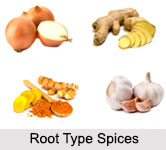
 Root Type Spices are extensively used to make food tasty and delicious. These spices have a sharp taste and thus make the predominant taste in the dish, yet in a subdued form. These plants mostly grow from thickened aromatic rhizomes with large, upright, alternate leaves. They are mostly found in tropical and subtropical regions in India. Root Type Spices are extensively used to make food tasty and delicious. These spices have a sharp taste and thus make the predominant taste in the dish, yet in a subdued form. These plants mostly grow from thickened aromatic rhizomes with large, upright, alternate leaves. They are mostly found in tropical and subtropical regions in India.
Some of the best-known root type spices in India are Galangal, Ginger, Horseradish, Leek and others. Turmeric Turmeric is one of the most popular root type spices in India. It is also popular as medicine popularly used as part of home remedy. Almost in every dish prepared in India Turmeric is added. Further, it is also regarded by the Hindus as ‘sacred’ for use in ceremonial and religious functions. 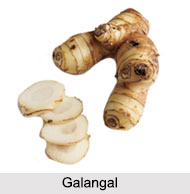 Ginger Ginger
Ginger or ‘Adrak’ is the dried underground stem or rhizome of the plant, which constitutes one of the most important major spices of India. It is widely used as a spice as well as a folk medicine. The ginger can be consumed fresh, powdered, dried as a spice, in oil form, or as juice. Horseradish Horseradish is another variety of ginger with a difference that its rhizome gives the flavour of mango. It falls under the category of root type spices in India. It is the thick white fleshy tasty root of horseradish, which is highly prized as an appetizing condiment with certain foods. Galangal Galangal, one of the widely used root type spices in India, is the dried rhizome or root of the plant, which grows mainly in the Eastern Himalayas and South West India. Galangal has a distinct peppery flavour and is widely used as a food flavouring and spice in stir fried dishes and soups. Onion Onion is a flavouring root type spice in India particularly used to hide certain repulsive odour especially in non-vegetarian dishes. In India, however onions including its leaves are considered as non-vegetarian. It is consumed raw with salads, often as side dish. India is the second largest onion growing country in the world. Indian onions are famous for their pungency and are available round the year. Shallots 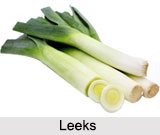 Shallots are pickled with or without vinegar. The flavour of shallots is somewhat milder than that of onion. They are baked, boiled and fried. Leaves are also consumed as green vegetable. It is reported that the leaves are rich in vitamin A. Like their cousin’s onion and garlic this is also considered as non-vegetarian food in India. Shallots are pickled with or without vinegar. The flavour of shallots is somewhat milder than that of onion. They are baked, boiled and fried. Leaves are also consumed as green vegetable. It is reported that the leaves are rich in vitamin A. Like their cousin’s onion and garlic this is also considered as non-vegetarian food in India.
Leek Another root type spice in India is the Leek that belongs to onion and garlic family. Leeks have a much subtler, sweeter and more sophisticated flavour. They can be used to enrich soups, stews and suppers that comfort and satisfy throughout the autumn and winter. Garlic Garlic or ‘Lahsan’ is another regularly used root type spice in India. It has long been recognized all over the world as a valuable condiment for foods, and a popular remedy or medicine for various ailments and physiological disorders. In India, the Hindus consider it as a non-vegetarian food. The root type spices in India have become an invariable ingredient for Indian food recipes and serves both odour and colour to the dish. |
| |||



Root Type Spices
| Root Type Spices in India are used to include a sharp yet subdued taste to any dish. |
| ||||||||||||||||||||||||||||

