Karna Parva consists of only one sub-parva from among one hundred sub-parvas of the great Hindu epic of Mahabharata. This Parva starts with the birth of Karna and it ends with the death of Karna in the great battle at Kurukshetra in the hands of Arjuna. He was born to Kunti with the blessings of Sun god as per the boon of a maharishi received by Kunti. Since Karna was born when Kunti was unmarried, she was very much afraid of losing her and her father`s prestige and thus placed Karna in a well-ventilated box and floated it in a river and the river currents carried the baby far away to the city of Champa on the Ganges and Adiratha the charioteer and his wife Radha found the child and took him. They kept him as their eldest son. As the son of the Lord Surya, Karna was born with natural earrings and a natural coat of armour as the signs of his immortality so that he would not be defeated by any mortal foe.
Karna was well known as a very wise person and at the moment when after bathing he performed his morning worship of the sun, there was nothing belonging to him which he would not give, if asked by anyone. Thus, one day Indra, taking the form of a Brahmin, stood before him at that time and boldly demanded his ear-rings and a natural coat of armour. Karma gave it away to Indra without and in return he received from Indra an invincible dart which Karna could use only once against any powerful foe. When the great warrior Dronacharya was killed in the battle, Duryodhana made Karna the commander of the Kuru army. The Karna Parva also describes about the death of Dushasana in the hands of Bhima. Bhima, in order to fulfill the vow made by him in the court of Hastinapur after Draupadi was offended before all, ripped open the breast of Dusasana in the battle field and drank the blood from his heart.
The Charioteer of Karna
When Karna was made the king of the Kuru army, the Madra King Salya refused to accept Karna as a superior warrior than him and thus he demanded a much greater share for him in the great battle at Kurukshetra. Thus, Salya was satisfied to be the charioteer of Karna in the battle and according to his promise to Yudhisthir he always demoralized Karna by abusing him and praising the Pandavas. Fifteen days of battle was over with the death of the great Guru Dronacharya, and before dawn on the sixteenth Duryodhana installed Karna as the commander of the Kuru host. On the sixteenth day of battle Karna had arranged the Kurus in the form of a great bird, and Arjuna spread out the Pandavas to oppose them as a crescent. But though Karna sought Arjuna earnestly all that day throughout the length and breadth of the battle-field, he was not able to encounter Arjuna face to face.
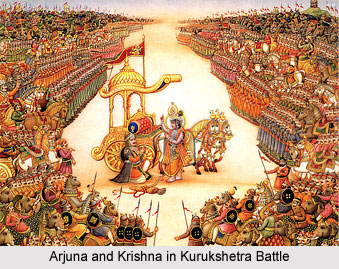
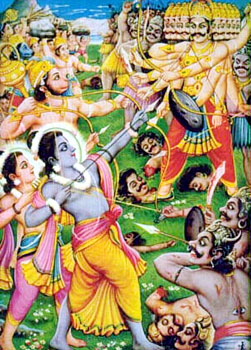
The next day, with the rising sun, the battle between the Pandavas and the Kauravas again broke out. Arjuna and Karna came face to face in the battle field and a fierce war took place between them. They fiercely challenged each other and joined in fight. And it was even narrated that their two standards fell upon each other and closed in conflict. Then each of the two heroes, raining arrows upon the other, darkened the whole sky. They inflicted wound upon wound to each other, but as long as they were not dead, neither seemed to feel the pain. Then the arrows of Arjuna covered the chariot of Karna like a flock of birds darkening the sky as they flew to roost and to each one of those shots was by Arjuna was deflected by an arrow of Karna.
When Karna was young, he disguised himself as a Brahmin and went to get lessons of archery from the great Parasurama. He excelled in every field and became the favourite student of Parasurama. However, the great sage once came to know about the actual identity of Karna and told him that even if he liked him the most among his students, still he cursed him for he concealed his identity before his guru. Thus Parasurama cursed Karna that in a great battle the wheels of his chariot would get stuck in the earth and that would result in severe consequences. Thus, while fighting with Arjuna the wheels of Karna`s chariot went inside the earth and at that time he was killed by Arjuna and with this concludes the Karna Parva of Mahabharata.