 Ancient Indian literature is the crowning glory of Indian civilization and its evolution towards contemporary times. No other part of the world has probably produced such voluminous literature of knowledge and wisdom. Indian literature of ancient times entails all the minute details of day-to-day existence through spiritual understanding acting like a talisman, a polestar guiding the contemporary populace.
Ancient Indian literature signifies the earliest known and acknowledged form in Indian literary traditions, which manifests its very first traces through the system of oral transmittance, or by word of mouth. Even prior to the arrival of Aryans into India, the legendary Indus Valley Civilisation possessed amongst them the custom of `gurukul` education. Gurukul essentially symbolised that a child during his boyhood was to leave his home and travel to his guru`s (teacher) place in the ashram, wherein he was to receive his absolute education, which was to be imparted orally. Such guru-shishya (relationship between a student and his teacher) educating fashion had paved way for the very first transmission of legends, stories, myths or facts, which further witnessed the gradual descending of this knowledge from generations to generations.
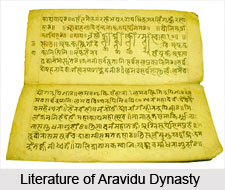
However, this very mode of oral transmission of invaluable treatises or profound knowledge, gradually posed a problem and a thing to worry about. It was deemed that there would be absolutely no use of these priceless words of mouth, if they would not be preserved; these chunks of knowledge and information would gradually lose its importance with time, fading into oblivion. Thus, was ushered in the first ever mode of scripting down priceless materials in the form of manuscripts, that is witnessed today. And herein lays the twist in ancient Indian literature and its traditions, which was to henceforth remain a viewer of the continuous rise in creation and creators.
 This reverse sweep from oral to written mode witnessed the coming forth of Sanskrit language and its vast literature by legendary authors in a chain system. In this context, the Vedic Period had much involvement in ancient Indian literature and its development. Classical Sanskrit literature had prospered in the first few centuries of the first millennium C.E., as did Sangam literature of Tamil Nadu and the Pali Canon.
According to historians, ancient Indian literature can be divided into two main categories of :
• Sruti
•Smriti
Shruti literally stands for `listened or heard`. Historians have also ascribed the word Shruti to the Guru-Shishya (teacher-student) system, where the disciple hears directly from the guru. On the other hand, some other explanations attribute Shruti to the revelation of truth through hearing, which is linked more closely to the sound of AUM (OM) being the utmost truth. Shruti are considered the principal text. Shruti has higher authority over any other document and Shruti constitutes the Vedas; Bhagavad Gita also falls under the category of Shruti.
On the other hand Smriti literally stands for `remembered or memorised`. Smriti is known to have been compiled over a great span of time, related to an assortment of subjects. Smriti though wields comparative lower authority, when associated with Shruti. If there comes about any contradiction between Sruti and Smriti, then Smriti needs to be discarded, while assuming Sruti as the authority. Smriti are divided into 6 basic categories: Dharmashastra, Itihasa, Purana, Sutra, Agama and Darsana
Vedic Literature and the Upanishads are highly esteemed as Shruti literature. The Sanskrit root `shrut` means `to hear`. During ancient times, while being engrossed in their tapasya and sadhana, the great sages are believed to have `heard` the divine truths. Whatever was `heard` of ancient Indian literature, was represented in the Vedas and the Upanishads. Henceforth they came to be known as Shruti literature later in the texts of ancient Indian literature.
The literature which was based upon the knowledge acquired through the experience or the tradition was the Smriti literature of ancient Indian literature. In general terms, Smriti literature is based on Shruti. The celebrated Manu Smriti and other smritis and shastras of ancient Indian literature, complete the full circle in Smriti literature. The guiding principle for ethics, moral obligations, social codes, customs and others can be encountered in Smriti literature. The great epics Mahabharata and Ramayana also fall under the category of Smriti literature and are integral parts of ancient Indian literature. Shruti literature is veritable and inviolable in ancient Indian literature, while Smriti literature may have been modified under the influence of time and place.
Vedic Literature is the most celebrated asset of the mankind. The Rig Veda is the oldest literary work in the history of the world highlighting, grasped how rich ancient Indian literature is. Vedic Literature is mellifluous with superb expressions of the Divinity. Their uniqueness lies in them being the first meaningful utterances on the lips of man. Ancient Indian literature is that glorious gift of Indian civilisation to the world and its people to comprehend the reality of the materialistic world in an improved way. Ancient Indian literature virtually comprises an endless list of illustrious scriptures. Indeed, the broadened category of Indian scriptures broadly is classed into these categories of Shruti literature and Smriti literature.
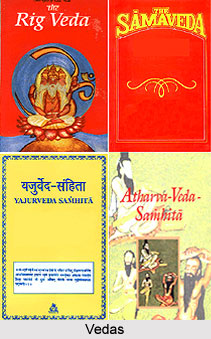
Vedic and Sanskrit literatures were considered almost inseparable, whose journey had set off with the Rig Veda, a collection of sacred hymns dating back to the period 1500 to 1200 B.C.E. It is quintessentially believed that most of ancient literature in India was scripted in Prakrit or Pali script, besides Sanskrit. Hence, ancient Indian literature can also be termed as `Puranic Literature` or `Sanskrit Literature`. Sanskrit literature is one of India`s two oldest languages and the source and origin of several modern languages in India. It was in Sanskrit itself that this ancient period had witnessed literature take superlative form through the four Vedas: Rig Veda, Yajur Veda, Sama Veda and Atharva Veda; the Upanishads, Samhitas, Brahmanas and Aranyakas; the Sutras; the epics Ramayana and Mahabharata; and finally the entrance of Panini and his henceforth Sanskrit literature like Vastu Shastra on architecture and build and Kamasutra, the treatise on love and union.
Composed within 2000 B.C. to 500 B. C., the four cardinal Vedic books also stand in historic argument amongst historians related to their significance. Some historians consider the first three as the most important ones, as compared to Atharva. Each book further possesses four kinds of associated literature - hymns, rituals, meditation and mystical philosophy. The Vedas, as it is acknowledged in the contemporary age, were not written during any single designated time, but compiled, accounts spanning several centuries by different people, they record the paradigm shifts, of time. As a result, the Vedas provide valuable insight into the historical and cultural development of ancient Indian literature and India as a whole during this period. Such diversity of content and volume also includes umpteen lines of thought and belief. The Upanishads also form a part of the Vedas and are strongly philosophical in content.
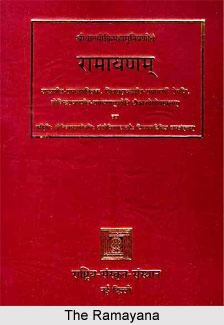
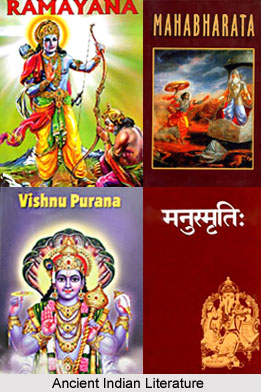
The great epic Ramayana was also handed down orally and evolved through several centuries before finally being penned down. Traditionally, the authorship of Ramayana is attributed to the Hindu sage Valmiki, who is referred to as "Aadikavi" or the first poet. He had introduced the Anustubh metre for the first time, which later went on to become the most popular metre in Sanskrit. The first and the last chapters (Balkhand and Uttarakhand) of the epic were added at a rather later stage. At times, it is also acknowledged that ancient Indian literature firmly stands on the basis of identification of these two epics. However Ramayana forms the basis of Hindu faith and assimilates tales that form the basis for modern Hindu festivals. In fact, some of its practices survive till to this date, as for instance the elaborate ritual of Hindu marriage. The story of Ramayana is one that deals with Prince Ram, his exile and the abduction of his wife Sita by the demon Ravana and the subsequent rise of Lankan War. In between this main plot, there comes to light a number of events, annals appearing as sub plots, intricately absorbed into the main plot.
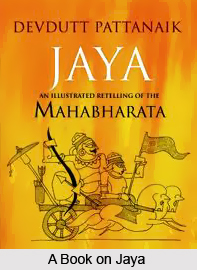
Mahabharata, yet another defining epic in ancient Indian literature, is one of the largest poetic works in the world. It comprises enormous tracts of Hindu mythology, philosophy and religious references. Mahabharata contains 100,000 stanzas, authored by sage Vyasa. The first stanza cites the book`s name as Jaya, even though it is known as the Mahabharata. It is believed that the epic must have been orally transmitted for a few centuries thus leading to modifications, before finally being written down.
Thus, the Mahabharata simply evolved alongside Indian culture and is a veritable storehouse of cultural mores, mythology, religion and philosophical sophistication in the seminal work of Hindu religion (Bhagavad Gita), which appears in the tenth chapter of Mahabharata. Right from political autocracy to power hungry Hamartia leading to catastrophe, to the evils of jealousy, womanizing all is included in this. The epic, an integral faction for the evolvement of ancient Indian literature, states the story of two rival royal families fighting for the throne of Hastinapur. It contains a number of sub-plots, which are additionally independent stories in their own rights. This epic had left a major impact and imprint on much later works. Mahabharata`s significant effect can be wholly reflected in Indian literature, religion, folklore and philosophy. At once eloquent and grand, the importance of Mahabharata can be summed up in what is in scripted in it "what can be found here can be found elsewhere, what cannot be found here cannot be found elsewhere".
However, ancient Indian literature does not only end in these much talked-about and society-mirroring scriptures and inscriptions. Literature during this very ancient period in India also has much in store for scholars and readers, which in no way is an understatement if stated that these treatises also attract sufficient weight beyond the Vedas and epics. Ancient Indian literature also mentions about the aspect of `Dharmashastra`, which primarily deals with duties and obligations of a person. Most of the Dharmashastras however have been derived from Vedas. This ancient Indian treatise defining duties can be divided into three major categories, comprising: Achaar or essential duties or rites, Byavahar or stated as behaviour and Prayashchit or interpreted as atonement.
In addition to these shining and illuminating mentioned Dharmashastras, there too exists hundreds of Dharmashastras penned down for the ages. Some of these few illustrious and distinguished major Dharmashastras comprise: Dharmashastra of Apastamba, Dharmashastra of Gautama, Dharmashastra of Baudhyan , Manu Smriti , Yagnavalkya Smriti and the Narada Smriti
Itihasa is yet another sub-section of ancient Indian literature, that states the definition of the collection of epics and their assimilation. According to historians, it is also acknowledged that Itihasa comes under the sub-section of Puranas. Besides Ramayana and Mahabharata, the path breaking Itihasas include: Yogavashista and Harivansa.
Puranas are perhaps the most colloquially rendered legends in ancient Indian literature that have been told and retold umpteen times in contemporary age, with much courtesy going to grandmothers and their tradition of reiterating stories to their grandchildren. Puranas literally stands for being `ancient` or `old`. The primary characteristics of Puranas are traditions and rituals or more of these customary aspects, making what Hindu tradition is today. Puranas basically deal with Triguna or `Three qualities`, Satva or Truthfulness, Rajas or Passion and Tamas or Darkness and Ignorance. Puranas are divided into four categories, comprising: Maha Purana - Main Puranas, Upa Purana - Secondary Puranas, Sthala Purana - Purana associated with specific places and Kula Purana - Purana associated with a dynasty.
Some other major Puranas include: Shrimad Bhagawat Purana , Vishnu Purana , Devi Bhagawat Purana , Bhavishya Purana , Matshya Purana , Karma Purana and the Brahma Purana.
Sutra literally signifies `Thread`. Sutras in ancient Indian literature are fundamentally rules and laws of the particular related or concerned topic that is equivalent to the Greek word `Nomos`. The few major Sutras include: Yoga Sutra - Sutras of Yoga, Nyaya Sutra - Sutras of Justice, Brahma Sutra - Sutras of Brahm, Kama Sutra - Sutras of Sensual Desire, Vyakarana Sutra - Sutras of Grammar, Jyotish Sutra - Sutras of Astrology and Astronomy and Sulva Sutra - Sutras of Geometry.
Agamas in ancient Indian literature stood for one`s `Arrival`. Agama exemplified mainly rules of rituals, many of which have not survived to this present date. To end this exceedingly illustrious list of ancient Indian literature, comes the Darshanas, which when interpreted, implies `Viewing` or `Seeing`. Darshanas are fundamentally philosophical documents. Several of the Sutras fall under Darshana category.
During the late concluding phase (from ca. 600 B.C.E.) of Golden Age in ancient Indian literature, it saw the ascension of the Mahajanapadas (literally implying "Great Kingdoms") and was succeeded by the Mauryan Empire (from ca. 320 B.C.E.), the classical age of Sanskrit literature and the Middle kingdoms of India.