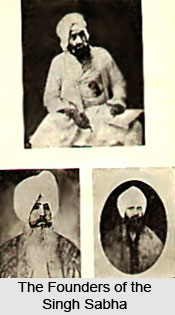
 The Sikhs in Amritsar formed the Sanatan Singh Sabha as the original Singh Sabha in 1873. Still reckoned as an ideal Indian renaissance movement, Sanatan Singh Sabha recovered a distinctive Sikhism in India. The Sanatan Sikhs refer to the Classical Sikhism as Sikhs to be a wider denomination of Sanatan Dharma by the individual who practices karma and Bhakti of the Almighty in any way for the achievement of Moksha, or spiritual liberation.
A second Singh Sabha was shaped and named the Tat Khalsa (`True` Khalsa) as a political reaction to the formation of the Sanatan Singh Sabha. The Governing British Administration based at Lahore in 1879 founded the Tat khalsa. This Sabha was also called the Lahore Singh Sabha. The British Raj utilized the Tat Khalsa Singh Sabhia Sikhs to apply their `divide and rule` policy. They eventually planned to negate Sanatan Sikhism in the name of `reform` whereas make Sanatan Sikhism predominantly inclusive.
Each of the Singh Sabhas represents a different world-view. The Sanatan world-view was basically oral, personal, popular, assorted, and dependent on past traditions and a historical in nature. The Tat Khalsa world-view was on the other hand, textual, impersonal, elite, homogenous, historical, dynamic and modern in nature. In the former view or the Sanatan view, there is a reception of the Indian tradition and its value over the western tradition and colonialism. While, in the latter there is a conflation and communication between Western colonialism and Indian inherited traditions. The basic belief of Sanatan Sikhism is religious diversity and Sikhism can be composed of a variety of different forms and practices, since boundaries are essentially flexible.
The point of disagreement with Tat Khalsa Sikhism and Sanatan view is that these practices are often indivisible from the practices evident in the Hindu and Muslim traditions. Another point of disapproval is when Sanatan Sikhs see Sikhism as an offshoot of Hinduism. This is unpleasant and misguided in the Tat Khalsa`s point of view. Thus Sanatan doctrines are deeply rooted in the Hindu scriptures such as the Puranas, Vedas, Shastras, popular poetic epics, mythology and legends, as well as in the practices of idol worship, worship of tombs, temples and other holy sites. There is also some Sufi, yogic and ascetic practices related to the Sanatan view. A key point of contention is the Hindu doctrine of the avataras (divine incarnations) where God is supposed to incarnate in different forms of living body at times when righteousness shall overcome the forces of darkness.
Sanatan Sikhs include the Udasis and Nirmalas and consider that the Amritdhari, Keshdhari and Sahajdhari are all Sikhs communities. Sanatan Sikhs also hold the Adi Granth and the Dasam Granth in equal status. The first Singh Sabha was founded at Amritsar in 1873 and was essentially conservative `eternal`, almost synonymous with Hinduism. It arose because of an apparent termination of the Sikh faith, i.e., Sikhs were believed to be interested into the folds of Hindu thought and practice. This was worsened and compounded by the conversions of some Sikhs to Christianity. This happened due to the expansion of English-speaking education and Christian missionary camps in the 1880s, thus causing a public uproar. The Hindus, Muslims and Sikhs all interpreted these colonial times as a threat to their traditions and started several reformist movements.
The Sikhs thus inaugurated the Singh Sabha to recover a distinctive Sikhism. With the start of the print media the task of discovering, defining real Sikhism was worked out in print, journals and tracts, religious assemblies, preaching and public conversation. The Singh Sabha movement speedily expanded and Sabhas were being formed all over the Punjab. The Sanatan Sikhs i. e the Udasis, Nirmalas and the Namdharis for the first time challenged and eventually marginalized. The Dasam Granth has been understood as reflecting the Sanatan Sikh`s world-view and the Adi Granth the Tat Khalsa`s since the Dasam Granth including many of the Hindu myths and goddesses, and incarnations of deities like Siva, Vishnu and the Goddess. The advent of the Tat Khalsa orthodoxy Sahajdhari Sikhs, Nanak-panthis and Sanatan Sikhs were associated in a way that their non-Khalsa qualities were greatly highlighted.
Sanatan Singh Sabha
Sanatan Singh Sabha is the original Singh Sabha formed in 1873 by Sikhs in Amritsar to recover a distinctive Sikhism.