Introduction
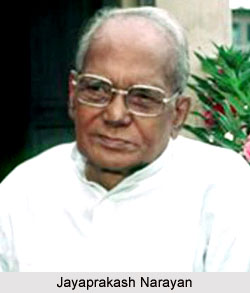 Jayaprakash Narayan was popularly known as JP and was an Indian freedom fighter and political leader. Jayaprakash Narayan is especially known for leading the opposition to Indira Gandhi in the 1970s and for giving a call for peaceful Total Revolution. His nationalist friend and an eminent writer of Hindi literature Ramavriksha Benipuri wrote a biography on Jayaprakash Narayan.
Early Life of Jayaprakash Narayan
Jayaprakash Narayan was born in Sitabdiara village between Ballia District of Uttar Pradesh and Saran District of Bihar. Jayaprakash Narayan`s father Harsudayal was a junior official in the canal department of the State government and often traveled across the region. Jayaprakash Narayan was called Baul affectionately and stayed with his grandmother to study in Sitabdiara. There was no high school in the village, so Jayaprakash traveled to Patna to study in the Collegiate School. He was an excellent student and his essay, "The present state of Hindi in Bihar", won the best essay award in school. Later, Jayaprakash Narayan entered the Patna College on a Government scholarship.
Career of Jayaprakash Narayan
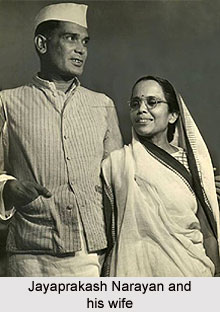
Jayaprakash Narayan joined "Bihar Vidyapeeth" that was founded by Dr. Rajendra Prasad for motivating young talented youths and was among the first students of renowned Gandhian Dr. Anugrah Narayan Sinha, a close colleague of Mahatma Gandhi In 1920 Jayaprakash married Prabhavati Devi. His wife was also a freedom fighter in her own right and a staunch disciple of Kasturba Gandhi. Prabhavati was the daughter of lawyer and nationalist Brij Kishore Prasad, one of the previous Gandhians in Bihar.
In 1922, Jayaprakash Narayan went to the United States, where he worked for tenure in order to support his studies in political science, sociology and economics at the University of California, Berkeley, University of Iowa, University of Wisconsin-Madison and Ohio State University. He supported Marxism while studying at the University of Wisconsin-Madison under sociologist Edward A. Ross. Due to limited finance and his mother`s ill health, he was forced to abandon his desire for attaining the PhD degree. Jayaprakash Narayan became familiar with Rajani Palme Dutt and other revolutionaries in London while returning to India.
Political Life of Jayaprakash Narayan
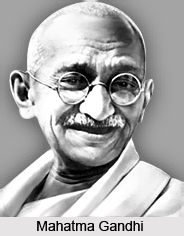
After returning to India, Jayaprakash Narayan joined the Indian National Congress on the invitation of Jawaharlal Nehru in 1929. Mahatma Gandhi became his counselor in the Congress. He shared the same house at kadam kuan in Patna with his close friend and nationalist Ganga Sharan Singh (Sinha). During the Indian independence movement Jayaprakash Narayan was arrested, jailed, and tortured several times by the British. He won particular fame during the Quit India movement.
Jayaprakash Narayan was imprisoned in Nasik Jail for civil disobedience against British rule, where he met Ram Manohar Lohia, Minoo Masani, Achyut Patwardhan, Ashok Mehta, Yusuf Desai and other national leaders. After being released, he was made the General Secretary of the Congress Socialist Party, or (CSP). This was a left-wing group belonging to the Congress and was formed with Acharya Narendra Deva as President
After independence and the death of Mahatma Gandhi, Jayaprakash Narayan, Acharya Narendra Dev and Basawon Singh (Sinha) looked after the CSP out of Congress to become the opposition Socialist Party, which later took the name, Praja Socialist Party.
On April 19, 1954, Jayaprakash Narayan declared in Gaya that he was dedicating his life (Jeevandan) to Vinoba Bhave`s Sarvodaya movement and its Bhoodan campaign, which promoted distribution of lands to Harijans (untouchables). He gave up his land, set up an ashram in Hazaribagh, and worked towards uplifting the village.
In 1957, Jayaprakash Narayan officially split with the Praja Socialist Party in order to pursue Polity of the people. By this time, Jayaprakash Narayan had become sure that lokniti should be non-partisan in order to build a consensus-based, unrestricted, participatory democracy, which he called as Sarvodaya. Narayan became an important figure in the India-wide network of Gandhian Sarvodaya workers.
In 1964, Narayan was vilified across the political spectrum for disagreeing in an article in the Hindustan Times that India had a liability to keep its promise to allow autonomy to the Indian state of Jammu and Kashmir. Jayaprakash Narayan called for Sampurna Kranti on the 5th of June 1975 - total revolution at a historic rally of students at Patna`s Gandhi Maidan.
 Jayaprakash Narayan again gained prominence in State politics in the late 1960s. In 1974, he led the student`s movement in the state of Bihar, which steadily developed, into a popular people`s movement known as the Bihar movement. It was during this movement that Jayaprakash Narayan called for peaceful Total Revolution Together with V. M. Tarkunde to uphold and defend civil liberties.
Jayaprakash Narayan had spent the first 25 years of independence as the patron saint of lost causes: the Praja Socialist Party, the Sarvodaya movement, even self-determination for Jammu and Kashmir. His most enduring contribution to the life of the Republic was the movement he led to unseat Mrs Gandhi, which provoked the Emergency.
Jayaprakash Narayan also wrote several books, the best of the lot was Reconstruction of Indian Polity. He promoted Hindu revivalism, but was initially earned criticisms for the formation of the revivalism promoted by the Sangh Parivar. Jayaprakash Narayan died in October 1979.
Jayaprakash Narayan and Sarvodaya
 On April 19, 1954, Narayan announced in Gaya that he was dedicating his life (Jeevandan) to Vinoba Bhave`s Sarvodaya movement and its Bhoodan campaign, which promoted distributing land to Harijans (untouchables). He gave up his land, set up an ashram in Hazaribagh, and worked towards uplifting the village.
In 1957, Narayan formally broke with the Praja Socialist Party in order to pursue lokniti (Polity of the people), as opposed to Rajniti (Polity of the state). By this time, Narayan had become convinced that lokniti should be non-partisan in order to build a consensus-based, classless, participatory democracy which he termed Sarvodaya. Narayan became an important figure in the India-wide network of Gandhian Sarvodaya workers.
In 1964, Narayan was vilified across the political spectrum for arguing in an article in the Hindustan Times that India had a responsibility to keep its promise to allow self-determination to the state of Jammu and Kashmir. He hit back at critics in a second article, dismissing the Indian version of the "domino theory" which held that the rest of India`s states would disintegrate if Kashmir were allowed its promised freedom. In his graceful if old-fashioned style, Narayan ridiculed the premise that "the states of India are held together by force and not by the sentiment of a common nationality. It is an assumption that makes a mockery of the Indian Nation and a tyrant of the Indian State".
Later Life of Jayaprakash Narayan
A university called the J P University in Chhapra, Bihar and two Hospitals, L N J P Hospital in New Delhi and Jai Prabha Hospital in Patna has been opened in his memory. The capital`s largest and best-equipped trauma centre, the Jai Prakash Narayan Apex Trauma Centre of the All India Institute of Medical Sciences, also commemorates his contributions.
Awards Received by Jayaprakash Narayan
In 1998, Jayaprakash Narayan was posthumously awarded the Bharat Ratna award, India`s highest civilian award for his social work. Other awards include the Magsaysay award for Public Service in 1965.