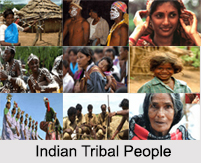
 Indian Tribal People or "Adivasi" is an umbrella term for the ethnic and tribal groups living in various states in India and Union Territories of the country. They are counted as a minor, but they occupy a larger part of the country as they are the original inhabitants in India.
According to Article 342 of the Constitution of India, there are 697 tribes in India as counted by the Central Government. These Indian tribal groups of people have been notified to occupy more than one State. More than half of the Indian tribal population is concentrated in the states of Madhya Pradesh, Chhattisgarh, Maharashtra, Odisha, Jharkhand and Gujarat. Other Indian tribal societies are found in Rajasthan, Bihar, Andhra Pradesh, Kerala, Andaman and Nicobar Islands, West Bengal, Mizoram and other states in north eastern part of India.
History of Indian Tribal People
The "Adivasis" governed themselves outside the influence of the particular ruler. In Ramayana, the kingdom of the demonic king Ravana and Kishkinda, the homeland of the Vanaras were places situated south of Chitrakuta Hill and north of Narmada River in middle India. Accordingly, Ravana and his people was an aboriginal tribe in India, most probably the Gond, and the Vanaras, like Hanuman in the epic, belonged to the Savara and Korku tribes whose descendants still live in the forestry belt of Central India. Even today, the Gond holds Ravana, the villain of Ramayana, in high esteem as a chief.
Indian Puranic Tribe
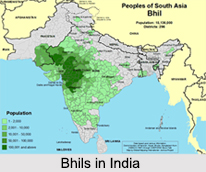
In Mahabharata, it is referred that the demise of Lord Krishna at the hands of a Bhil Jaratha showed the existence of tribal people in India. In the ancient scriptures various terms are used depicting Adivasis as almost animals. The epics of Ramayana and Mahabharata, the Puranas and Samhitas refer to Adivasis as Rakshasa (demons), Vanara (monkeys), Jambuvan (boar men), Naga (serpents), Bhusundi Kaka (crow), Garuda (King of Eagles), etc. In medieval India, they were called derogatorily as Kolla, Villa, Kirata, Nishada, and those who were subjugated as slaves and the robbers.
 North East Indian Tribes
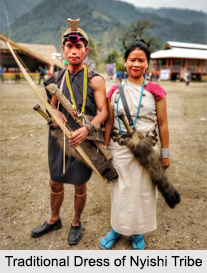
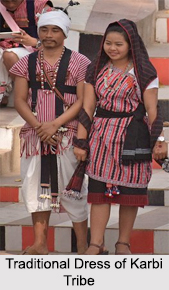
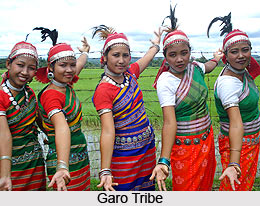
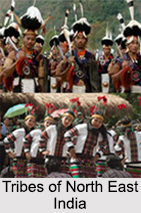
In the north eastern part of India, there is a concentration of a number of tribes. The tribal people of Meghalaya are categorised in two major groups namely the Garo tribe and Hynniewtrep. Chakma tribe is one of the important tribes of Mizoram. The tribes of Manipur are Aimol, Anal, Angami, Chiru, Chothe, Gangte, Hmar, Kabui, Kacha Naga, Koirao, Koireng, Kom, Lamgang, Mao, Maram, Maring, Lushai tribes, Monsang, Moyon, Paite, Purum, Ralte, Sema, Simte, Sukte, Tangkhul, Thadou, Vaiphei and Zou. Bodo tribe and Mishing tribe constitute the largest population in Assam.
North Indian Tribes
North India also encompasses many tribes. Tribes of Jammu and Kashmir have strictly descended from the Indo-Aryan group of people. Tribes of Uttar Pradesh and Uttarakhand comprise a colossal portion under the north Indian tribal section, with variety speaking out from every section and every sphere of daily life.
Tribes of Haryana basically are consisted of nomadic and semi-nomadic individuals, with a somewhat decaying condition of their social and economic condition. Tribes of Himachal Pradesh can be singled out for their looks, good conduct and religious behaviour towards every kind of situations and places.
 East Indian Tribes
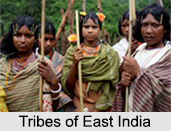
East Indian tribes come to a significant numbering count under the vast section of Indian tribes. Tribes of West Bengal with their incredible talents and improvisations has elevated Bengali tribes into a prestigious hold. Tribes of Odisha have their own set of faiths when it comes to marriage and holy union. Tribes of Jharkhand are diversified through their hand-work and religious customs.
West Indian Tribes
West India, comprising the states of Rajasthan, Gujarat, Maharashtra and Goa house sufficient section of Indian tribes. West Indian tribes have been pocketed in several far-away areas, living a life of their own. Agriculture and harvesting seem to be the basic occupations of the tribes of Gujarat since olden times. Tribes of Rajasthan have been involved with rest of the Rajasthani population since ancient times, with their unique customs and culture spreading each other day. Tribes of Maharashtra are primarily classified in the groups of nomadic tribes and scheduled tribes.
Central Indian Tribes
Tribal life in Central India is an excellent instance of the blending of rural and urbanity. Tribes of Madhya Pradesh is basically classified under the group of scheduled tribes, with other sub-groups of tribes also making their presence felt. Tribes of Chhattisgarh primarily consist of a significant number that even surpasses the urban population.
South Indian Tribes
The numbers of South India tribes are perhaps unlimited with their miscellaneous existence, which has now gained popularity throughout the country. The tribes of Tamil Nadu comprise significant number of population ranging from dwindling to massive. Tribes in Karnataka are astoundingly enormous in number, with the count exceeding a bare minimum. Tribes of Kerala are perhaps the most unique among all the south Indian tribes. Residing basically in the mountainous terrains of the state, they have been striving to uphold their indigenous traditions and customs from any foreign influence.
Tribes of Union Territories of India
The tribes of the Union Territories are categorised under the Scheduled Tribes, except for Delhi. Tribes of Lakshadweep had the highest percentage of tribal populations among all the Union Territories.
Indian Tribal People
The Indian Tribal People comprise 8.14 percent of the total population of the country. The culture and tradition of different races vary from the region of origin.