Indian timber trees are sources of timber or wood. The obtained timber is processed into beams and planks and is used for varied purposes. They are often referred to as fancy trees and are widely used for making lavish furniture. Timber trees are found extensively in India and have varied characteristics and utility. There is hardly any timber tree in India, which do not have any utility. There are over 150 species of timber produced in India. The well known Indian states where timber is produced are Uttar Pradesh, Bihar, Odisha, Maharashtra, Madhya Pradesh, Andhra Pradesh and Tamil Nadu. Indian timber trees are also found in extreme Himalayas and the neighboring states.
Types and Uses of Indian Timber Trees
Indian timber trees have utility value in day-to-day life. Mango tree grows throughout India. It is well known for producing a fruit called mango, but mango tree can also be utilized for making cheap furniture, packing boxes, panels for doors and windows, etc. Palm tree grows all over India and is useful for making furniture, roof covering, rafters and joists. Tamarind tree grows throughout India. It is utilized for making agricultural instruments, well-curbs, carts, etc. Banyan tree grows throughout India.
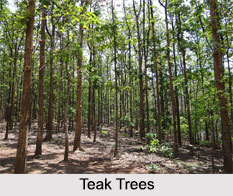
 The aerial roots of Banyan tree are utilized for making tent poles and well-curbs. Bakul tree is grown in north India and is reddish brown in color. It is used for making cabinets. Benteak species of timber grows in south India and can be used for boat building and making furniture. Coconut tree is found throughout coastal India and is used for making poles, piles, furniture and formwork. Mulberry tree grows in Punjab. Mulberry is utilized for making baskets and sports goods like hockey sticks and cricket bats. Deodar tree is the source of soft wood. It is used in structural work and in making railway sleepers, cheap furniture, packing boxes, railway carriages, etc. Babul tree is used for making the wheels of bullock cart, tool handles, agricultural instruments and well-curbs. Sissoo tree is used for making good quality furniture, plywoods, bridge piles, railway sleepers, etc. Indian timber trees namely, teak, sandalwood, sal, seesham, etc hugely contribute to agro-forestry.
Other Indian Timber Trees
Some of the other Indian timber trees are Satinwood tree, Sundri tree, Bijasal tree, Gambar tree, Indian Elm tree and Axlewood tree.