


 Hindu customary ceremonies in India are celebrated for all time with all rituals. Hinduism pens down its enormous list of religious concepts to its followers, the Hindus. The Vedas, the Upanishads, or the Aryans in Indus Valley Civilization for the first time had laid down strict scriptures that had manifested educational and intellectual motives. With passage of time, from the times prior to Christ to times after Christ, Hinduism has come down as the most prevailing and followed religion in India, also the most synonymous. Hindu customary ceremonies in India initially were things of much revelry amongst the highest section of society, with the religious volumes laying down four divisions in caste system: the Brahmans, the Kshatriyas, the Vaishyas and the Shudras. Hindu customary ceremonies in India are celebrated for all time with all rituals. Hinduism pens down its enormous list of religious concepts to its followers, the Hindus. The Vedas, the Upanishads, or the Aryans in Indus Valley Civilization for the first time had laid down strict scriptures that had manifested educational and intellectual motives. With passage of time, from the times prior to Christ to times after Christ, Hinduism has come down as the most prevailing and followed religion in India, also the most synonymous. Hindu customary ceremonies in India initially were things of much revelry amongst the highest section of society, with the religious volumes laying down four divisions in caste system: the Brahmans, the Kshatriyas, the Vaishyas and the Shudras.
Hindu Brahmans, the pandits were the ones who had detailed the true purpose of Hindu customary ceremonies in India, with the phrase implying an essential religious or ceremonious initiation of a child into the common society. And these customary ceremonies commenced from the very birth, ending in death of an individual. The Hindu customary ceremonies in India are as follows: Birth Ceremonies: Jatakarma can be considered as the first customary Hindu ceremony in India, which involves pompous and massive festivities to usher in the child into a family. Many religious mantras are followed in Jatakarma, which also assimilates in the mother of the child, who are both washed out of impurities prior to the birth-stage. Secondly comes Simantonnayana, a ritualistic Hindu ceremony which is solely dedicated to the mother in her fourth month into pregnancy, to defend her and her child from evil spirits. Carefully following the astrological calendar, the moon's phase is counted of prime importance in Simantonnayana ceremony. At birth, before the umbilical cord is detached, the father touch the baby's lips with a gold spoon or ring dipped in honey, curds and ghee. The word vak (speech) is whispered three times into the right ear and mantras are chanted to make certain a long life. 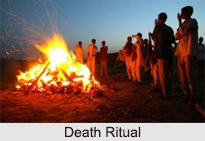
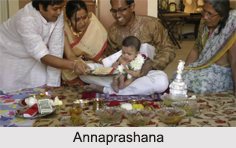
A number of rituals for the newborn include the first visit outside to a temple that often occurs at a temple or during a celebration when the hair is offered to a deity. Annaprashana: Annaprashana is yet another customary Hindu ceremony in India, which is followed serially in the third stage in Hindu familial rituals. This ceremony is done under much fanfare and merriment, with the baby being six to nine months of age. He or she is then first introduced to solid and boiled food like rice or dal. Chudakarma, or shaving of the hair of a child is also known by several other names like ‘Mundan’. Karnavedha, the ritualistic Hindu ceremony of piercing the nose or ear-lobe of a child into the third or fifth year in his or her life is the fifth stage in age-old ceremonial list. Nishkraman: It is the very interesting Hindu ceremony which necessitates the child to be taken out into the basking sun and fresh air and flora. Done by the mother and father of the child concerned, Nishkraman is performed under astrological calendar. Upanayana (Thraed Ceremony): Upanayana is that customary Hindu ceremony in India that has been abided by since the Vedic times. The concept of Gurukul is very much associated with this very ceremony. Upanayana is followed by the upper three sections in Hindu caste system, implying the boy (girls also in Vedic period) being initiated into the Brahmacharya Ashrama, where his guru teaches him the essentials of weaponry, Vedas and Upanishads. Ushered in with chanting of the Gayatri mantra, Vedrambha is that Hindu ritualistic ceremony which calls for the child to be introduced to studying of the four Vedic scriptures, considered the second stage to Upanayana. Vedrambha very much requires the presence of the child's guru or Acharya. Warmly welcoming back the child from his gurukul or ashrama, Samavartana implies that Hindu customary ceremony in India that too is prevalent since Vedic times. Samavartana is a significant stage in a child's life, who has grown up to be a man, ending his Brahmacharya stage, to enter into married life. Wedding: At Hindu weddings, the bride and bridegroom symbolize the god and the goddess. The groom, ornamented in all his finery, often travels to the wedding site on a caparisoned white horse or in an open limousine, accompanied by a procession of relatives, musicians, and bearers of ornate electrified lamps. Hindu marriages naturally have at their centre the narration of mantras by priests. In a crucial rite, the new couple takes seven steps northward from a holy household fire, turn and make offerings into the flames. Death: After the death of a family member, the relatives become concerned in ceremonies for the preparation of the body and a procession to the burning or funeral ground. For most Hindus, interment is the ideal method for dealing with the dead, although many groups practice burial instead; infants are buried rather than cremated. At the funeral site, in the existence of the male mourners, the closest relative of the deceased (usually the eldest son) takes charge of the final sacrament and, if it is burial, lights the funeral pyre. After a cremation, ashes and fragments of bone are collected and ultimately engrossed in a holy river. After a funeral, everyone undergoes a purifying bath. The immediate family remains in a state of powerful pollution for a set number of days (sometimes ten, eleven, or thirteen). At the end of that period, close family members meet for a ceremonial meal and often give gifts to the poor or to charities. |
| |||



Home > Art & Culture > Indian Festivals > Hindu Customary Ceremonies > Hindu Customary Ceremonies in India
Hindu Customary Ceremonies in India
| Hindu customary ceremonies in India are severely followed according to religious customs and instructions. |
| ||||||||||||||||||||||||||||

