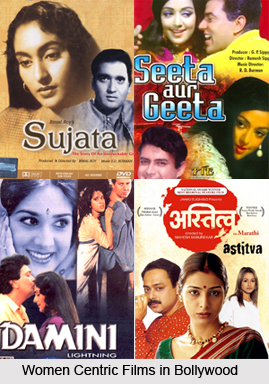
 Women centric films in Indian cinema, as is seen, are rare but they do exist. It is true that one cannot ignore the sojourn of woman in Indian Cinema from Mother India to Mirch Masala to Chandni Bar to Page 3, Fashion and Heroine. The patriarchal society has its roots ingrained within the social nexus and often proved by the domination of Hero centric cinema. However the breeze of social change has even swept the pillars of art, both being directly proportional to each other. Scripts are penned down; characters are crafted keeping in mind the changing social roles of women, their venture, and their transgression from private to public domain, their transgression from the known lands of security towards the unknown depths of uncertainty. There have been many innovative scriptwriters and film producers who have given a unique importance to women in Bollywood, breaking the shackles of set formulae. One of the early films that dealt with the plight of untouchable films was Achhyut Kanya. . Some of the popular Hindi women centric films till date are Seeta Aur Geeta, Sau Din Saas Ke, Insaaf Ka Tarazu, Arth, Ek Pal, Khoon Bhari Maang, Damini and Lajja.
Women Centric Films in Bollywood
In the early years of Indian cinema it was Bimal Roy who made a host of films in which his heroines had the lead part to play. Whether it was Parineeta, Sujata, Bandini, Biraj Bou and other films were mainly women centric. One of the outstanding commercial hits of all times, Seeta Aur Geeta concentrated more on its heroine than the two heroes. Besides such mirrored plots, some films have focused exclusively on the heroine, and woven the script around a female central character. In such films, the heroine has no prototype. Jaya Bachchan"s Guddi was one of the early hits where the innocent girl-next-door image of a star-struck teenager became representative of each school-going girl for years to come. The educated wife changes course midway from a happily married woman to a leading politician as in Aandhi. In Khoon Bhari Maang, the plain-Jane wealthy woman, Rekha,is apparently murdered by a scheming, Casanova husband, Kabir Bedi. After a miraculous escape the post-plastic surgery, glamorous wife returns to seek revenge. She is no more the contented housewife who painstakingly bears the trauma of domestic violence, she revolts, being an iconoclastic icon.
In Aakhir Kyon, Smita Patil portrays a jilted wife who, after the infidelity of her husband, rebuilds her life and becomes a famous writer. Smita Patil also starred in Ketan Mehta`s Mirch Masala wherein a woman refuses to give in to the pestering of a subehdaar. She saves her honour by killing the wicked man. Smita and Shabana Azmi came together in Mahesh Bhatt`s Arth. Much later in Mrityudand, Shabana Azmi defies society and bears the child of her lover while her husband hides behind a facade of renunciation and celibacy. Deepa Mehta`s Fire brings lesbianism to the Hindi screen for the very first time. Filhaal, starring Sushmita Sen and Tabu, is another feature film where friendship between two women is explored. In this film the woman is ready to bear and carry her friend"s child, and give life in a way only a woman can; enacting the role of surrogate mother. In Mahesh Manjrekar"s "Astitva", the soulful Aditi gives birth to a child out of wedlock and shatters the vain world of male vanity when ultimately the truth is disclosed. The film questions the feminist moral concerns through the detailed examination of sexual and familial relationships. And of course who can forget Meenakshi Sheshadri`s powerhouse performance in Damini An interesting phenomenon in Indian films is the vamp.
 She is a tangible contrast to the all-virtuous heroine in Indian cinema. Quite often as a cabaret dancer, her presence was essentially to add glamour. Popularized by Cuckoo, perfected by Helen, and followed through by Bindu and Kalpana Iyer, the vamp once in a while traded places with the heroine.
Women Centric Films in West Bengal
Besides the Hindi films Bengali and south Indian films have also the seen in the development of women centric films. In West Bengal, Mrinal Sen made a bunch of films that dealt primarily with women. Films like Neel Akasher Neechey and Punoscho are instances of such films. While discussing about women centric films one cannot miss Satyajit Ray and his films. Charulata, Devi, Teen Kanya, Mahanagar, Pather Panchali and other Satyajit Ray movies explore different facets of women. Besides these, Ritwik Ghatak`s Meghe Dhaka Tara and Subarnarekha are considered path breaking films in this genre. Much later it was Aparna Sen whose films questioned the traditional mores that were imposed on women. Her films presented women breaking away from the age old conventions to create a world of their own. Paroma, shows a world torn between idealism and realism where the woman tread the path of so-called "promiscuity" only to gain psychological maturity in the long run. Paromitar Ek Din and Sati even highlight the idiosyncrasies of the patriarchal social cosmos.
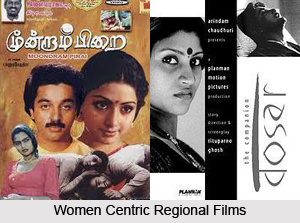
Women have also found a special place in the works of the contemporary Bengali directors like Rituparno Ghosh. Dahan, Unishe April, Bariwali, Doshar, Chokher Bali and others can easily be termed as women centric films. Rituporno Ghosh"s "Dosar", is a movie about nuptial infidelity, and the trauma of young woman who laments a relation approximately lost. His movie Abohoman traces the pangs of two women torn between affection for one man, within the mappings of meta-theatre genre, a cinema about a cinema. Again, very recently, in "Shunyo-e-buke", a Bengali film by Koushik Ganguly, the protagonist is a flat-chested woman of the 21st century who questions the very basis of judging the worth of a woman by her physical appearance. This hard-hitting film questions the projection of women as sex objects in Indians panoramic scenario. Aparna Sen"s Goynar Baksho was another landmark in this category.
Women Centric Films in Assam
Other regional films like Assamese cinema have also dealt with women centric films. Bhaben Saikia`s Agnisnaan, Jahnu Barua`s Firongoti, Dr Shantanu Bordoloi`s Adajya and several other films have time and again raised the problems of the contemporary women.
Women Centric Films in South India
Down south films like K.S.Sethumadhavan`s Stri, Prema Karanth`s Phaniyamma, Girish Kasarvalli`s Kraurya, Balu Mahendra`s Moonram Pirai (remade as Sadma in Hindi) or Adoor Gopalakrishnan`s Mathilukal treat women as their protagonist.
Women Centric English Films in India
 With the gradual passage of time women issues have been more properly addressed in Indian films. The recent day films like Lajja deal with exploitation of women at various levels of society. Even the English films in India have also come up with the problems that women face. These include domestic violence, stifled aspirations, loneliness, widowhood and others. Fire, Provoked, Water, Bend It like Beckham, Mitr: My Friend and other films address different women centric problems.
Women Centric Films in Contemporary India
In recent times, films like Dirty Picture and Kahaani have been extremely successful at box-office. `No One Killed Jessica" traces the attempt to bring alive the struggle of Sabrina Lall`s brawl with the Indian judiciary for years to receive justice for her murdered sister. Turning 30` and `7 Khoon Maaf` - all women-centric films in the last few months show the female leads in strong and powerful roles. `Dor`, `Silsilay` `Tehzeeb` `Pinjar` `Chameli` `Satta` `Filhaal` `Zubeidaa` `Lajja` `Chandni Bar` and `Fiza` brought women into the limelight. People have gladly accepted the new trend in Indian cinema that shows the women in the lead role.That Girl In Yellow Boots, English Vinglish, Queen and Gulab Gang are some other prominent women centric films which have portrayed unique concepts illuminating the role of women in the society.
