


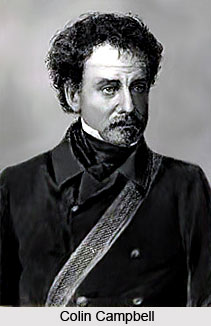
 The extensive stretch between Agra and Kanpur was a huge annoyance to the British Governor-General. The native rebels had already plundered much in various other states. Agra had already been accomplished under the fit guidance of Sir Colin Campbell, Greathed, Hope Grant and General Wilson. The victory however, did come with a price; several officers and British lives were lost. With clandestine measures adopted by Greathed, the troops made victory possible in the dead of the night. Although, worried still lay in the near distance. Kanpur was yet to be occupied, and the mutinied soldiers posted there were a source of botheration. The extensive stretch between Agra and Kanpur was a huge annoyance to the British Governor-General. The native rebels had already plundered much in various other states. Agra had already been accomplished under the fit guidance of Sir Colin Campbell, Greathed, Hope Grant and General Wilson. The victory however, did come with a price; several officers and British lives were lost. With clandestine measures adopted by Greathed, the troops made victory possible in the dead of the night. Although, worried still lay in the near distance. Kanpur was yet to be occupied, and the mutinied soldiers posted there were a source of botheration.
The Secretary to the Agra Government wrote to Delhi to request that Hope Grant of the 9th Lancers might be sent down to take on command. Hope Grant was sent and travelling fast he joined the column at Firuzabad. Grant travelled with it and reached Kanhpur (Kanpur) on the 26th October. At Kanhpur (Kanpur) Grant found that Sir Colin Campbell had made arrangements to increase the column to the divisional strength of approximately 5000 men. On the 30th, Grant crossed Ganga River into Oudh. In consequence of orders received from Sir Colin, he camped his force in a plain beyond the Banni Bridge. The site was within a few miles of the Alambagh. Grant was to wait there for further instructions. While Hope Grant was marching into Oudh, other columns, despatched from Delhi, were doing brilliant work in the districts adjacent to that city. In all of these the authority of the Mughal had been recognised. Sharp actions were necessary to prove to the revolted populations that the power of that family had finished forever. Van Cortlandt, an outstanding officer, with native recruits, cleared the ground to the northwest of the city. Showers, with a mixed column, marched to the west and south-west, forced the chief of Ballabgarh to submit, and took Riwari, Jajhar, and Kanauri successively. He returned to Delhi, on 19th October, with three rebel chiefs as prisoners. Much booty, mintage of the value of 80,000 pounds, seventy guns, and a large quantity of ammunition were seized. Scarcely had Showers returned when the mutinied troops of the Jodhpur legion, fresh from a victory over the soldiers of the loyal Raja of Jaipur, invaded the territories he had just overrun. The rebels thus occupied Riwari. Against them Gerrard, an officer of blatant merit, was despatched with a strong column. Gerrard, marching from Delhi on 10th November, reoccupied Riwari on the 13th. He then pushed on to Narnul, which the rebels had occupied in considerable force. So strong was their position there that, had they had the patience to await attack, Gerrard would have found that all his work had been cut out for him. No sooner had it been reported to him that the British were in sight, than the rebel leader advanced to meet him in the plain. The cavalry fight which followed was most desperately contested. The Guides, led by Kennedy and the Carabineers by Wardlaw, fought magnificently against substantial odds. The rebels, too, fought well, but eventually gave way. On the left the Multani horse, new levies, had at first displayed considerable reluctance to join in the disturbance. Roused at length by the instance of their officers and by the success achieved by the Carabineers and the Guides, they joined in the combat. They finally took their proper place in the front. Meanwhile, the infantry and the artillery had been following up the advantage gained by the defeat of the rebel horse. The enemy was now in full flight. At this crisis Gerrard, riding in front, striking on his white Arab charger, was mortally wounded by a musketball. In the momentary confusion which followed, the rebels, rallying, made a desperate effort to re-establish the fortunes of the day. In vain did they attempt their foray. The Fusiliers charged and drove them into flight and completed their expulsion from the fort of Narnul. Caulfield, who had succeeded to the command, followed up his advantage. He, however, a few days later, was relieved by Seaton. Under orders from headquarters, Caulfield led back the force to Delhi. He was to participate in the measures which Sir Colin Campbell was devising for the recovery of Oudh, Fathgarh, and Rohilkhand. Sir Colin Campbell had arrived in Calcutta on 13th August. During that period, though Delhi had not fallen, the position for an advance from Kanhpur (Kanpur) had materially improved. There was, however, still much to be accomplished. The security of the line of 600 miles had been prominently put forward by Secretary Beadon in the early days of the Mutiny. The stretch was not only insecure, but also was being daily broken. The evil had been intensified for a time by the refusal of the Government to disarm the native regiments at Danapur, and by the consequences of that refusal. Then, too, the division of Chutia Nagpur, a mountainous territory lying between Southern Bihar, Western Bengal, Orissa, and the Central Provinces, was surging with revolutionaries. These were constantly traversing the Grand Trunk Road, obstructing communications, and rendering travelling dangerous. However, none of these difficulties scared Sir Colin. His aim was to despatch troops, and to proceed himself, to Kanhpur (Kanpur). From there, he was to march to relieve Outram and Havelock. Under the pressure of his requisitions, the Government organised a bullock-train for the despatch of troops to Allahabad. In the meantime, Colin sent out strong parties to patrol the road. The well-timed arrival of the British troops intended for China, enabled Sir Colin to utilise the means thus prepared for their despatch. Then the Shannon and the Pearl arrived. Captain William Peel proceeded to organise his famous brigade from the crew of the former, while Captain Sotheby did the same from the crew of the Pearl. Troops arrived from England in October. On the 27th October, Sir Colin, having completed all his arrangements for the immediate despatch of regiments as they might arrive, set out for Allahabad. Narrowly escaping capture on his way from a body of rebels who had breached the famous line, he arrived there the evening of 1st November. He found matters in good progress. The Naval brigade had left Allahabad for Kanhpur (Kanpur) in two detachments, on the 23rd and 28th October. The 53rd and drafts for other regiments had accompanied the second detachment. The whole despatch was commanded by Colonel Powell of the 53rd. Sir Colin, having organised a party under Longden of the 10th, for the clearing of the Azamgarh district, set out for Kanhpur (Kanpur) on the 2nd November. He arrived there on the 3rd. He found the position there, in a military point of view, perilous. Oudh was still teeming with rebels. While, to the south-west of him, within a distance of forty-five miles, the trained soldiers of the Gwaliar (Gwalior) contingent were threatening his communications. The road which Sir Colin had just traversed, between Allahabad and Kanhpur (Kanpur), was liable to invasion from Oudh. It was thus far from safe. Only two days before he had proceeded along it, Powell and Peel had a very sharp encounter with the rebels at Kajwa, twenty-four miles from Fathpur. Though the struggle terminated in a victory, Powell had been killed, and ninety-five men killed and wounded. The problem Sir Colin had to consider was whether, with the road communicating with Allahabad liable to invasion, and his left rear seriously threatened, he could venture to engage in an operation. This would occupy many days, and the duration of which any unbecoming accident might prolong. The rebels were well served by spies. Sir Colin well knew the opportunities which his invasion of Oudh with the bulk of his force would open to men possessing soldierly instincts. The rescue of the garrison of the Residency seemed to Sir Colins' mind, the most pressing necessity. He resolved, then, to attempt it with as little delay as possible. He had ordered Hope Grant, with a portion of the Delhi force, to await further instructions in the plain beyond the Banni Bridge. There he formed the population of the invading army, upon which all carts and supplies were to concentrate. There, too, Sir Colin had despatched all his available troops. He arranged to leave behind him at Kanhpur (Kanpur) around 500 European troops, under Windham and some Sikhs. Colin bestowed authority on Windham to detain a brigade of Madras sipahis, under Carthew, expected the next day. Sir Colin and his staff then quitted Kanhpur (Kanpur) on the 9th. They joined Hope Grant beyond the Banni Bridge the same afternoon. |
| |||



Siege Of Kanpur
| Siege of Kanpur was laid by the British through dire measures to oust the natives. |
| ||||||||||||||||||||||||||||

