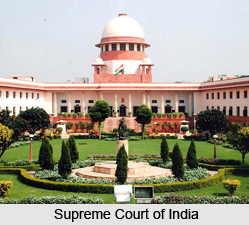
 Supreme Court of India came into being on 26th of January, 1950. The inauguration took place in the Chamber of Princes in the building of Indian Parliament. After its inauguration, the Supreme Court of India started its sittings in the Chamber of Princes in the Parliament House. The Chamber of Princes had earlier been the seat of the Federal Court of India for 12 years, between 1937 and 1950, and was the seat of the Supreme Court, until the Supreme Court acquired its present premises in 1958. Presently, the Supreme Court of India is situated at Tilak Marg, New Delhi.
Composition of Supreme Court of India
The original Constitution of India in 1950 supplied the Supreme Court with a Chief Justice and 7 lower-ranking judges leaving it to the Parliament to increase this number. In the past, a full bench of the Supreme Court sat together to hear the cases presented before them. As the work of the court increased and cases began to compile, Parliament increased the number of judges from 8 in 1950 to 11 in 1956. The number of judges further increased to 14 in 1960, 18 in 1978 and 26 in 1986. As the number of the judges increased, they started sitting in small benches of 2 and 3. Large benches of 5 and more were used, only when required to do so or to settle a difference of opinion or controversy. Any bench was authorized to send the case up to a larger bench, if needed. The Supreme Court of India also comprises of the Attorney General of India, who acts as the chief lawyer of the court.
Selection of Judges in Supreme Court of India
 The Supreme Court of India comprises of the Chief Justice of India and not more than 25 other judges appointed by the President of India. However, the President must appoint judges in consultation with the Supreme Court and appointments are made on the basis of experience and seniority and not on the basis of political pressure. A judge of the Supreme Court retires after attaining the age of 65 years. In order to be appointed as a judge of the Supreme Court, a person must be a citizen of India. He must have been for at least 5 years, a judge of High Court or of 2 or more such courts in-continuation or an advocate of High Court or of 2 or more such courts in succession for at least 10 years or the person must be in the opinion of the President, a Renowned Legal Expert.
Eminent Judges of Supreme Court of India
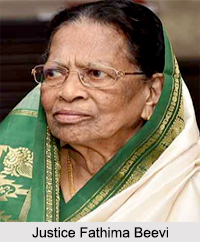
The Supreme Court has always maintained a wide regional representation in its composition. It is known to have a good number of judges belonging to different religious and ethnic minorities. The first woman to be appointed to the Supreme Court was Justice Fatima Beevi in 1987. She was later succeeded by Justice Sujata Manohar and Justice Ruma Pal. The first Dalit to become a judge was Justice K.G. Balakrishnan in 2000. He also became the Chief Justice of India in 2007. Justice B.P. Jeevan Reddy was so intellectual that he was appointed as the Chairman of the Law Commission of India even though he was not a Chief Justice of India.
Powers of Supreme Court of India
Under Articles 129 and 142 of the Constitution, the Supreme Court has been given the power to punish anyone for contempt of any law court in India, including itself. Powers of the Supreme Court of India relate to three forms of jurisdiction. They are original jurisdiction, appellate jurisdiction and advisory jurisdiction. These jurisdictions are described below.
•Original Jurisdiction: Supreme Court of India has exclusive original jurisdiction over any conflict between the Government of India and one or more states, or between the Government of India and any state or states on one side and one or more states on the other, or between two or more states. In addition, Article 32 of the Constitution grants an extensive original jurisdiction to the Supreme Court with regard to the enforcement of fundamental rights.
•Appellate Jurisdiction: Appellate Jurisdiction of the Supreme Court can be raised by a certificate granted by the High Court concerned, under Articles 132(1), 133(1) or 134 of the Constitution in respect of any discernment, enactment or final order of a High Court in both civil and criminal cases, involving substantial questions of law as to the interpretation of the Constitution. The Parliament has the power to enlarge the appeal jurisdiction of the Supreme Court and has exercised this power in case of criminal appeals by enacting the Supreme Court Act of 1970.
In criminal cases, an appeal lies to the Supreme Court if the High Court
1. has an appeal reversed an order of acquittal of an accused person and sentenced him to death or to imprisonment for life or for a period of not less than 10 years, or
2. has withdrawn for trial before itself, any case from any court subordinate to its authority and has in such trial convicted the accused and sentenced him to death or to imprisonment for life or for a period of not less than 10 years, or
3. has certified that the case is a fit one for appealing to the Supreme Court. The Parliament is authorized to confer on the Supreme Court any further powers to entertain and hear appeals from any discernment, final order or sentence in a criminal proceeding of a High Court.
Appeals also lie to the Supreme Court in civil matters, if the High Court certifies that the case involves essential question of law of general importance and that in the opinion of the High Court, the said question needs to be decided by the Supreme Court.
•Advisory Jurisdiction: The Supreme Court has special advisory jurisdiction in matters which may specifically be referred to the President of India under Article 143 of the Constitution.
Judicial Independence of Supreme Court of India
The Constitution ensures the independence of the judges of the Supreme Court in various ways. A judge of the Supreme Court cannot be removed from office, except by an order of the President passed after an address in each house of Parliament, supported by a majority of the total membership of the house and by a majority of not less than two-thirds of the members present and voting, and presented to the President in the same session for such removal on the ground of proved misconduct or incapacity. A person who has been a judge of the Supreme Court is prevented from practicing in any court of law or before any other authorization in India.