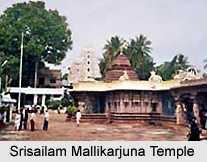
 Srisailam is located near Kurnool in the forests of the Nallamalai hills, on the Rishabhagiri hill of Kurnool district where a deity of Lord Shiva as Srisailam is placed. Here it is known as Mallikarjuna, which is one of the twelve Jyotirlingas.
Legend of Srisailam Mallikarjuna Temple refers to Srisailam is found in the Mahabharata in the Vanaparva which states that the Lord Siva abides with his consort Parvati on Srisailam. Brahma also stays here with other Gods. A bath in the sacred lake has the same value as the performance of an Asvamedha sacrifice. The pilgrim benefit and his entire race are freed from sins. The Lingapurana also refers to the Jyotirlinga here. The goddess here is known as Brahmaramba. The place is one of the eight main sthans of Lord Shiva and is a Shakti peetha of the Goddess.
Sri Adi Sankara stayed here and composed the beautiful verses in praise of Mallikarjuna Swamy in Sivanandalahari. The Sthalamahatmyam of the temple has an interesting story, of the origin of the temple. A princess Chandravati, the daughter of Chandragupta offered a garland of jasmine flowers to Srisailam and eventually married him. This legend is written on one of the stone records of the 16th century in this temple.
Among the bas-reliefs on the outer side of the courtyard, there are two panels, which illustrate this legend on stone. There is another legend concerning the origin of this temple. The tribal say the Chenchus lived in these hills. Once Lord Siva came to Srisailam on a hunt and fell in love with a beautiful Chenchu woman. He married her; she accompanied him in his hunting expeditions to the neighbouring forests. Hence he is also known as Chenchu Malliah. This story is corroborated by beautiful bas-relief, on the prakara of the temple - showing a tiger being killed by Lord Siva with his trident. He is followed by Parvati dressed as a forest woman with a quiver full of arrows and four dogs. Chenchus are allowed admission into any part of the temple even today. The garbha griha enshrines a linga. The tribal people drag the cart or rath during the festival of the temple and perform minor services within the temple.
During the great Mahashivratri festival, thousands bathe in the waters of the Pathalaganga and worship Lord Mallikarjuna, the Chenchus also perform worship from inside the garbha griha without the priests. Everyone is allowed to perform abhishek - they have to be just Hindus with the waters of Pathalaganga or offer flowers directly. The Buddhist pilgrims, Fahiyan and Hieun Tsang have made references to the Sriparvata hill.
Festivals: The main festivals period lasts from February to May, during this period; the temple comes under Pushpagiri Math of Cuddapah district, while otherwise the management is taken care of by the Jangam priest who is assisted by local Chenchus. The Chenchus take the leading part in the festivities both before and after Sivarathri. Goddess Bhramaramba`s festival comes a month or two after Sivarathri.
The temple stands in a little hollow on top of Srisailam hill overlooking river Krishna and is surrounded by forests. On the eastern side there is a causeway from Nagaluti down the hill, to the bed of the river, which is here known as Pathalaganga. The river is two miles from the temple, with a flight of stone steps leading to it. An inscription inside the temple records these steps were built by a Reddi king from the Kondaveedu Reddi dynasty.
The enclosure of the temple forms a rough square measuring 500 feet from east to west and 600 feet from north to south. On the north, south and east sides there are lofty gateways. The centre of the outer enclosure stands a stone enclosure with the main temple. The main temple of Lord Mallikarjuna stands in the centre of this inner courtyard and is surrounded by a number of minor shrines. The temple of Bhramaramba or the Amman temple as it is popularly known is in a separate enclosure to the west of the inner courtyard.
The main temple is a little structure of a single cell enshrining the Lord in the form of a linga with a small-pillared porch to the front. The main temple of Mallikarjuna is a stone-built structure, and up front is the exquisitely carved Mukhamantapa. It contains several beautifully sculptured stone pillars and ornamental stone eaves. The most valuable object in the temple is a beautifully carved bronze image of Lord Siva as Nataraja. Between the Mallikarjuna Temple and the eastern gateway two pillared halls, one contains the Nandi. On the northern side under the tree - Vata vriksha is another shrine dedicated to Mallikarjuna. Local legends say this contains the original linga where the black cow of the princess Chandravati gave its milk.
On the northern side of the pillared Mukhamantapa, is a small Siva temple containing a carved linga known as Sahasra Linga. This is famous for having twenty-five facets, each representing forty lingas thus making a total of 1000 lingas. The three-headed Naga is wrapped around the linga, which is mounted on a stone pedestal. Over the main shrine there used to be a stepped tower, the door frames, eaves of the pillared hall, and figure of bulls were all said to be engraved in copper gilt plates and covered in ornaments.
This temple is famous for its bas-relief work on the outer courtyard walls particularly the south and east walls. The scenes and figures are numerous and different. They act as a museum and a library of the past. All the forms of Siva can be seen here and the legends connected with them in great detail. Srisailam is also a principal seat of Veerashaiva sect. These people wore Shivalingas openly and would defend it with their lives. This was in open defiance of the Jains who persecuted them, and hence these lingas came to be called Pranalingas. The temple dates back to Mahabharata. Even the Puranas declare this the place where Vrishabha or the sacred bull of Siva performed penance to please him.