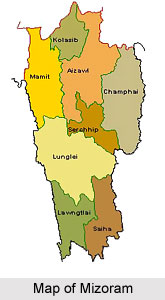
Mizoram is known as the `Land of Blue Mountains`. To the southernmost outpost of the North East India, is the land of the highlanders, Mizoram. A winding mountain road takes you into forests and bamboo-covered hills of Mizoram. Encircled by the Indian states of Manipur, Assam and Tripura and countries such as Myanmar and Bangladesh, this state has a diverse culture and tranquillity. Evergreen ranges of Mizoram hills with blooms of exotic flora and dense bamboo jungles rise sharply from the plains of Assam in a north south direction. These hills and plunging gorges are criss-crossed by gushing rivers and sparkling waterfalls. Mizoram is lagely mountainous and its capital is Aizawl.
History of Mizoram
The origin of the history of Mizos is mysterious. Their history is marked by a series of raids and expeditions. It is said that the Mizos came from Shinlung or Chhinlungsang, which is believed to be the Chinese city situated close on the Sino-Burmese border. They first settled in the Shan area and lived there for about 300 years and then moved to the Kabaw Valley around 8th century. The Mizos who earlier migrated to India were known by the name Kukis. The last of the Mizo tribes to migrate to India were the Lushais. The Mizo Hills were declared as part of British India in 1895. The areas including Lushai Hills were declared as backward tracts. It was during the British rule that there was a political awakening among the Mizo and as a result in 9th April 1946, the first political party, the Mizo Common People`s Union was shaped.
 Geography of Mizoram
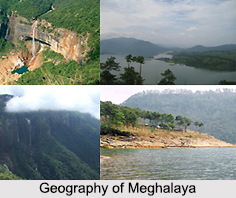
Mizoram is a gorgeous land of hills, rivers and lakes. 21 hills of different heights run through the length and breadth of the state. The highest peak, `Phawngpui` (Blue Mountain) towers 2,065 meters above the sea level. Mizoram is the most multicoloured topography among all hilly areas in the country. Mizoram contains some beautiful lakes like Tamdil Lake, Pala Lake and a few others. Pala Lake is considered the biggest lake present in the Saiha district in this state. It is spread over a total area of 74 acres. Regional residents are of the opinion that this lake originated as a consequence of a flood or an earthquake. The Rih Dil Lake is another lake in Mizoram which exudes natural beauty. As per a common belief, the souls of deceased people continue their journey of their afterlives through this very lake, prior to reaching heaven or `Pialral`.
Mizoram enjoys a tropical and sub-tropical climate. Principal crops grown in Mizoram are orange, banana and pineapple. The climate in the state is suitable for the cultivation of spices as ginger, turmeric, chilly, pepper, cinnamon, large cardamom and citronella. The state also grows cash crops like coffee, rubber and tea.
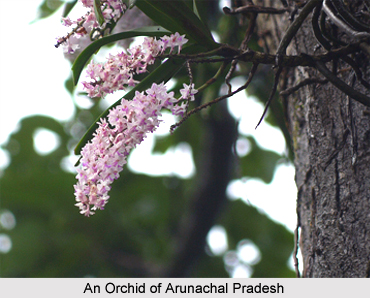
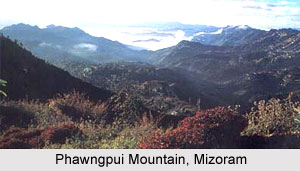 Mizoram lies on the northeastern corner of India. The green environment of Mizoram is the home for a rich variety of flora and fauna. The state has dense and thick bamboo forests. Mizoram is evergreen throughout the year. There are a variety of orchids here. There are fine flora and bright flowers, which attract tourist`s attraction. The highest peak known as the Blue Mountain is a garden of rhododendron of arboretum and veitchianum species.
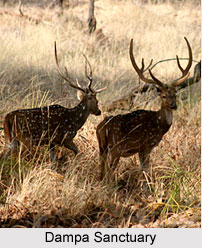
Deer, Royal Bengal Tiger, leopard, elephant and gibbon inhabit the forest area of Mizoram. Mizoram has a variety of wild life accumulated mostly in the Dampa Sanctuary, established in 1976 at the north-western tip of Mizo hills. There are also a wide range of insects, molluscs and crustaceans. There are about 1,000 species of insects, 12 species of butterflies and moths, 20 of beetles, 13 of molluscs and various types of snails. Seven species of owls, 10 of pheasants, 12 of hawks and eagles, 11 of bulbuls belonging to 13 families, nine of egrets and herons too exist here. The mammals consist of black and wild bear tiger, leopard, gibbon, Chinese pangolin, clawless otter, porcupine and mongoose.
 Demography of Mizoram
The majority of the people are ethnic Mizos. The Mizo tribes living in different parts of northeastern states of India live with unity. The Mizos are divided into many tribes. The largest among them are the Lushai, which comprises of two- thirds of the states population. Other Mizo tribes include Mara, Hmar, Pawi, Ralte.
Culture of Mizoram
Mizoram is close to the Indo-Bangladesh border and the Indo-Myanmar border. The closeness to the international borders has made Mizoram a blend of various tribes that migrated from China, Myanmar (the erstwhile Burma), and the other parts of the Northeast. The Mizo people belong to a Mongoloid race associated to the Shaans of Myammar (Burma). The Lushai, Hmars, Paithes, Raltes, Pang, Mara, Lakher, Kukis and Pawis of Mizoram are the tribes who were the believers of the Pathan. With the immigration of the British and the settling of the Christian missionaries in the region, most people converted to Christianity. Due to the influence of the British in this region, most of the population speaks in English besides Mizo. The nomadic Chakmas practices a mix of Hinduism, Buddhism and Animism. The Mizo code of ethics states that everybody should be hospitable, kind, unselfish and helpful to others. They believed in self-sacrifice. The Mizos had no class difference and no discrimination on the grounds of sex. Members in the village take part in occasions like birth of a child, marriage, and death. The traditional crafts of Mizoram are weaving, cane and bamboo work. The Mizo women weave traditional designs and patterns on their looms.
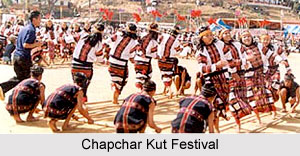
Mim Kut festival is celebrated during the months of August and September. It is celebrated by drinking rice-beer, singing, dancing, and feasting. Samples of the years harvest are consecrated to the departed souls of the community. Chapchar Kut festival is celebrated during March after the completion of the most hazardous task of Jhum cultivation. Another festival, known as Pawl Kut, is celebrated in December to commemorate the end of harvest season.
 Education in Mizoram
The state of Mizoram has been ranked as the state which possesses the second highest literacy rate, just after the Southern Indian state of Kerala. Before the missionaries established fundamental levels of education in the year 1894, Mizo communities lacked formal, written languages. In 1898, the first primary school was developed at Aizawl, Mizoram. This Indian state is equipped with several educational institutes and colleges which offer undergraduate courses in various disciplines. There are 29 colleges, which includes two institutes which are affiliated to Mizoram University. Other important institutes located here are Regional Institute of Paramedical Nursing Aizawl, College of Veterinary Science and Animal Husbandry, National Institute of Technology Mizoram and ICFAI University.
Administration in Mizoram
Mizoram shelters three councils for ethnic tribes, namely Autonomous District Councils (ADCs), Lai Autonomous District Council (LADC) for Lai communities in southern portions of this state, Chakma Autonomous District Council (which is present in the southern regions of the state that borders the country of Bangladesh), Mara Autonomous District Council (MADC) for Mara people who are based in the south-western corner of Mizoram.
Economy of Mizoram
Mizos are agriculturists and practice jhum-cultivation. All their activities revolve round this cultivation. The crops grown in the jhum are mixed. The principal crop is paddy, maize, cucumber, beans, arum, ginger, mustard, sesame, cotton etc. After clearing the burnt jhum, seeds for paddy are sown. Two types of paddy seeds are sown in the same field as early paddy and principal paddy. Tapioca, sugarcane, cotton, pulses and oilseeds are also cultivated. Pulses like cowpea, rice beans and oilseeds crops like sesame, mustard and soybean too are cultivated.
Tourism in Mizoram
The land of Mizoram is believed to the traveller`s paradise. The ministry of tourism has extended all its support towards the promotion and growth of tourist spots within the state. The Dampa Sanctuaries and Ngengpui Sanctuaries contain a rich population of elephants. The wild water buffalo, which is quite rare, is also found in these parts of the country. Numerous rhinoceroses are present in the Lushai Hills, while there are various species of birds which breed in Mizoram.