


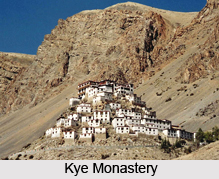
 Kye monastery is the oldest and biggest Tibetan Buddhist monastery of the Spiti valley and located at (4116 m) above Kye village. It houses beautiful scriptures and paintings of Buddha and other goddesses. Here Lamas practice dance, sing and play on pipes and horns. Many Lamas get religious training here. This monastery is an outstanding example of the monastic architecture, which developed during the 14th century in the wake of the Chinese influence. Kye monastery in Kaza is one of the most beautiful monasteries in the valley. The monastery completed 1000 years in 2000 AD. Kye monastery is the oldest and biggest Tibetan Buddhist monastery of the Spiti valley and located at (4116 m) above Kye village. It houses beautiful scriptures and paintings of Buddha and other goddesses. Here Lamas practice dance, sing and play on pipes and horns. Many Lamas get religious training here. This monastery is an outstanding example of the monastic architecture, which developed during the 14th century in the wake of the Chinese influence. Kye monastery in Kaza is one of the most beautiful monasteries in the valley. The monastery completed 1000 years in 2000 AD.
Location of Kye Monastery The monastery is located 12 kms north of Kaza and serves the western population of Spiti in the Lahaul and Spiti District of Himachal Pradesh. It is situated at an altitude of 4,166 metres (13,668 ft) above sea level. History of Kye Monastery The history of the monastery dates back to 1000 AD. It was founded by Dromton, a pupil of the famous teacher, Atisha. Thereafter, there have been several attacks on it. In the 17th century, the Mongols were the one who attacked the monastery. The 19th century saw three more effort to ruin the monastery. This continuous onslaught on the monastery resulted in frequent renovation and reconstruction work, which in turn has given rise to irregular box like structure. The structure of the monastery now gives an appearance of fort rather than a monastery. Architecture of Kye Monastery The design of monastery is not symmetrical one. Continuous attacks and rebuilding led to an uneven design pattern. The monastery looks like a fort, where temples are built on top of one another. Paintings and murals cover the walls of monastery. This monastery is an outstanding example of the monastic architecture, which developed during the 14th century in the wake of the Chinese influence. The monastery enshrines Buddha images and idols, in the position of Dhyana. The structure is so huge, that it looks more like a fort, than a monastery. The construction of this monastery does not look very orderly; rather it seems that in successive time, many temples have been added on top of the existing one. Kye houses beautiful scriptures and paintings of Budha and other Gods and goddesses. The monastery is also a centre for religious teachings to Lamas (the Tibetan Monks). One can find Lamas practice, dance, sing and play on pipes and horns. It has a collocation of ancient murals and books of high aesthetic value. This monastery is a perfect example of the monastic architecture. This 1000 years old monastery is another millennium year's old monastery, after Tabo monastery. Kye dates back to 1000 AD and a celebration of its millennium years were conducted in 2000. The celebrations witnessed 'His Holiness Dalai Lama', along with more than 15,000 Buddhist devotees from all parts of the globe. Buddhist regards 1000 years as Kalachakra or the 'Wheel of Time'. Kalchakra is a religious celebration performed by the Dalai Lama every year. It is considered the most revered and secret spiritual practice of Trans Himalayan Buddhism for the Moksha (salvation) of all mankind. Connectivity of Kye Monastery Kye monastery can be easily accessed by air, rail and road. The nearest airports are Kullu and Shimla that are well connected to other parts of India. The closest railway stations from Spiti lies at Shimla and Pathankot. Regular buses and taxis can also be availed. |
| |||



Kye Monastery
| Kye monastery in Kaza is one of the most beautiful monasteries in the valley, which completed 1000 years in 2000 AD. |
| ||||||||||||||||||||||||||||

