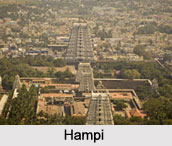
Hampi was the royal capital of Vijayanagara Empire. It is rightfully recognised as the domain of artistically carved temples with magnificent architectural monuments and creations. Situated on the banks of
Tungabhadra River, Hampi preserves the remnants of the Vijayanagara Empire. Adorned with the ancient heritage of South India, Hampi stands as the evidence of brilliant of
Lord Vishwakarma in earth.
Hampi is located in the central part of the state of
Karnataka , in southern India. It is 353 km from
Bangalore and 13 km from
Hospet. This location was the obvious choice for the capital of the empire, as it is naturally fortified and protected on all sides; in the north by the mighty Tungabhadra River and on the other three sides by steep, rocky mountains with massive boulders of granite. The treacherous terrain provided ample defence, and the few areas of access were well defended. The ruins of Hampi lie scattered in an approximately 26 square kilometre area, where the land was also fertile and had an abundant water supply.
The history of Hampi depicts that the Vijayanagara kingdom was ruled by three dynasties namely
Sangama dynasty (AD 1336-1485),
Saluva dynasty (AD 1485-1505) and
Tuluva dynasty (AD 1505-1570) up to AD 1565. The first king, Harihara I, (AD1336-1356), the eldest of the five sons of Sangama, built up within a few years a kingdom stretching from coast to coast. During the latter part of his reign, the Bahmani kingdom emerged beyond the
Krishna River and its establishment commenced an era of constant warfare between these two kingdoms. Harihara I was succeeded by his brother Bukka I (AD 1356-1377), whose great achievement was the conquest of the Tamil country. Harihara II (AD 1377-1404) was the first ruler of the dynasty to assume the imperial title of Maharajadhiraja. His reign witnessed the expansion of the Vijayanagara kingdom over the whole of southern India, south of the river Krishna. On the death of Harihara II, there was a dispute over the succession among his three sons, Virupaksha II, Bukka II and Devaraya I, but ultimately it was Devaraya I who secured the throne and then ruled from AD 1406 to 1422. His rule was followed by the short reigns of his sons, Ramachandra and Vira Vijaya. The latter was succeeded by his son Devaraya II (AD1424-46), the greatest of the Sangama line. The glorious reign of Devaraya II was followed by a period of decline and disorder during the period of Mallikarjuna (AD 1446-65) and Virupaksha II (AD 1465-85). The dismal rule of these last Sangamas facilitated the rise to power of Saluva Narasimha, who usurped the throne.
Hampi displays a variation from this layout of centralized temple with outlying ancillaries. Religious buildings are scattered about in small units, each with its own importance and function. Perhaps one of the reasons for this change was the terrain of the area, with the plan of the city following the lay of the land. The temple architecture throughout is based on the traditional Hindu style - each temple typically has a sanctum, a passage, an antechamber, and pillared hall and a kalyana mandapa (marriage hall).
Each dynasty that ruled the Vijayanagara Empire left its mark on Hampi. The Vijayanagara style of architecture relied heavily on the availability of natural resources, namely granite, which was the material used primarily by the
Sangama dynasty. Other dynasties employed the softer schist rock, suitable for ornate carvings. Many of the palaces have long since disappeared, as the kings used wood and bricks in their construction. Some brickwork is still visible on the gates to the temple courtyards.
The temples of Hampi are famous for their large dimensions, florid ornamentation, both in painting and carving, majestic pillars, magnificent pavilions and a great wealth of religious and mythological depictions, including subjects from the
Ramayana and the
Mahabharata. The stones of Hampi speak of the ancient civilization and these provide ample magnificent carvings that soothe the mind and eyes of the art-lovers and tourists including historians and archaeologists.

The stone carvings of Hampi record the stories of the vanished past. The rulers of Hampi were the patrons of art and culture and thus promoted the growth of architectural and sculptural side of Hampi during their reigning period. The Virupaksha temple along with intricately painted Kalyana mandapa, temples namely the Hazara Rama, the Vitthala, the Bala Krishna and a line of other monuments viz. Kamala Mahal, Mahanavani Dibba, Queens Bath, Lakshmi Narasimha statue and the Elephant stable. A number of round and relief stone images, stucco figures and terracotta objects stucco figures that were the bedecking objects of the palaces and temples of Hampi were unearthed recently. Apart from these, gold and copper coins, a square stepped tank and household utensils were excavated that stand for the then cultural scenario of Hampi.
Tourism in Hampi encompasses paying visit to the marvelous temples and monuments that are the evidences of creative and artistic excellence. The Hampi Bazaar a long street 32 metres wide and nearly 728 metres long, runs between
Virupaksha Temple and the foot of the Matanga Hill and was once lined with magnificent houses and beautiful mandapas. The Virupaksha Temple rises majestically at the western end of the Hampi Bazaar. Another renowned temple of Hampi is the Vitthala temple which is the most splendid of temples at Vijayanagara located near the
Tungabhadra River. It is considered to be the most ornate of the Vijayanagara temples.

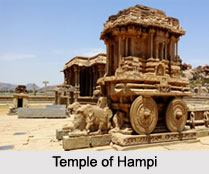
Moreover, inside the Vijayavittala Temple complex, the Stone Chariot attracts special attention because of the artistic magnificence it displays. This wonderful man-made piece of art has a Stone chariot which is situated to the east of the hall and has stone wheels which some believe actually rotate. The chariot is reckoned as a miniature temple. Though some believe it is carved out of a single rock, it is not the case. It resembles the temple chariots or rathas in which the idols of the temple are taken out on a traditional procession.

Achutaraya temple is one of the well known temples of Hampi. This temple can be reached either from Kodanda Rama Temple through the Bazaar wrongly called “Soolai Bazaar” or “Courtesan Street” or from the Virupaksha Bazaar by climbing the steps next to the monolithic
Nandi at the end of the bazaar. Achyutaraya Temple is a large complex built by an officer of the King Achyutaraya, Salakaraju Tirumaladeva. This temple is better known as Achyutaraya temple, in whose period it was built rather than the name of the deity “Tiruvengalanatha” or Lord Venkateshwara.
The Narasimha idols, another example of great artistry, are temples in themselves. The gigantic 8 - 9 metres tall Narasimha image is situated in the South of the Hemakuta group of temples that includes the Virupaksha Temple. The Narasimha is a seated four-armed figure under a canopy of a seven-hooded snake. Though in a damaged state, the image depicts the benign aspect of the God since apart of the right hand of
Goddess Lakshmi skirts around the waits of Narasimha suggesting that goddess Lakshmi was originally seated on his lap. The monolith is disfigured and was partly destroyed in an invasion of the
Golconda rulers but is magnificence is undisputed.
This image of Lakshmi-Narasimha, popularly called Ugra Narasimha, meaning Narasimha of terrifying countenance, is hewn out of a rock in-situ. According to an inscription found here, it was executed in 1528 A.D. during the rule of
Krishnadevaraya. Originally, the icon bore a smaller image of Lakshmi sitting on his lap. This gigantic image, 6.7 meters in height, was mutilated and the figure of Lakshmi was entirely damaged and vandalized in 1565 A.D. Narasimha with an articulately chiseled and well delineated mane and large bulging eyes and broad chest still retains His awesome charm. He is seated on the coils of the snake Adisesha, who rises behind him with seven hoods, which serve as a canopy. The entire image is set within a Makara torana, or arch, with a lion-mask above the hoods of Adisesha.
The statue of Lakshmi can now be found at
Museum at Kamalapur. The whole statue of Narasimha and Lakshmi was cut in a single boulder with delicate work of art. While other kingdoms further southwards used Schist, a soft stone as the medium of their constructions, the rulers of
Sangama dynasty decided to go in for granite as the building material for their temples. The hard granite was available on the site in plenty and was economic. Granite, being hard, was not suitable for the delicate filigree work that could be carved on Schist. What the artists had to sacrifice on the delicacy of the work was compensated by the massiveness of the sculptures. The statue of Ugra Narasimha is a perfect example of what they achieved in volume, which they could, not in delicacy.

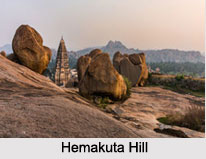
The Shivalinga is another instance of religious prevalence and is situated next to the Narashimha and is again, gigantic in size. It is 3metre high and stands permanently in water that comes through an ancient channel. On the slope of Hemakuta Hill, near the Sasivekalu Ganesha is another monolith called in the same vein, the Kadalekalu (gram seed)
Lord Ganesha. The huge seated God, carved in the round out of a massive boulder, is about 4.5 metres high and is housed in a large shrine with a fine open pillared mandapa in front. The tall, slender and graceful pillars are of the ornate cubical Vijayanagara type with solid early corbels. The mandapa is singularly classical in its architectural proportions and has been admired by many architects and critics. The temple also forms one of the important vintage points from which a good and picturesque view could be had of the Hampi monuments.
On the slope of Hemakuta Hill beyond the Krishna Temple, there are two huge stone images of Lord Ganesha. First one is the Sasivekalu Ganesha about 2.4 metres tall and ironically named as Sasivekalu or mustard seed. The God is seated in a large open mandapa with plain rough square pillars. The right hands hold the ankusa and broken tusk, while the upper left holds a looped pasa or noose. The lower left hand and the trunk are broken. The belly is tied with a snake. This Ganesha is fashioned out of a single boulder in sitting position. Apart from these temples and sculptural excellence, there are some other places of interest in Hampi namely the Archeological Museum located at Kamalapura, Ganigitti Temple, Domed Gateway that carries the repertoire of ancient tradition, a structure called the Kings Balance which is one more attractive points of Hampi, Bhimas Gateway which is one of the gateways and attracts attention due to the distinct style of carvings and constructions.
Hampi, where the stones speak the past, is the abode of religious propensity and the architectural and sculptural brilliance are the treasures of the domain where people discover the history of various dynasties and the socio cultural scenario of that time.