Introduction
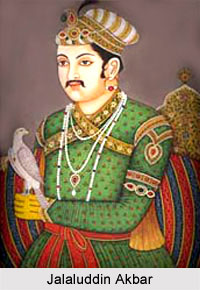
Fatehpur Sikri, a historic town in the Agra, Uttar
Pradesh, lies approximately 35.7 kilometers from Agra, the district
headquarters. Established as the capital of the Mughal Empire in 1571 by
Emperor Akbar, it remained the imperial seat until 1585, when Akbar abandoned
it due to a military campaign in Punjab. By 1610, the city was completely
deserted.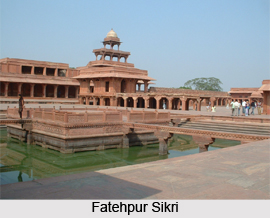
The town's name originates from the village of Sikri, which
previously occupied the site. Excavations conducted by the Archaeological
Survey of India (ASI) between 1999 and 2000 revealed evidence of earlier
settlements, including residential areas, temples, and commercial hubs
predating Akbar's rule. The region was initially settled by the Sungas during their
expansion and later controlled by the Sakarwar Rajputs from the 7th to the 16th
century CE until the Battle
of Khanwa.
History of Fatehpur Sikri
The royal planned city in Fatehpur Sikri had served as the
political capital of India`s Mughal Empire during Emperor Akbar`s reign. The
city is known to have been built on the Sikri ridge, in honour of Saint Shaikh
Salim Chisti. A famous legend states that Akbar had to live without an heir for
a long time and hence he had assayed a pilgrimage to the Sufi saint, Shaikh
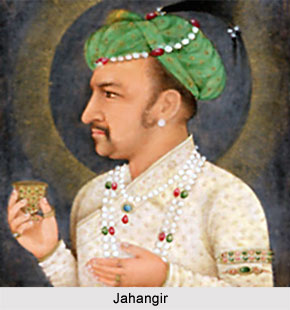
Salim Chisti, to seek his blessings. Later, when a son, Emperor Jahangir was
born to him, Akbar had erected the new capital to mark his birth. It is here,
that the legends of Akbar and his clever courtier Birbal is also
strongly believed to have arisen. The fort or the town was later named as
“Fatehpur” and the “Sikri” is named after the Sikri ridge of Saint Shaikh Salim
Chisti. Together, the region is known as Fatehpur Sikri, although it has two divisions,
one for Mughal
administration and the other dedicated to spirituality.
Due to Fatehpur Sikri`s sheer colossal and massive
architectural planning, the place, besides containing such stellar and
significant households, also remains the most talked-about and researched, among
all other forts in India. The fort’s
every nook and corner, the umpteen chambers, the various vaults, the forever
locked rooms or the forsaken wonders, the sturdily built bastioned walls, are
all known to heave heavy sighs of unobtainable elements at night.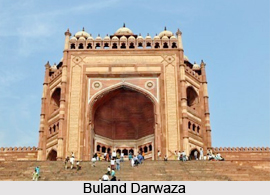
From 1571 until 1585, the city of Sikri was much full of
well-planned administrative, residential and religious buildings. Akbar
abandoned Fatehpur Sikri in 1585 when he left for a military campaign in Punjab, and by 1610, the city
was completely deserted. The commonly cited reason for its abandonment is water
scarcity, though Akbar’s waning interest may have also played a role, as the
city was built entirely at his discretion. After leaving, he returned only once
in 1601.
During the bubonic plague outbreak from 1616 to 1624,
Emperor Jahangir stayed in Fatehpur Sikri for three months in 1619. Later, Muhammad Shah, the thirteenth
Mughal emperor,
resided there for a time and initiated restoration efforts. However, as the
Mughal Empire declined, the condition of the city's buildings deteriorated
further. After capturing Agra in 1803, the East India
Company set up an administrative center in Fatehpur Sikri, which remained
operational until 1850. In 1815, the Marquess of Hastings directed the
restoration of monuments in Sikri.
The buildings in Fatehpur Sikri have brilliantly blended
both Islamic and Hindu elements in their architectural style. Now marked as a UNESCO World
Heritage site, some architects have also cited it as a sublime and
uplifting source of inspiration. However, in present times, this ghost city
owns a population of approximately 30,000. This deserted city has had retained
many of its olden structures, because of the efforts of the competent
Archaeological Survey of India. One of the buildings even reflects the then new
syncretical faith founded by Akbar, Din-i-ilahi, which though short-lived,
remains a matter of controversy. 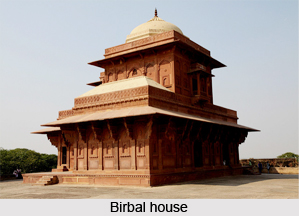
The finest monuments within this area comprise - the Diwan-i-Am, Diwan-i-Khas, Panch Mahal,
Buland Darwaza (a stupendous piece of architecture, noted for serving as the
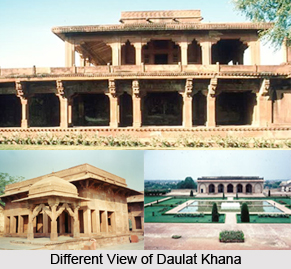
biggest entryway in the world), Turkish Sultana`s House, The Treasury, Daulat
khana-i-Khas, Jodha Bai`s Palace, Palace of the Christian
Wife, Birbal house, Sunehra Makan, Karawan Serai and Hiran
Minar and the tomb of Saint Sheikh Salim Chishti, of course, not forgetting
the Jama
Masjid (one of the biggest mosques In India). Fatehpur Sikri had
served as Mughal Dynasty`s capital from 1571 until 1585, when
it was abandoned for reasons which remain indistinguishable to this day.
Architecture of Fatehpur Sikri
Fatehpur Sikri Fort reflects Akbar`s design and architectural philosophy. This ‘Akbari’ style of architecture consisted of a synthesis of earlier styles, Timurid, Persian and Indian. The lavish use of red sandstone sought to minimize the stylistic clashes consequent to the mixing of these disparate elements.
The layout of the Fatehpur Sikri city owns a conscious
attempt to produce rich spatial effects by the organisation of built forms
around open spaces in fascinating and appealing ways. Of particular note is the
way in which shifts in axes occur, as one moves along the city and the location
of squares in important places with buildings forming a backdrop or envelope.
Unlike other significant Mughal cities, Fatehpur Sikri possesses various
aspects of informality and improvisation. Indeed, the newly constructed city
bore a similarity to the movable 'imperial encampment', also designed by Akbar.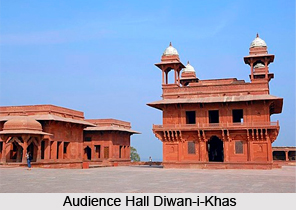
The buildings of Fatehpur Sikri demonstrate itself to possess a synthesis of several regional schools of architectural craftsmanship such as Gujarati and Bengali, due to the presence of indigenous craftsman from various regions. These once-gifted men owing allegiance to the Mughal Empire were used for the construction of the buildings. Influences from Hindu and Jain architecture are seen hand in hand with Islamic elements in the Fatehpur Sikri monuments within. The building material predominantly utilized to give Fatehpur life, was red sandstone, quarried from the same rocky outcrop on which it is situated. The construction of the buildings had commenced, with its elaborate palaces, formal courtyards, reflecting pools, harems, tombs and a massive mosque. However, shortly after the work was completed fifteen years later, it was realized that there was a lack of adequate water supply and the immaculate complex was hence abandoned.
Indeed, with its magnanimity in structural merit and
gigantic endeavours to give Fatehpur the edifices it houses, sculpture of
Fatehpur Sikri does demand so much of attention and meticulous acclamation for
the remaining years to come. Situated on the highest place on the ridge, the
khanqah in Fatehpur Sikri is the site`s focal point. Within this religious
compound, 111 by 139 metres, is housed the enormous and legendary Jama Masjid,
its cloistered enclosure walls, three entrance gates and of course, the tomb of
Shaikh Salim Chishti. Beneath the courtyard are underground reservoirs, an
important consideration for a site which suffers from a poor water supply.
Buland Darwaza at Fatehpur Sikri
The Buland Darwaza,
the complex`s towering, overpowering and colossal south entrance gate of
Fatehpur Sikri, is visible from a considerable distance. This enormous gate was
almost certainly constructed concurrently with the Jami mosque complex. While
commonly conceived that it was not erected until the early 17th century, Buland
Darwaza was certainly designed before 1587, when the calligrapher Ahmad
al-Chishti, responsible for its monumental Quranic inscriptions, had expired.
The entryway is acknowledged to have been built to commemorate Akbar`s
victorious Gujarat campaign in 1573, when Sikri came to be recognized as
Fatehpur Sikri - the City of Victory. This monumental gate, however, was
probably less intended to commemorate a military victory than to underscore
Akbar`s connections with the Chishti order. Its surface is covered by marble
slabs inscribed with Quranic verses promising paradise to true believers,
appropriate for the entrance into a khanqah, a complex designated for
meditation and devotion.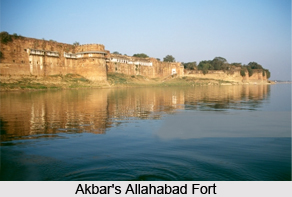
Jama Masjid at Fatehpur Sikri
The Jama Masjid, amidst the barren mammoth surroundings of Fatehpur Sikri, is situated on the west side of the complex, so that it can face Mecca as commanded in Islam. An inscription on the mosque`s east facade states that it was constructed in 1571-72, by Shaikh Salim himself, while interior inscriptions are dated 1574, indicating its completion. Textual references also corroborate that Jama Masjid was finished about this time. Measuring 89 by 20 meters, the mosque was at that time the largest in the Mughal Empire.
Akbar’s Palace at Fatehpur Sikri
Akbar`s palace complex in Fatehpur Sikri lies to the southeast direction of the mosque. This complex was clearly planned, for the palace buildings are axially and geometrically related to the khanqah. Abul-Fazl described Akbar`s architects and designers as "lofty-minded mathematicians"; even the emperor, one chronicler stated, owned a "geometry decoding mind," and his architecture was described by the court biographer as understandable to "the minds of the mathematical." Geometry in the emperor`s own palace, serves as a metaphor for Akbar`s control and power.
Hathiya Pol at Fatehpur Sikri
The Hathiya Pol, or Elephant gate, situated at the southern end of the palace complex, probably had served as the exclusive royal entrance. A number of other monumental architectures housed within Fatehpur Sikri complex, can indeed be viewed, reasons enough for Hathiya Pol functioning as the imperial entrance. At the foot of the rampart leading to the Hathiya Pol, is a minaret spiked with stone projections resembling elephant tusks, admired and well-liked as the Hiran Minar and considered a hunting tower.
Diwan-i-Am at Fatehpur Sikri
To the west of the Elephant Gate is a huge quadrangular courtyard, acknowledged as the Public Audience Hall, the Diwan-i-Am, one of the most celebrated destinations in Fatehpur Sikri. It is one of the few areas within the palace whose function is known for certain. The road leading from the city walls to this audience hall was lined with shops and markets once, that was commenced in 1576-77. The Diwan-i-Am is a focal point of the palace, a secular one complementing the mosque complex. The rest of the palace lay between the mosque and audience hall, pivotal points which reflect Akbar`s concerns with religion and the welfare of the state.
Anup Talao at Fatehpur Sikri
Only a few structures in this area can be identified with much certainty in contemporary times. One of these is the Anup Talao, a square pool in whose centre was a pavilion. Its base still remains connected to each of the pool`s four edges by stone planks. Here, Akbar used to engage in serious discussion regarding Islamic law with leading Muslim theologians, as several contemporary writers delineate. They also note that the Mughal emperor had filled this Anup Talao with gold coins and distributed them to shaikhs and amirs. It is also the same place where the famous court musician Tansen use to perform. It is believed that he ignited fire on the water of Anup Talao or the tank simply by performing Deepak raag and then doused with raindrops by praying to the Rain God with Megh raag.
Sultana’s Mahal in Fatehpur Sikri
Surrounding the tank can be witnessed trabeated structures, most of them a single story high. One, acknowledged as the Turkish Sultana`s House, is completely covered with carvings of geometric patterns, trees, flowering vines, birds and animals. Although some of this ornamentation draws upon earlier Indian imagery, the decor of this palace, more than that of any other residential or civic structure here, is based on Timurid tradition. The richly carved ornamentation, situated at floor level, indicates that inhabitants were intended to sit on silk and cotton cushions in the Turkish Sultana`s House and not stands as in a public audience hall. The ceiling and walls, too, were often covered with luxurious fabrics. Thus, it can be always be recalled that these buildings in the splendorous and exhilarating environs of Fatehpur Sikri, was not simply red sandstone, but decked, as contemporary accounts reminds, with rich textile trappings.
Khwabgah in Fatehpur Sikri
On the south edge of the Anup Talao is a multi-storied building, traditionally known as the Khwabgah, or Akbar`s sleeping chamber. Its plain architectural members bear traces of figural painting and calligraphy, suggesting that structures not carved were indeed polychromed. The painted verses make direct reference to Akbar, calling him "the adorner of the realm of Hindustan," and so suggesting that this palace was intended exclusively for imperial usage. Further underscoring this Fatehpur Sikri marvel, is the plan of the top story, consisting of a central rectangular pavilion with a flat interior roof surrounded by a pillared veranda, a type identified at Akbar`s Allahabad Fort as one intended for imperial use.
On the southernmost side of a courtyard aligned with the Khwabgah and immediately to its south is the so-called Daftar Khana, or records office. The Daftar Khana of Fatehpur Sikri complex consists of a small room with a large open window that overlooks the terrain below. This was Akbar`s jharoka, the window at which daily he had displayed himself to his subjects. Although this ritual was derived from a custom of Hindu kings, the Mughals earlier had adopted it. For instance, after Humayun’s death, a man resembling the deceased ruler was displayed at a similar window in the Delhi citadel, until the young prince Akbar could be crowned. Such regular appearances had reassured the population that all was well in the state.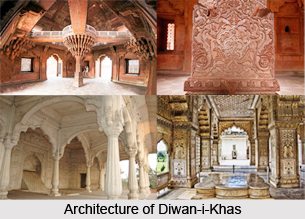
Diwan-i-Khas in Fatehpur Sikri
Of all the buildings that are still standing strong in
Fatehpur Sikri, a small square building universally acknowledged as the
Diwan-i-Khas, has been the subject of greatest guesswork and admiration since
the times of Mughal India. Its location, situated just behind the Public
Audience Hall (Diwan-i-Am) and aligned with the jharoka, indicates that this
indeed had served as Akbar`s Private Audience Hall.
Panch Mahal in Fatehpur Sikri
Towards the west of Diwan-i-Khas can be witnessed a great many exquisite palaces, all of whom were dedicated to the princes and women of Akbar`s household. The tallest of these is the legendary Panch Mahal, a beauty five-storeyed building to behold in Fatehpur Sikri. The name derives from its five tiers, the final one consisting of a huge single chattri. It is beloved that this was a pleasure pavilion where people were stimulated by its elevation and design. It was the place where people use to go for experiencing cooling breeze in the evening. Because this tall building provided a classic view of the areas reserved for the emperor and the royal household, only the most trusted had access to the Panch Mahal. Pierced stone screens faced the facade and probably sub-divided the interior as well, suggesting that it was used by the women of the imperial harem.
Jodha Bai`s Palace in Fatehpur Sikri
The largest among these small palace complexes is however today referred to as Jodha Bai’s Palace, emperor Akbar`s much-admired and free-spirited wife. This may have been the first palace constructed in Fatehpur Sikri since it leads most directly, via a passage that once was covered, to the Hathiya Pol.
Birbal’s Palace in Fatehpur Sikri
The so-called House of Raja Birbal, one of Akbar`s principal courtiers, is inscribed with a date corresponding to 1572. A phrase following this date, "royal mansion of initiation," suggests that its purpose was not residential, but ceremonial or even administrative. It accentuates even the fact that how little one is aware about the function of Fatehpur Sikri`s buildings.
Hawa Mahal in Fatehpur Sikri
To the right of Jodha Bai`s palace is the Hawa Mahal, the Palace of Winds. This small-screened wind tower faces the garden and is attached to the palace. The walls of this palace are made entirely of stone latticework. The garden is laid out in the Char Bagh style, with straight walls intersecting at right angles and divided by shallow channels. To the north west of the Jodha Bai’s Palace is the 2-storied palace occupied by Akbar`s two senior queens - Ruqnayya Begum and Salima Sultan Begum. It has two storeyed-four rooms and two porches with pyramid roofs below and two rooms with cupolas and screened terraces above. Hawa Mahal of Fatehpur Sikri combines Hindu and Muslim styles of architecture.