Ustad Vilayat Khan, Indian classical instrumentalist - Informative & researched article on Ustad Vilayat Khan, Indian classical instrumentalist
  Indianetzone: Largest Free Encyclopedia of India with thousand of articles Indian Music


in  
Art & Culture | Entertainment | Health | Reference | Sports | Society | Travel
Forum  | RSS Feeds  | Free E-magazine
Indian Music : Indian Music l Traditional Indian Music l History of Indian Music l Indian Musicians l Gharanas Of Hindustani Vocal Music l Bollywood Music l Pop music l Western Music in India l Indian Classical Instrumentalists l Indian Music Bands l Indian Classical Vocalists l Indian Musical Instruments l Raaga
Home > Movies & Entertainment > Indian Music > Indian Classical Instrumentalists > Ustad Vilayat Khan
Ustad Vilayat Khan, Indian classical instrumentalist
This man is a genius in sitar, with the improvisations he has made, followed even today.

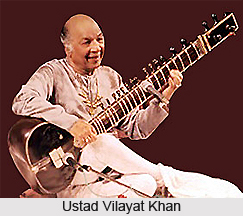
Ustad Vilayat Khan needs not much introduction to describe him and his flamboyant intellect, because whatever is said falls short to his stateliness. Facing tremendous initial hindrances to further his fancy for sitar, he was doggedly determined to make it the elite class. His historical journey began from an early age of 11, and since then there was no looking back. His epoch-making improvisation with the sitar is unforgettable - the manner in which he deviated from the traditional thinking and made the instrument much more user friendly, is envious to todays sitarists. His style was that of a khayal singer, more rhythmical, more emotional, and thus rousing a feel of charm. He always laid stress on essence and the lyrical sentiment of the recital, and not the strict form. His widely recorded versions of raagas like, Yaman, Darbari, Piloo, Poorya or Shankara are haunting to the ear, making it as if perceivable by the eyes like crystal.

Ustad Vilayat Khan, Indian classical instrumentalistFollowing the death of his father, Ustad Inayat khan (1895-1936), Vilayat Khan found that he was not only deprived of a parent, but also a preceptor who had trained him for approximately six years. He turned to a senior disciple of his father`s for further training. His mother initially taught him the basics of the sitar for a while. Later, he learned under his uncle Bande Hussain Khan and D.T. Joshi. In any event, his training in vocal music under his uncles in Punjab helped him greatly in moulding his mind in the vocal idiom.

Soon, the 11-year-old Vilayat left Calcutta and reached Delhi AIR with only a sitar in hand, determined to prove his grit, being the son of such an erudite. He was successfully able to showcase his talent to the Director General of AIR Delhi, and was finally offered a jib as a staff artist. While working as an artist, Vilayat also trained under his uncles in vocal music and of course the sitar. Side by side, he was also a regular attendant of concerts and was an avid listener of recordings. The music of Ustad Faiyaz Khan, Zohrabai Agrewali, Kesarbai Kerkar, Pt.

Omkarnath Thakur and, most importantly, that of Ustad Amir Khan, became the other part of his life. One stupendous aspect of his genius was his ability to ingest and reproduce any vocal style he had listened to. He could not only sing whatever he had ingested, but also replicate it with equal ease on the sitar. In 1944, the gifted Vilayat, aged only 17, was invited to participate in a music festival in Bombay. The story goes that he was asked to repeat his chosen item five times. And, from that point of time, Vilayat strode from the ordinary path of life and soared into the stratum of adulation, fame and immense wealth.

While continuing the tradition of his grandfather and his father, it was Vilayat who placed his gharana on the fundamentals of fame on which it rests assuredly. This he achieved by bringing his style of playing closer to the human voice. Credit goes to him for having introduced the gayaki-ang into the sitar. In fact, it was he who pioneered this move several decades back, at least in the field of stringed instruments that are plucked. Even his grandfather and father followed the instrumental idiom, or the tantkari style of playing. Until he came along, only the instruments played using the bow like the sarangi and the violin were known to be capable of replicating the refinements of the human voice. But Vilayat Khan went ahead, and re-engineered, redesigned and returned the sitar completely, in order that it may become the apt instrument capable of reproducing every vocal shade he wished it to. The story of how the Vilayatkhani style emerged is inextricably entwined with the history of the changes his instrument endlessly underwent over the decades until it became supple and submissive to the powerful will of this masterful musician.

The changes he fashioned on the sitar are nothing short of radical. He completely did away with the steel kharaj strings, used for rendering the lower octave, with brass strings which produce a higher pitch. These he turned to the key notes of the raaga. The chief melody string had a higher pitch than the one used by those following Senia or Maihar styles. The outcome was that the melody strings would give off an attractive treble flexible enough to take the subtleties of vocal music like glides, trills and gamaks. The base, frets and the bridge were all remodified accordingly. In the refashioned sitar, glides, trills could be kept up in the unbroken manner of the human voice. In earlier times, the instrument could not replicate these ornaments given that the sound disintegrated rapidly no sooner than it was produced.

The mandra saptak could not be attempted at all in this sitar as those strings were removed to make way for treble strings. The deep veena-like effects are wholly absent in this baaj. But what was lost in terms of range, Vilayat gained in terms of tunefulness. The chikari or the drone strings became tonally more prominent, as they began to function like a tanpura, providing a sense of continuity. In other words, while the Maihar and Senia instrumentalists capture the grandeur of dhrupad gayaki in all the octaves, the Vilayatkhani baaj devotedly echoes the fascinating tonalities of khayal and thumri. The gayaki-ang he fashioned, replicates the aesthetic and emotional profusion of vocal music.
Thus was born the `singing sitar`, the marvel of 20th century instrumental music, as also the singing sitarist who transposed his overwhelming desire to become a singer onto his Ariel-like instrument which did all that the Magus bid him to do. It thus, comes as no surprise that Vilayat Khan`s music displays the emotional expansiveness, typical of khayal, even as it brims with the swing and lyrical charm, typical of semi-classical and other lighter forms of music. His alaaps do not follow the segmented approach characteristic of the tantkari school; instead, it takes the raaga through a series of narrative sequences, typical of a minstrel or a balladeer. Sentiment, and not structure, essence, and not form, are dominant in his music. He produces thrill, suspense, sentiment, sorrow and elation through an intimate rapport with the notes. Vilayat Khan`s approach to the raaga is not that of an explorer or a quester, searching for the unknowable and the monumental in the sphere of the poignant and the spiritual. Vilayat, is above all other things, a passionate wooer and lover of raagas. His object is to delight the ear and deluge the mind with sensitive and colourful emotions. When one listens to Vilayat Khan render lighter raagas like Piloo, Gara or Maand, one is in the presence of an enraptured lyricist, exuding overpowering charm.

Vilayat Khan is possibly one of the most widely recorded sitarists in India. The EMI releases that have come out in recent times, give one a sound idea of his extensive raag-daari. Six decades of intense concerting and recording have given his audience a rich legacy. Of these, his Yaman is by far his greatest and most influential of recordings. It is the matchless marvel of recorde music, one that he himself did not equal in terms of the standards he set here. In the vilambit section, Vilayat Khan weaves such rich textures of strings, that Gods might fall to envy. The madhya laya composition with its leisurely pace and liquid elegance is ecstasy personified. Similarly, many think Vilayat`s Darbari to be the most definitive interpretation of this grand midnight raaga. The old-world charm it exudes, takes one back to the leisurely world of grandly-lit, richly-coloured, spacious princely darbars of the pre-Independence era. His alaap does not aspire to depth and repose, but to achieving lyrical charm, while his swiftly pacing gat brims with sweetness. His Poorya, Alaihya Bilawal, Shankara and Saazgiri, offer excellent instances of the gayaki-ang. The mature control he achieved over his instrument is seen in the EMI recording he made in the very late 1980s. Of these, his Bhairavi is a revelation. Similarly, his stunning live recording of Pilu, played a few years before his death, will remain as one of the most exhaustive interpretations of this raaga. What he does in the three gats has to be heard to be believed. In the jhala, such is the speed and dexterity that one can see his taans flash like crystal swords. Being an extroverted romantic by temperament, he allows the free play of his lyrical imagination to ride over an inward-looking approach. As part of his repertoire comes a thumri or a dhun, which he sings prior to playing it on the sitar. His singing charmed a good part of his audience, for he apparently possessed a tuneful voice.

Vilayat Khan was supposedly an Ustad with a traditional bent of mind, who passed on his trade secrets only to close family members and unfalteringly loyal students. He expected even his loyal students to pick up what they could from him, because his his level of expectation was indeed exceedingly high. Yet, in spite of his exasperating eccentrities, Vilayat Khan has trained some of the finest sitarists in the country, like his son Shujaat Khan, by his first marriage, Hidayat Khan, his son by his second marriage, his nephews Nishat and Irshad Khan, Arvind Parikh and Kalyani Roy. Shahid Pervez, though trained by his father, has absorbed mosta spects of Vilayat Khan`s baaj into his style. Buddhaditya Mukherjee, one of the renowned sitarists in the country, closely follows Vilayat Khan`s style.

(Last Updated on : 7/01/2009)
  More on Indian Classical Instrumentalists...
 
Ustad Zakhir Hussain Kanchipuram Nayana Pillai Ustad Zia Mohiuddin Dagar
Ustad Asad Ali Khan Ustad Imrat Khan Pt. Nikhil Banerjee
Ustad Vilayat Khan Ustad Allauddin Khan Ustad Ali Akbar Khan
Ustad Amjad Ali Khan Ustad Bundu Khan Pt. Ram Narayan
Pt. Pannalal Ghosh Ustad Bismillah Khan Pt. Shiv Kumar Sharma
Pt. Ravi Shankar    
Recently Updated Articles in Indian Music
  • Indian Classical Music
    Indian Classical music originated in the Vedas and later branched into two streams of Carnatic and Hindustani music.
  •  
  • Music in Medieval India
    Music in medieval India has great impact in the history of Indian music.
  •  
  • Music In Modern India
    Music in Modern India has developed in almost all aspects and a new genre has been introduced.
  •  
  • Indian Music Bands
    Indian Music Bands have created an upheaval of modernised music and concerts among the young generations of the nation.
  •  
E-mail this Article | Post a Comment
Free E-magazine
Subscribe to Free
E-Magazine on Indian Music

 
Ustad Vilayat Khan, Indian classical instrumentalist - Informative & researched article on Ustad Vilayat Khan, Indian classical instrumentalist
Sitemap
Contact Us   |   RSS Feeds
Copyright © 2008 Jupiter Infomedia Pvt. Ltd. All rights reserved including the right to reproduce the contents in whole or in part in any form or medium without the express written permission of Jupiter Infomedia Pvt. Ltd.