





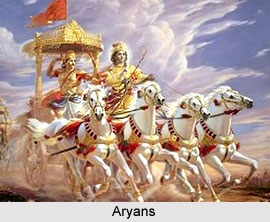
 The classical civilization of India developed from the earlier Vedic civilization, and the Vedic civilization was the creation of the Aryans. They were invaders, whose first arrival in India, probably dates back to about 1500 B.C. Perhaps some 200 years after this estimated date there began to come into being a collection of religious hymns which were eventually organized as the Rig Veda, the final redaction of which probably antedates 1000 B.C. The Vedic Aryans ushered many of the gods, the Vedic hymns, some of the most important per¬sonal rituals of Hinduism, the patriarchal and patrilineal family system, and the horse. The term Aryan originates from the Indo Iranian term Arya mentioned in the ancient texts of Hinduism, the Rig Veda and the Gathas of Zoroaster in Zoroastrianism. The ‘Aryan race’ is a concept in European culture that was influential in the period of the late nineteenth and early twentieth century. The classical civilization of India developed from the earlier Vedic civilization, and the Vedic civilization was the creation of the Aryans. They were invaders, whose first arrival in India, probably dates back to about 1500 B.C. Perhaps some 200 years after this estimated date there began to come into being a collection of religious hymns which were eventually organized as the Rig Veda, the final redaction of which probably antedates 1000 B.C. The Vedic Aryans ushered many of the gods, the Vedic hymns, some of the most important per¬sonal rituals of Hinduism, the patriarchal and patrilineal family system, and the horse. The term Aryan originates from the Indo Iranian term Arya mentioned in the ancient texts of Hinduism, the Rig Veda and the Gathas of Zoroaster in Zoroastrianism. The ‘Aryan race’ is a concept in European culture that was influential in the period of the late nineteenth and early twentieth century.
The knowledge of the early Aryans in India is derived from the Rig Veda. Moreover, a series of related tribes, settled mainly in the Punjab and adjacent regions, speaking a common language, sharing a common religion, and de¬signating themselves by the name ‘arya’, are represented as being in a state of permanent conflict with a hostile group of peoples known variously as Dasa or Dasyu. From the frequent references to these conflicts it emerges that their result was the complete victory of the Aryans. During the period represented by the later Samhitas and the Brahmaria texts the Aryans are seen to have ex¬tended their territory, principally in the direction of the east, down the Ganga valley. Other terms, e.g. ‘mleccha’ and ‘nisdda’ are used as designations of non-Aryan tribes. On the other hand, the word ‘dasa’ becomes the usual word for ‘slave’. However, the term ‘arya’ is opposed not only to the external barbarian, but also to the lowest of the four castes, the sudra. In the latter context the word ‘arya’ naturally ac¬quires the meaning noble, honourable, and the word continues in use in both senses down to the classical period. North India is referred to as Aryavarta, ‘the country where the Aryans live’, or, in Pali, as ‘ariyam dyatanant’. The Jain texts have frequent references to the distinction between Arya and Mleccha. In Tamil literature the kings of North India are referred to as the Aryan kings. The Aryans reached north-western India and occupied the region through a migration, or rather, a succession of migrations, from outside the Indian subcontinent. The final stage of this migration cannot have been very far removed from the be¬ginning of the composition of the Rig Veda. The Aryan races can be divided into two great divisions, the Northern or European Aryans, and the Southern or Asiatic Aryans. The Southern or Asiatic Aryans may be further divided into three principal branches: Armenians, Iranian ethnic groups, and Indians. There is little archaeological evidence of the Aryans in the first phase of their migration in India. The ancestors of the Indian Aryans had remained for a long time on the borders of the subcontinent, which is now Afghanistan and Soviet Central Asia. Some time after the Aryan’s migration into India, another branch, the ancestors of the Medes and the Persians, left their homeland for what is now Iran and gave their name to that land (the name Iran comes from Airyanam vaejo, “Realm of the Aryans”). Other set of Aryans made their presence felt elsewhere in the Middle East. No written document or not even any archeological evidence has been found regarding the Aryan invasion of India, but it is nevertheless firmly established as a historical fact on the basis of comparative philology. 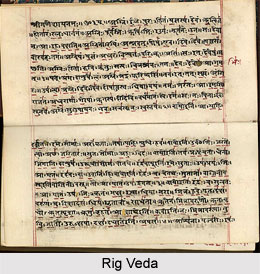 The Indo-European languages, of which Sanskrit in its Vedic form is one of the oldest members, originated in Europe. The only possible way by which a language belong¬ing to this family could be carried all the way to India was a migration of the people speaking it. Apart from its belonging to the Indo-European family in general, Sanskrit, or Old Indo-Aryan, is more closely and specifically related to the Iranian group of languages, of which the oldest representatives are Old Persian and Avestan. The relationship is in fact so close that these two peoples, who both designated themselves as Aryans, must, at some earlier time, have constituted a single nation or people, speaking, with due allowance for dialectal diver¬gence, the same language. This earlier Aryan language, commonly referred to as Primitive Indo-Iranian, is the source from which the later Iranian and Indo-Aryan languages are derived. In the period preceding the Aryan invasion of India, they were settled probably in the Central Asian regions border¬ing the Oxus and the Jaxartes, and the Aral and Caspian seas. From this base, sections of them may be presumed to have pushed up into the highlands of Afghanistan, and then to have descended from this base into the plains of the Punjab.
The common culture and religion developed by the Aryans in their earlier home is still reflected in the earliest texts of the Iranians and Indo-Aryans respectively. The second millennium B.C. was conditionally stated as the period when the Aryans were reckoned as a separate community. The historical evidences state that the Indus civilization was in cer¬tain respects superior to that of the Aryans. In particular it was a city civiliza¬tion of a highly developed type, while by contrast city life was unfamiliar to the Aryans. The superiority of the Aryans lay in the military field, in which their use of the light horse-chariot played a prominent part. The Aryans built their settlements of wood and they were distributed in small units, villages rather than towns, during most of the Vedic period. Since their houses and furniture were made mainly of wood and other perishable materials. The territory occupied by the Aryans at the time of the Rig Veda can be de¬fined with reference to the rivers of India. They are, in the first place the Indus (Sindhu) and its main tributaries, the five rivers of the Panjab. To the west of this there is mention of the Krumu, Gomati, and Kubha (the Kurram, Gomal, and Kabul rivers) and of Suvastu (Swat), show¬ing that the Aryans extended to within the boundaries of present Afghanistan. To the east the Saraswati, Drsadvati, and Yamuna River are in Aryan territory and the Ganga River is mentioned in one late hymn. Most of this territory had lain with¬in the sphere of the Indus civilization. The Aryans were divided into a large number of independent tribes, norm¬ally ruled by kings, who, when not fighting the Dasas or Dasyus, were fre¬quently engaged in fighting each other. Nevertheless, the Aryans were highly conscious of their ethnic unity, based on a common language, a common re¬ligion, and a common way of life, and of the contrast between themselves and earlier inhabitants. The latter were partly absorbed into the Aryan com¬munity in the capacity of sudras, and partly they withdrew to regions tem¬porarily out of the reach of the Aryans. The fact that the Aryans were able to retain their identity and maintain their culture so completely, in a country which had previously been both well populated and highly civilized, implies that they must have come in great numbers, not in one campaign of conquest, but in a series of waves lasting over a long period. The area occupied by the Aryans continued to expand in the period repre¬sented by the later Vedic texts, and there was a shift eastwards in the centre of gravity. By the time of the Brahmanasthe centre of Aryan civilization had be¬come the country of the Kurus and Panchalas, corresponding roughly to modern Uttar Pradesh. Further expansion to the east had taken place and the most im¬portant states in this region were Kosala, Kasi, and Videha. The main Aryan advance at this period was down the Ganga valley, keeping primarily to the north of the river. It is likely that the main route of migration followed the foot-hills of the Himalaya. By far the greater number of tribes and kingdoms mentioned in the texts of this period lay to the north of the Ganga. Those lying to the south, e.g. the Cedis, the Satvants, and the kingdom of Vidarbha, were much fewer, and more rarely mentioned. The Aryans were at this time surrounded by a variety of non-Aryan tribes, of which a list is pro¬vided by the Aitareya Brahmaria: Andhras, Pundras, Mutibas, Pulindas, and Sabaras. The countries of Anga and Magadha appear from the sources to have been only partially Aryanized. In the Rig Veda the conflict between Arya and Dasyu figured prominently, reflecting a prolonged armed struggle in which the Aryans finally emerged as the undisputed victors. History says that the third stage in the Aryan occupation of India falls within the period 800-550 B.C. Accord¬ing to the evidence of the Brahmanas, it has been observed that at the beginning of this period, the portion of India occupied by the Aryans was still comparatively limited, and that they were surrounded by a ring of non-Aryan people. A very much wider extension of Aryan language and culture can be observed at the time of the rise of Buddhism and Jainism, towards the end of the sixth century B.C. Obviously the intervening period had been one of extensive migration and colonization. The result was that the boundaries of Aryavarta, the country of the Aryans, were defined as the Himalaya and Vindhya mountains to the north and south, and the eastern and western oceans. One of the main lines of expansion at this time lay to the south-west, embracing Avanti and adjacent regions, and extending as far as Asmaka and Mulaka in the region of the upper Godavari. The advance to the east continued with the occupation of the greater part of West Bengal (Pundra, Suhma, Vanga, etc.) and Orissa (Kalinga). The areas to the south of the Ganga connecting these two lines of advance were also progressively brought within the Aryan fold. As per the references, by the end of the sixth century B.C. the portion of India occupied by Aryans was vastly increased, and the currency of the Indo-Aryan language was correspondingly extended. After this, Aryan influence further south, in Dravidian India, was a matter of cultural penetration, not, as previously, of conquest and settlement. During the Brahmana period the Aryans maintained in essentials their ethnic identity and their Vedic culture. There was considerable internal de¬velopment, and, in particular, the Brahmans increased their status and strengthened their organization. The ritual was enormously developed, and the texts on which we depend for a picture of the period are mainly concerned with this. This state organization was stabilized and developed, and a variety of offices are recorded, even though their precise functions are not always clear. The political units became larger and the state began to replace the tribe. There were considerable advances in material culture, as attested by both literature, and archaeology. City life began again in a small way, since a number of places mentioned, e.g. Kampilya, Paricakra, Asandivant, appear to have been towns rather than villages. The rapid expansion during the period 800-550 B.C. had resulted in the formation of new territories. By this time the Aryans mixed greatly with the pre-existing population. As mentioned in some ancient texts, the people of Avanti, Anga, Magadha, Surastra, Daksinapatha, Upavrt, Sindhu, and Sauvira are of mixed origin and further lay down an offering of atonement for those who visit the countries of the Araftas, the Karaskaras, the Pundras, the Sauviras, the Vangas, the Kalingas, and the Pranunas. These lists cover a large part of the territories colonized during the period 800-550 B.C., and attest to the fact that these territories were only imperfectly Aryanized in contrast to what had happened in the earlier periods. The lists also contain the names of a number of non-Aryan tribes, many of which still no doubt retained their identity and language. The influence of the pre-Aryans on Aryan culture should probably be regarded as having begun to take effect during this period, and it is associated with the transition from the Vedic civilization to the later Hindu civilization. This was probably also the time when the epic traditions, later to culminate in the Mahabharata and the Ramayana, began to take shape. New developments in religion which eventually evolved into the later Hinduism, which contrasts in many ways with the Vedic religion, also had their first beginnings in this period. The Aryan culture, based on the Vedic culture, remained the centralizing factor, but from now on it was more subject to non-Aryan influences. The influence of Aryan civiliza¬tion was felt latest in the Dravidian south. The first Aryan colonization of Ceylon is supposed to have taken place about the time of Lord Buddha, and the earliest Aryan penetration in south India is likely to have occurred about the same time. Later the Maurya Empire was in control of most of the Deccan, only the Tamil princes of the extreme south remaining independent. Moreover, the Satavahana Empire also represented Aryan domination and penetration in this region, as can be seen from the official lang¬uage of this dynasty and some of its immediate successors were Middle Indo-Aryan. This political influence was associated with the spread of reli¬gions from North India, both Brahmanical and Buddhist or Jain. In contrast, however, to the previous stages of expansion, the Aryan language was not permanently imposed on this region, and after about 500 A.D. Kannada and later Telugu, began to be used in inscriptions. Gradually the native Dravidian element gained the upper hand, and the boundaries between Aryan and Dravidian India were restored to a line. At the same time the whole subcontinent was united by a common culture, of which the Aryans were the original founders, but to which Dravidians and others also made their contributions. |
| ||||||||||||||||||||||||||||

