


 Rice is the major food grain in India. It is in fact the dominant crop of the country. India is one of the leading producers of this crop accounting for 20 percent of all world rice production. It is the seed of the grass species ‘Oryza sativa’ (Asian rice) or ‘Oryza glaberrima’ (African rice). Rice is the staple food of the people of the eastern and southern parts of the country. Rice is the major food grain in India. It is in fact the dominant crop of the country. India is one of the leading producers of this crop accounting for 20 percent of all world rice production. It is the seed of the grass species ‘Oryza sativa’ (Asian rice) or ‘Oryza glaberrima’ (African rice). Rice is the staple food of the people of the eastern and southern parts of the country.
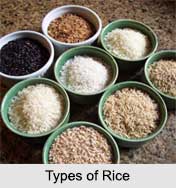
Types of Rice Rice has about 90 percent carbohydrate, 8 percent protein and 2 percent fat. There are various types of Indian rice which have different health benefits. Following are the different types of rice: Rice Production in India Since 1950, production of rice has been increased more than 35 percent. Though, the country's rice fabrication had declined. The regions cultivating this crop in India are differentiated as the western coastal strip, the eastern coastal strip, covering all the key deltas. West Bengal, Uttar Pradesh, Andhra Pradesh, Telangana, Punjab, Odisha, Bihar, Chhattisgarh, Tamil Nadu, Assam, Haryana are the major areas of rice production in India. Andhra Pradesh is called the 'Rice bowl of India'. 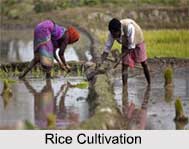
Methods of Rice Cultivation Rice can be cultivated by different systems based on the nature of region. The conventional methods are still in use. Following methods of the rice cultivation are practised in India: Conditions for Rice Production in India Rice is produced in a broad range of locations and under a variety of climatic conditions and grows on a mixture of soils. It can also endure alkaline and acid soils. It is a tropical plant and needs high heat with high moisture for its flourishing development. The temperature for rice cultivation should be fairly high at mean monthly of 24 degree centigrade. It should be 20 degree centigrade to 22 degree centigrade at the time of sowing, 23 degree centigrade to 25 degree centigrade in growth and 25 degree centigrade to 30 degree centigrade at the harvesting period. Good care has to be taken because this crop flourishes only if the soil stays wet and in growing years is should be under water. In the plain areas, rainwater is allowed to engulf the rice fields and stream gradually. Rice is lifted in well watered lowland areas. In the hilly areas, hills are cut into terraces for the cultivation of rice. Thus, the rice grown in the hilly areas is known as dry. Uses of Rice in India Rice is the staple foodstuff of over half the country’s inhabitants. The particles of long-grain rice lean to stay in one piece after cooking. The medium-grain rice suits stickier. Medium-grain rice is used for sweet dishes, and a lot of rice dishes. Short-grain rice is often used for rice pudding. The long-grain rice is normally used for boiling, quick-cook products, and soup. Whereas, the short-grain rice is used for cereal, baby food, and beer or liquors. White rice is a good source of magnesium, phosphorus, manganese, selenium, iron, folic acid, thiamine and niacin. Brown rice is often considered healthier rice than white rice. Rice is a cereal grain; it is the most extensively consumed staple food for a large part of the world's human population, especially in Asia. |
| |||



Rice
| Rice is one of the chief food grains of India. Moreover, India has the biggest area under rice cultivation, as it is one of the principal food crops of India. |
| ||||||||||||||||||||||||||||

