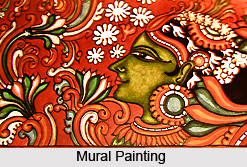
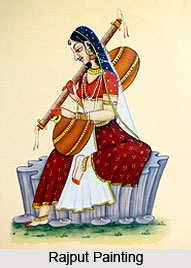
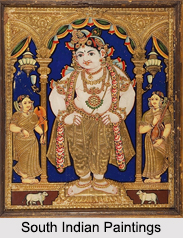
Deccan school of painting was effective in southern part of India in medieval age and later years. Adil Shahi, Nizam Shahi and Qutub Shahi rulers were the patrons in the development of Deccani School of painting. A lot of artists flourished during the rule of Ibrahim Adil Shah (II) (1580-1627), who was a great lover of painting. It is evident from the availability of numerous portraits of Ibrahim Adil Shah in different museums of the world. Deccani painting can be illustrated as a perceptive and an extremely included mix of original and overseas style of art.
History of Deccani School of Painting
The miniature painting method, which increased at first in the Bahmani court of Bahmani Sultanate and later in the courts of Ahmadnagar, Bijapur, Bidar Berrar and Golkonda is generally well-known as the Deccan school of Painting. The Nujum-ul-ulum of 1570 is the first dated manuscript, appears to be a producer of Bijapur, which continued to be one of the major centres of the style. Deccani art also had its consequence on the expansion of miniature painting in the Hindu courts of Rajasthan and central India.
The art of painting carried with it the influence and essence of the culture it represented. The art of painting widespread in other parts of India were very much influenced. Ibrahim Adil Shah was shown as a musician in few other paintings available in the Naprstck Museum, Prague, and the Goenka Collection, Kolkata. Although the Mughal School of painting and the Deccani School of painting developed the naturalism due to European influence, yet there was a difference between the two. The Mughal school paintings were more dazzling in technique whereas the Bijapur or the Deccani School of painting represented more naturalism due to imaginative composition and poetic content.
Features of Deccani School of Painting
Deccani School of Painting"s style is a perceptive, highly integrated merge of indigenous and foreign art forms. The Vijaynagar painting"s similarity is seen in the lengthened figures while the floral backgrounds with a general use of landscape shows Persian influence. Deccani colours are rich and luminous, and much use is made of gold and white. For the most part of the colour of Deccani paintings are Islamic, Turkish and Persian tradition particularly the arabesques, but those are surmount by a pure Deccani part of undergrowth. These paintings have a distinct quality of their own in the very unconventional composition. The rich landscape mysterious atmosphere, gem-like colouring, lavish use of gold, exquisite finish, profusion of large plants, flowering shrubs and typical Dakhni castles in the background and above all, the sweeping decorative rhythm that is of Bijapur origin are quite visible in them.
In the Prince of Wales Museum of Mumbai, the painting gallery has some typical examples of Deccani paintings, which have pale green, mineral-coloured backgrounds with figures placed squarely in the foreground. There are few other collections of Deccani paintings from Bundi, of the 18th century available here in this gallery, which deals with the theme of love. Another painting of the gallery depicts a lady looking in a Mirror (Bundi, 18th century). In this one, the artist has created a courtyard with a lush garden in the background and a pond of lotuses in the foreground that blossom in reflection of the glory of the young girl, or lover. One more painting of Bundi in 17th century depicts a `Nayika` in agony painting in another mood. The young lady is in agony, suffering the torment of separation from her lover.
Notable Works of Deccani School of Painting
The Deccani School of Painting has done some great and wonderful works which are very significant and they are as follows:
Ahmednagar Paintings: This school was patronized by Hussain Nizam Shah of Ahmednagar. The important manuscript is "Tarif-i-Hussain Shahi".
Bijapur Paintings: Bijapur was second Mughal capital at Delhi as a hub for artistic creativeness. Among the initial known Bijapur paintings are contained in a copy of a Persian manuscript on astronomy, titled "Nujum al-Ulum". Probably created for Sultan "Ali Adil Shah I", the subjects are illustrated in an unprocessed but extremely animated style.
Golconda Paintings: The initial paintings in Golconda under Qutb Shahi aid are attributable to the sovereignty of Ibrahim Qutab Shah. These paintings show the dancing girls entertaining the important guests. The Kulliyat of Sultan Muhammad Quli Qutb Shah from about 1590 is one of the primary illustrated manuscripts under majestic support at Golconda to combine effectively Indo-Persianate artistic modes.
Hyderabad Styles: A total set of 36 ragamala paintings called the "Johnson Ragamala" is considered by some to be the finest and most sophisticated example of Hyderabadi painting.