 Vajrayana is one of the schools of Buddhism thoughts which was first practiced in India and from here the Vajrayana school of Buddhism spread to Tibet, Bhutan and Mongolia. The Vajrayana school of Buddhism comes from the Mahayana Buddhism. Vajrayana is closely associated with the Theravada schools of Buddhism and Mahayana school of Buddhism, even if there are few differences as far as practice between them is concerned.
Etymology of Vajrayana
Vajrayana is derived from the two words "vajra" and "yana". Vajrayana is also regarded as the third Yana of Buddhism, it is the Sanskrit word which when translated means; "vehicle". This school of Buddhism got its name from Sanskrit word "vajra" which symbolizes the thunderbolt handled by the God of weather and war, Lord Indra. It also loosely translates in order to mean "diamond", symbolizing the unbreakable strength. Thus, the Vajrayana school of Buddhism is also known as the Diamond Vehicle and also the Indestructible Path of Buddhism. It also possesses various other names like True Words Sect, Esoteric Buddhism, Thunderbolt Vehicle, Tantric Buddhism, Secret Mantra and Mantrayana among others.
History of Vajrayana
One form of Vajrayana Buddhism is Tantric practice and there are also various other forms. Vajrayana developed in the northern parts of India during the 7th Century. Particularly, the path which led to the birth of Vajrayana is considered to have originated from the `wheel of dharma`s,` third turning, a list of oral traditions and Buddhist teachings generally called sutras. Its chief philosophical roots are in Madhyamika of Nagarjuna, Vijnanavada and Chandrakirti, Vasubhandu and Chittamatra of Asanga. The emergence of Vajrayana during the 7th century is credited to the Indian tantric master Padmasambhava, also called the "Second Buddha". Guru Padmasambhava was the renowned teacher of Vajrayana.
Significance of Vajrayana
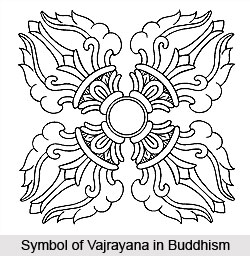
It is assumed that Vajrayana was more popular in the Himalayan territories. This school is called Vajrayana because of the use of the vajra. It is a symbol for thunder, diamond and lightning. The most prominent features of Vajrayana include the use of mantras, which is a form of chanting. It gives much importance to the teacher or guru. Another feature of Vajrayana is the significance of meditation, which also includes concentration techniques like; the visualization of bodhisattvas. The followers of the faith are brought in to these practices by initiation called empowerment. One of the salient features of Vajrayana is that it considers Mahayana and Theravada as the base on which the tantras could be practiced. The knowledge of these two earlier branches is absolutely essential to practice Vajrayana.
Philosophy of Vajrayana
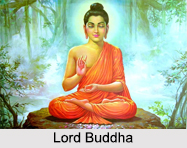
Vajrayana school of Buddhism is regarded as a spiritual and life philosophy which embraces the teachings of Siddhartha or Lord Buddha. Vajrayana principles are regarded as very close to those which the Buddha practised in order to attain true enlightenment. However, the Vajrayanists hold that Buddha did not disclose most of these principles since he believed them too private for the non-initiated. Similar to various other Buddhist teachings, Vajrayana is established on tantric doctrine or tantras, which are accessible by exercising several sadhanas. A sadhana can comprise meditation, yoga, controlled breathing or Pranayama and the reiteration of particular prayer called mantra.
Different from a number of Buddhist teachings, the course of Vajrayana school of Buddhism does not prescribe that the follower should endeavour to reach Nirvana, a method considered to absorb several lifetimes. In coalition with the bodhisattvas of Mahayana Buddhism, the practitioners of Vajrayana school of Buddhism should look for perfect enlightenment but be eager to reincarnate to help others on the material world to attain the same. The notion that the practitioners of Vajrayana may achieve pure enlightenment in one lifetime also varies from other teachings and which is why Vajrayana Buddhism is at times called the Short Path.