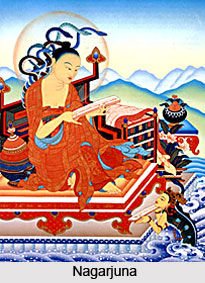
Nagarjuna, Buddhist Thinker - Informative & researched article on Nagarjuna, Buddhist Thinker
  Indianetzone: Largest Free Encyclopedia of India with thousand of articles Indian Religion


in  
Art & Culture | Entertainment | Health | Reference | Sports | Society | Travel
Forum  | Free E-magazine
Indian Religion : Vastu Shastra l Indian Religions l Indian Myths l Indian Mythology l Gods of India l Goddesses Of India l Religious Thinkers of India l Types of Religion in India l History of Indian Religion l Indian Yogis l Ajivikas l Sacred Scriptures in Indian Religion l Tantrism l Shaivism l Indian Communities l Sacred Animals in India l Roman Impact on South Indian Art and Society l Bhattacharyas l Indian Classical Terms
Home > Society > Indian Religion > Types of Religion in India > Buddhism > Nagarjuna
Nagarjuna, Buddhist Thinker
Nagarjuna was the founder of Madhyamika Buddhist philosophy. Nagarjuna is one of the most popular Buddhist thinkers after Lord Buddha.
  Teachings of Nagarjuna      

Nagarjuna, Buddhist ThinkerNagarjuna (150 CE) was presumably born in Andhra Pradesh in South India into a Brahmin family. He later converted to Buddhism. His writings formed the foundation of the Madhyamika School. The Prajnaparamita sutras were also developed by him. Nagarjuna was closely associated with the University of Nalanda. Nagarjuna`s most important works are the Mulamadhyamaka-karikas and Vigrahavyavartani. Nagarjuna insists that the Abhidharma outlook is contrary to authentic Buddhist teaching which says everything is empty of inherent nature. According to him entities with essential nature would have to be self-created, which is not possible.

Nagarjuna is primarily remembered for his contribution to the Buddhist philosophy. He developed further the concept of emptiness or Sunyata. This doctrine is also related to the concepts of anatta and dependent origination. He is also believed to develop the two-truth doctrine. According to this philosophy there are two levels of truth. One is the ultimate truth and the other is the conventional truth or the upaya. In Kaccayanagotta Sutta Nagarjuna describes the doctrine in details. There cannot be any dharmas with absolute nature. If reality consisted of dharmas possessing essence, the universe would be static and no changes would take place. Buddhists believe that everything in the world arises in dependence upon causes and conditioning factors. All Buddhists accept that accustomed entities lack essence. Nagarjuna insists that whatever is interdependently originated it is devoid of essential nature. If there are no essences, there are no stable entities with clearly defined identities. He denies that causation is a real relation. Events happen sequentially and human minds impose associations that are treated as causal realities. There are no types, kinds or classes of entities.

The truth is that there is no ultimate description of reality. Conceptual construction ends if there is a realisation that everything is empty. The realisation that there are no absolute truths leads to a compassionate outlook and mental peace. In Vigrabavyavartani Nagarjuna defends an extreme form of skepticism. Nagarjuna is not presenting an alternative version of objective reality.

His writings reveal that he was well conversed with the doctrines of the Nikaya School. Though the influence is apparent but there are not enough proofs to establish the connection. He was however predominantly a Mahayanist. In Buddhism he is also seen someone who has both the qualities of a human and the snake. In Indian tradition the snake is responsible for rain and other water bodies. In Buddhism this term refers to wise person or even an elephant.

He is also referred to as the Second Buddha. He is also referred to as a part of the Six Scholarly Ornaments. This group also includes Aryadeva, Asanga, Vasubandhu, Dignaga, and Dharmakirti. Nagarjuna`s death is also associated with several legends. While some say that he spent his last days meditating at Shri Parvatha Mountain, others are of the opinion that Nagarjuna was killed by his opponent. However, the teachings of Nagarjuna are still widely followed in Mahayana Buddhism.
(Last Updated on : 20/01/2011)
  More Articles in Buddhism
 
Schools of Buddhism Noble Eight Fold Path , Buddhism Buddhist Councils, Buddhism
Tripitaka, Buddhist Scripture Avalokitesvara, Buddhism Four Noble Truths
Abhidharma Dukkha Suchness
The Five Precepts of Buddhism Ambapali Mahayana Buddhism
Bodhisattvas Buddhist Literature Buddhism in India
Wheel of Dharma Dependent Origination Buddhist Pilgrimage Centers
Tantrik Buddhism Wheel of Life Akanithaka
Appamanabha Appamana Subha Awiha
Bodhi-Sattwa Rebirth in Buddhism Sravaka
Lohan Nagarjuna Maitreya
Jataka Sotapanna Triple Gems in Buddhism
Angulimala Brahma Sahampati Middle Path
Dagoba Mara Mudita
Dasa Dandu Dasasil Punya
Rahula Sakwala Samanera
Sangha Sardhawa Dinachariyawa
Sangha Hinayana Dharma in Buddhism
Decline Of Buddhism In India Brahma Nirvana  
Recently Updated Articles in Indian Religion
  • Life of the building
    Vastu Shastra provides exhaustive information about the life of a building.
  •  
  • Basement
    Vastu shastra recommends certain tips for the construction of the basement.
  •  
     
  • Tips for Purchasing a Flat
    Tips for Purchasing a Flat, as suggested by Vastu Shastra, an ancient Indian science for construction, will lead to prosperity and pleasure
  •  
  • West-North-West Extended Plot
    The residents of these buildings will experience a steady increase in the wealth.
  •  
  • Upper Floor
    According to this ancient architectural form, the upper floor needs special attention whiles constructing.
  •  
    E-mail this Article | Post a Comment
    RSS Feeds
    Forum
    Forum on Indian Religion

    Free E-magazine
    Subscribe to Free
    E-Magazine on Indian Crafts
     
     
    Nagarjuna, Buddhist Thinker - Informative & researched article on Nagarjuna, Buddhist Thinker
    Sitemap
    Contact Us   |   RSS Feeds
    Copyright © 2008 Jupiter Infomedia Pvt. Ltd. All rights reserved including the right to reproduce the contents in whole or in part in any form or medium without the express written permission of Jupiter Infomedia Pvt. Ltd.