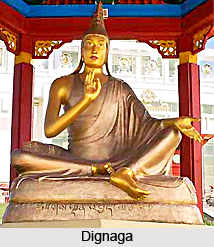
About Dignaga

DignagaDignaga (480-540 CE) was born into a Brahmin family in Simhavakta near Kanchipuram. He defended the view that a real kind of personality exists which is independent of the elements composing it. Dignaga totally annuls sensory perception and thoughts involving concepts and inference. There is no conceptualisation in sensory perception. Perception is a direct experience of objective reality that consists of a flux of unique and momentary particulars.

Perception is indescribable as they do not share any common features. The categories that the Nyaya-Vaiseshika realists claim to find in the world are imposed by the minds. Conceptual thought and language dealt generally. Simple concepts have no objective general features. They are causally related to the realities and arbitrary fictional inventions. There is a gap between how the minds work and the way things are at. Thought and language cannot be separated. Conceptual thought is born out of language and language is again born out of concepts. Interpretation of sensory impressions is through conceptual construction. Unique particulars are grouped together and it is understood as continuing objects bearing types of assets.

Dignaga inherits the terms svalakshana and Samanya and lakshana from the Abhidharma tradition. Svalak-sbana is an individual basic atomic factor as it is in itself. It means the common features to dharmas when their combinations produce trained formations. Non-eternity, unsatisfactoriness and lack of permanent identity are included in such generalities. The notion of the unique instant particular is modeled on the Abhidharma notion of dharma, however rejects their view that each atomic factor has an unchanging essence. He has paid a considerable contribution to the theory of inference.

Dignaga was an indirect student of Vasubandhu. Aspects of Yogachara and Sautrantika theories of perception were combined with his own innovative logical methodology. He has written a number of books on Abhidharma and Pramana. The work deals with the problems regarding sense-perception and its role in knowledge, knowledge reliability and the relationship between sensations, images, concepts, and the external world. His Pramana-samuccaya is a work that laid the foundations of Buddhist logic. He defined perception in anew manner. He regarded only pure sensation as perception. In his inference theory he distinguished between inference for oneself and inference for the other. His Hetucakra was his first work on formal logic. It is a bridge between the older doctrine of trairuupia and Dignaga`s own later theory of vyaapti. He had introduced a new form of deductive reasoning. Other works include The Treatise on the Objects of Cognition and The Treatise on the Correct Principles of Logic which were written in an effort to establish the valid sources of knowledge.
Teachings of Dignaga

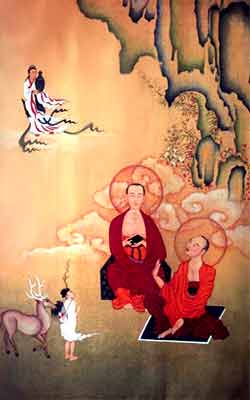
Teachings of DignagaTeachings of Dignaga reveal that he presented a theory of immaterialism which is comparable to that advocated by Berkeley. He lived at a point when heated debates were going on among various Buddhist schools. He wrote books disapproving the views of his adversaries. As he was dissatisfied with a particular doctrine and he moved north to Magadha where he became a pupil of Vasubandhu.
He advocated a certain metaphysical school of Buddhism. However later he moved away from it and became a disciple of Lord Buddha. Thereafter he became an analytical philosopher and logician. He advocated a system of logic which contains non-absolutism.

He annulled sensory perception and thoughts that involve concepts and inference. There is no conceptualisation in sensory perception. Perception cannot be described as they do not share similar features. He inherits the terms svalakshana and Samanya and lakshana from the Abhidharma. Svalak-sbana is an individual basic atomic factor. Non-eternity, unsatisfactoriness and lack of permanent identity are included in such generalities. He has considerably contributed to the theory of inference.

Features of Yogachara and Sautrantika theories of perception were combined with his logical methodology. He has defined perception in a new manner. He regarded According to him only pure sensation is perception. In his theory of inference theory he has differentiated between inference for oneself and inference for the other. He had introduced a new version of deductive reasoning.

His influential theory of cognition has been delineated in his main work, the Pramanasamuccaya. It is a theory that had a massive importance and has influenced in the development of Buddhist logic. The two basic elements in his theory are perception or pratyaksa and inference anumana.

He is the founder of the Buddhist school of epistemology and logic in India. He was a proponent of the Yogacara doctrine. However the notion of the alaya vijnana is not mentioned in any of his works. In some works he shows an interest in Sautrantika doctrine. Dignaga`s epistemological theories are expounded in the Pramanasamuccaya.

The originality of Dignaga lies in his insistence that an object of cognition must fulfil two necessary conditions: the object must be the cause of cognition, and it must possess the same form as that appears in the cognition. He examined and rejected the realist theories and concluded that the object of cognition is the form of an object that appears in the cognition. His major contribution in the field of logic is the invention of the "wheel of reasons". It shows nine possible relations between a logical reason and what is to be proven. It also enables one to distinguish a valid reason from an invalid reason.

Dignaga’s Conceptual Construction

Dignaga’s Conceptual Constructionis a linguistic activity. Whenever an object possesses a feature one conceptually constructs. The features of Conceptual construction are those classes whose wings are fixed by noun-phrases. A noun-phrase collects objects on the basis of similarity relation. What an object has in common belongs to the particular object, this has to be admitted. However it is not in the object. The word is the thing that objects have in common. Objects have similar figures of speech as they are denoted by the same noun-phrase. Language is a vehicle for the relation of this similarity. This explains as to why objects in Dignaga`s ontology are inexpressible. According to some idealists the cognitive make-up is such that conceptual construction forms an integral part of all mental events which also includes perception.

In order to denote an object, a word needs to pick a concurrence class of figures of speech. However words pick out exact similarity classes therefore would never denote objects. A simple noun-phrase `lotus" denotes the class of lotus flowers. If one were to adjoin adequately many noun-phrase qualifiers, one would construct a compound noun phrase which denotes a single class containing one object. His argument was against this possibility rests on the "cognitive opacity of real things`. An object has more properties than can ever be known. Therefore according to Dignaga, a thing possesses many properties that cannot be cognised in all its aspects by the sense.

An object has to be cognised with all its properties. A sense-module informs one only about the tangible properties of the object. Similarly inferential signs and words inform about specific properties of the object. According to Dignaga the For Dinnaga the significant contrast is between the self-marked and the generically marked objects and properties. Objects are not potential constructs of conception as it is impossible to know everything. Similarly on the trope-theoretic analysis, one cannot know every member class of concurrent figures of speech.

According to Dignaga objects are non-conceptually made available in perception. Perception is a medium for detaining coincidence. Basically according to Dignaga all perception involves some conceptual construction. \