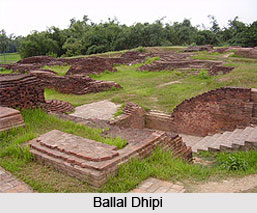
The early years of Skandagupta to the throne of the Gupta Empire was marked with violent civil war between the different sons of Kumaragupta I. Skandagupta defeated his rivals and became victorious. Finally he ascended the throne and assumed the title `Kumaraditya` and ruled for 12 years till 466 A.D. Skandagupta`s reign is marked with enormous struggles and conquests. The Junagarh and Bhitari pillar inscriptions were the chief sources, which throw light on the reign and conquests of the king. Skandagupta had to fight with his adversaries to retain supremacy of the Gupta Empire in India.
From the epigraphic evidences it is known that towards the termination of his father`s reign, Skandagupta had defended the Gupta Empire from invasion of the powerful tribe, Pushyamitras. From the Bhitari Pillar inscription it is known that Skandagupta had defeated the Pushyamitras. From the "Junagarh Pillar inscription" it is known that as soon as Skandagupta had ascended the throne, the enemy kings had raised a revolt against him. Though there is no clear identification about these rival kings, yet historians on the basis of Junagarh Pillar inscription have suggested that Bandhu Varmana, a Gupta feudatory of Malwa had allied with the Vakatakas and had raised a joint revolt against Skandagupta. However Skandagupta had successfully suppressed the revolt of the enemy kings allied with the Vakatakas. The local chief Prabhakara supported Skandagupta. This significant event took place in 467 A.D. Therefore it is evident from epigraphic evidences that Skandagupta had to face various internal attacks and rivalry in the beginning of his career as the king of the Gupta dynasty.
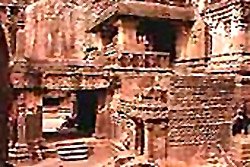
Apart from civil war and internal rivalries, the reign of Skandagupta is a striking period in the history of ancient India, probably because of the Hun invasion. Moreover the chief credit of Skandagupta lies in his conquest against the Huns. The reference of the Hun invasion is found in the 8th stanza of the Bhitari Pillar inscription. The most formidable war of Skandagupta in his reign was against the Huns, for which he is legendary. However since the inscriptions do not provide any valid date of the invasion, there are enough controversies regarding the time of the Hun assault. According to Dr. R.C. Majumdar, the invasion perhaps took place in the latter part of Skandagupta`s reign. From the Bhitari pillar inscription it is known that the Huns, who invaded India during the reign of Skandagupta, were Epthalite or white Huns. They had found their way by crossing the Hindukush Mountain and had entered India through Gandhara. The Huns had established their kingdom in India, which extended from Persia to Khotan in Central Asia, with their capital city in Bamiyan in Afghanistan. Toraman, the king of the Huns, invaded India through the frontier countries like Punjab, Kashmir and Rajasthan. Since the tribal republics in the frontier countries were completely collapsed by the conquest and annexation policy of Samudragupta and Chandragupta II, these border republics could not provide any resistance against the Huns. Hence they entered India almost without any difficulty. The Huns marched unopposed to the vast plains of the Gangetic Valley, which was the heart of the Gupta Empire. Toraman with his notorious army advanced towards the Gupta Empire and revelled in wanton slaughter over the conquered people. However available records prove that though the Huns had penetrated and posed as a great menace to the Gupta Empire, yet Skandagupta had successfully suppressed them. Thus Skandagupta after a sanguinary battle with the terrific Huns had repulsed the tide of the Hun invasion in India. He not only retarded the surge of the Hun usurpations, but it is presumed by historians that Skandagupta also had expelled the Huns completely from Punjab and Kashmir by 442 A.D. So well before his death he had strengthened the northern countries from Hun incursions. According to Dr. R.C. Majumdar, the Huns could hardly recover for the next 50 years from this stunning blow delivered by Skandagupta. Dr. Majumdar has also suggested that the conquest against the Huns was a great achievement for Skandagupta for which he is famous in ancient history as " the saviour of India". The violent conquest of Skandagupta against the Huns is described in literary documents of the time. The "Chandra Vyakarana", "Katha Sarit Sagara" etc. vividly depicts the Hun invasion and the conquest of Skandagupta against the Huns.
The Hun war was probably fought in 136 to 138 of the Gupta Era. Sardar K.M. Panikkar and some other scholars have suggested that there were repeated Hun marauds in the Gupta Empire even in the post-Skandagupta period, but these were of lesser importance. The defeat in the hands of Skandagupta exhausted the Huns and they even lost their former prowess. Apart from the conquest against the Huns, Skandagupta also is renowned for other conquests. According to Dr. H.C Roychowdhury, Skandagupta had some conflict against the Vakatakas of Deccan, who tried to infiltrate the Central Indian region (Kosala Mekala region) of the Gupta Empire. But Skandagupta successfully routed them.
However historians generally opine that Skandagupta was undoubtedly a great conqueror. But unlike his predecessors, his conquests and military campaigns were not aimed for the annexation and expansion of the Empire. Rather Skandagupta`s conquest against the Huns and the Vakatakas were for strengthening his Empire. The invaders invaded the country and Skandagupta just repulsed them out from the boundary of his Empire. Apart from protecting the country there is nothing called `expansionism` in his conquest. Hence Skandagupta is more popular in history as the "saviour of India", rather than a great conqueror like his predecessors.

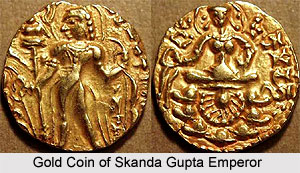 Skandagupta was the ruler of Northern India and is considered as the last of the great Gupta emperors. Skandagupta was the immediate successor of Kumaragupta I. The concluding years of Kumaragupta`s reign was full of troubles, due to the invasion of the Pushyamitras. Quite naturally Skandagupta faced some of the greatest challenges whilst contending with the Pushyamitras and the Hunas. Skandagupta ideally defeated the Pushyamitras. But soon after this he had to face the invading Indo-Hephthalites or `White Huns` from the northwest side. Scholars have opined that the successor of Kumaragupta I, Skandagupta did not find it an undisputed and peaceful succession to the throne of Gupta dynasty. According to them there was probably a civil war among the sons of Kumaragupta I in which Skandagupta ultimately emerged victorious. The Bhitari Pillar Inscription also corroborates the fact of civil war.