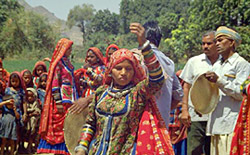
Santhal Tribe is the largest tribal community in India. They live mainly in the states of Jharkhand, West Bengal, Bihar, Odisha and Assam. Their concentration is mainly in Dumka, Godda, Deoghar, Jamtara and Pakur districts of Santhal Parganas and East and West Singhbhum districts of Jharkhand. Santhals are among the most backward of the ethnic groups of India. The people of this tribal community generally prefer to live in concentrated settlements close to forests and rivers and are segregated into groups known as "Thars".
Origin of Santhal Tribe
Santhal Tribe dates back to the pre-Aryan period. They belong to the proto-Australoid racial group, linguistically they belong to the Mundari group of Austro-Asiatic linguistic family. It is also believed that they had come from the Districts of `Santha` and that is why they are called as `Santan` or men of Santha state. The Santhals live in peace and harmony among themselves.
History of Santhal Tribe
The Santhals were well-known fighters in the time of the British rule in India. People of this community waged war versus Lord Cornwallis" Permanent Settlement in the year 1855. During the later parts of 1850, one of the tribal heroes named Sidhu was able to gather about 10,000 Santhals in order to run a parallel government against the British. The first Santhal leader was Baba Tilka Majhi who raised weapons in the year 1789 against the British.

Language of Santhal Tribe
The Santhali language is part of the Austro-Asiatic family, distantly related to Vietnamese and Khmer. Santhals have their script called "Olchiki". They did not have a written language until the 20th century. It was developed by Dr. Raghunath Murmu in1925. Apart from santhali they also speak Bengali, Oriya and Hindi.
Occupation of Santhal Tribe
The day-to-day life of the Santhals encircle around the area of the forests in which they live. The Santhals fulfil their basic requirements from plants and trees in the forests. They also engage themselves in fishing, hunting and cultivation in order to sustain their livelihood. People of this tribal community have the unique skills in constructing musical equipments, baskets and mats from plants and this talent is passed safely from one generation to another.
Religion of Santhal Tribe
The Santhal tribes follow the religion called "Sarna". They believe in supernatural beings and ancestral spirits. Santhals do not possess any temple and they worship no idols. Thakurjiu is their ancestral deity. Goddess and Gods of Santhals are Jaheraera, Marangburu and Manjhi. They give respect to the spirits and ghosts like Lakchera, Kal Sing, Beudarang, etc.
Culture of Santhal Tribe
Dancing is very much loved by the Santhalis. It is the most prominent component of the festivals and fairs of the Santhal Tribe. After a daylong work, Santhals take rest by enjoying very light music along with dance. The women of this tribal community dress in sarees and they dance in the sequence of a line. The Santhal men play the music with instruments like Tirio, hotok, Dhodro banam, Phet banam, Tamak, Tumdak, Junko and Singa.
Festivals of Santhal Tribe
The Santhal tribes generally celebrate the Karma festival which comes every year in September and October. This festival is celebrated to please the God to bless them with more wealth and decrease their enemies. Some of the other major festivals observed by the Santhals include Baba Bonga, Sahrai, Maghe, Ero, Namah and Asaria. Santhals also enjoy the hunting festival known as Disum Sendra on Baishakhi Purnima.