


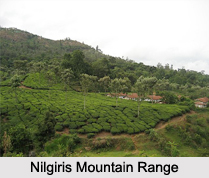
 The Nilgiri is defined as a range of mountains. This range is located at the junction of the south Indian states namely, Karnataka and Kerala. It is a part of the Western Ghats which is called its parent range in western Tamil Nadu. This range of mountains is also well known by the name of ‘Nilgiri Hills’ or ‘The Queen of Hills’ or ‘Blue Mountains’. The Nilgiri is defined as a range of mountains. This range is located at the junction of the south Indian states namely, Karnataka and Kerala. It is a part of the Western Ghats which is called its parent range in western Tamil Nadu. This range of mountains is also well known by the name of ‘Nilgiri Hills’ or ‘The Queen of Hills’ or ‘Blue Mountains’.
History of Nilgiri Mountain Range John Sullivan had lead expeditions to the Nilgiri on 2nd January, 1819, after previous explorations in the Hills. He is known to be the grandson of Lawrence Sullivan, Director of East India Company. He had received an order from the British East India Company that directed him to the Nilgiri with a detachment of Europeans and Madras sepoys. More specifically, he was entrusted with the responsibility of investigating the "origin of the fabulous tales that are circulated concerning the Blue Mountains to verify their authenticity and to send a report to the authorities". After six days of expedition, which resulted in the loss of the lives of some of the members of the expedition, Sullivan arrived at a plateau from where he proudly hoisted the British flag. John Sullivan then commenced a personal campaign to convince the government of Madras that the unusually temperate and healthy climate of the hills made it ideal as a ‘resort of invalid’s, primarily soldiers. Consequently in 1821, three assistant surgeons were ordered by the Medical Board of the presidency to asses the claimed conditions. They reported their analysis in affirmative and also advised that fifty invalid soldiers should be sent there to test the favorability of the region to health. Sullivan and other officials from neighboring districts had then set summer residences at Ootacamund, in the heart of the Nilgiri. This was the nascent community of the Nilgiri, which further drew a number of visitors looking for health, comfort and leisure. Geography of Nilgiri Mountain Range Globally, the Nilgiri Mountain Range can be pinpointed at latitudes 11 degrees and 08 minutes to 11 degrees and 37 minutes north and longitudes 76 degrees and 27 minutes east to 77 degrees and 4 minutes east. Geologically, this mountain range belongs to the azoic age of rock (3000 to 500 mya) and this type of mountain range is labeled as fault. It is situated at an elevation of about 2,637 m (8,652 ft) and is spread over an area of about 2,479 square kilometers (957 sq mi). These mountains are separated from the Karnataka plateau to the north by the Moyar River and from the Anaimalai Hills and Palni Hills to the south by the Palghat Gap. It is important to note that the entire area covered by the Blue Mountains comprises of the present district of Nilgiri. Peaks of Nilgiri Mountain Range Nilgiri is a range of mountains with several pointed tops called peaks. The hills or their respective peaks are known by different names. The highest peak of this range is Doddabetta. Doddabetta Peak This peak is located near about 4 km east southeast from Udhagamandalam (Ooty). It is the southern extent of the range and has a height of about 2,637 meters (8,652 ft). This peak is connected to other peaks in the west and nearby Udhagamandalam. They are Kolaribetta (height: 2,630 meters (8,629 ft), Hecuba (2,375 meters (7,792 ft), Kattadadu (2,418 meters (7,933 ft)) and Kulkudi (2,439 meters (8,002 ft)). Snowdon Snowdon is identified as the northern extent of the Nilgiris range. It has a height of about 2,530 meters (8,301 ft). Snowdon has other significant elevations too. They are the Club Hill and Elk Hill. The former has a height of about 2,448 meters (8,031 ft), whereas the latter has a height of about 2,466 meters (8,091 ft). Snowdon along with Club Hill and Elk Hill and Doddabetta create a valley namely, Udhagamandalam Valley. Devashola South of Doddabetta range is another noteworthy peak of Nilgiris Mountain Range called Devashola. It has a height of about 2,261 meters (7,418 ft) and attracts attention for its blue gum trees. Kulakombai Kulakombai is located east of the Devashola. As per estimations, this peak has a height of about 1,707 meters (5,600 ft). The extensions of Kulakombai are Bhavani Valley and the Lambton's peak range of Coimbatore district. Hullikal Durg Hullikal Durg is located about 3 km southeast of Coonoor. It means Tiger Rock Fort in the Kannada language. It is also known by the name, Bakasura Parvata, which has been derived from Sanskrit language. It has a height of about 562 meters (1,844 ft). The base of Hullikal Durg hill is a home to tropical pine forest and its valleys houses green foliage. Coonoor Betta Coonoor Betta is located on the northern side of a gorge, having the Nilgiri Mountain Railway to Coonoor. The estimated height of Coonoor Betta is about 2,101 meters (6,893 ft). It is also known by the other name of Teneriffe. Rallia Hill Rallia Hill is almost equidistant from Udhagamandalam and Kotagiri. More specifically, it is located in the midst of a reserved forest and has a height of about 2,248 meters (7,375 ft). Dimhatti Hill Dimhatti Hill is located above the Gajalahatti pass. According to history, this pass functioned to provide a short cut from Mysore to the Carnatic plains. It is known to have strategic importance in the eighteenth century. The estimated height of Dimhatti Hill is about 1,788 meters (5,866 ft).This hill is regarded as holy by the residents of the nearby villages and also has a ruling deity called Rangaswamy. Avalanche Hill Avalanche Hill is known for twin-peaks of Kudikkadu and Kolaribetta. The former has a height of about 2,590 meters (8,497 ft), whereas the latter has a height of about 2,630 meters (8,629 ft). Derbetta Hill Derbetta Hill and Kolibetta (height: 2,494 meters (8,182 ft)), south of the Ouchterlony valley, are a continuation of the Kundah range. Derbetta Hill is also known by the other name of Bear Hill. It has a height of about 2,531 meters (8,304 ft). Mukurthi Peak Mukurthi Peak is known to have a height of about 2,554 meters (8,379 ft). Muttunadu Betta Muttunadu Betta is located north northwest of Udhagamandalam at a distance of about 5 km. It has a height of about 2,323 meters (7,621 ft). Tamrabetta Tamrabetta is located southeast of Udhagamandalam at a distance of about 8 km. It has a height of about 2,120 meters (6,955 ft). Vellangiri Vellangiri is located west-northwest of Udhagamandalam at a distance of about 16 km. It has a height of about 2,120 meters (6,955 ft). Other name of Vellangiri is Silvery Hill. Waterfall of Nilgiri Mountain Range Nilgiris Mountain Range has several waterfalls. Kolakambai Fall is the highest waterfall, north of Kolakambai hill. Halashana falls is located near Kolakambai Fall. Catherine Falls is the second highest waterfall near Kotagiri. Law's Fall is situated near Coonoor. Kalhutti Fall is situated off the Segur Peak. The Karteri Fall is located near Aruvankadu. It is popular for the first power station which supplied the original Cordite factory with electricity. Flora and Fauna of Nilgiri Mountain Range As per estimations, the Sholas of the Nilgiri is a home to over 2,700 species of flowering plants, 160 species of fern and fern allies, innumerable kinds of flowerless plants, mosses, fungi, algae and land lichens. Certain species of plants are ‘threatened’ in the Nilgiri and are consequently classified as vulnerable species, rare species and endangered species. As far as fauna is concerned, Nilgiri hills are a home to Nilgiri tahr animals. Nilgiri Biosphere Reserve in Nilgiri Mountain Range The Nilgiri Hills is a part of the Nilgiri Biosphere Reserve. This Biosphere Reserve is an International Biosphere Reserve and a part of the UNESCO World Network of Biosphere Reserves. It is the first biosphere reserve in India, established in the year 1986. Related Articles: Indian Mountains Indian Mountain Ranges Indian Islands |
| |||



Home > Reference > Geography of India > Indian Mountains > Indian Mountain Ranges > Nilgiris Mountain Range
Nilgiris Mountain Range
| This range is a part of the larger Western Ghats mountain chain making up the western edge of the Deccan Plateau. |
| ||||||||||||||||||||||||||||

