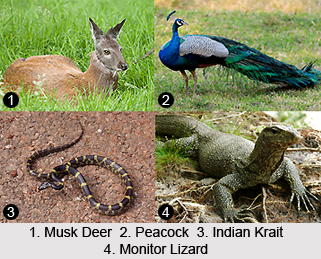
 Indian animals comprise of a diverse category of wildlife present in the country. India is a home to thousands of animals, mammals, reptiles, amphibians and birds. The country has one of the world`s largest ranges of species. From Himalayan Mountains in the north to Lakshwadeep in the south and from Thar Desert in the west to rain forests in the east, rarest of rare species are present that are found only in India. Varied climate, rivers, dense forests and topography of India, make it ideal for the existence of wild species. Apart from wild animals, India is a home to various household animals, cattle being the most important animal for the Indian population.
Types of Indian Animals
Indian animals can be grouped into two categories. They are wild animals and pet animals. These categories are described below.
•Indian Wild Animals
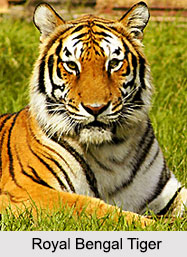
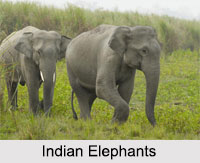
Wild animals found in the country are innumerable. Some of them are tiger, lion, elephant, rhinoceros, deer, leopard, clouded leopard, black bear, monkey, panda, hyena, wild boar, camel, chinkara, Himalayan tahr, abarimon, black buck and horse. Royal Bengal tiger is the largest living member of the big cat family. Its solid body structure truly gives it a royal look.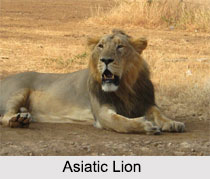 India had over 40000 tigers in the beginning of the 20th century. The count of tigers was 1,411 in the year 2006. This count increased to 1,706 in the year 2011, which further increased to 2,226 in the year 2014. The records of World Wildlife Fund and Global Tiger Forum highlighted 3891 wild tigers in the year 2016. Lions had played a major role in the symbols and folklore of Indian culture for over 2000 years. Asiatic lion was once widespread throughout southwest Asia. At present, this species can only be found in a single location in the wild, that is, the Gir forest in India. Indian elephant is one of the three subspecies of Asiatic elephant. Over the last 60 to 75 years, its population has reduced by at least 50 percent. Indian rhinoceros is native to India. Unlike others, Indian rhinoceros has only one horn. The count of Indian rhinoceros ranged from 1,870 to 1,895 in the early 1990s. The count increased to 3,555 in 2015. Indian deer is a member of the Cervidae family. There are several species of deer found in India like hog deer, musk deer and barking deer. Sambar deer is the largest species of deer native to India.
•Indian Pet Animals
Pet animals are kept at homes for companionship and enjoyment, as opposed to livestock, laboratory animals and sport animals, which are kept for economic reasons. Some of the common Indian pet animals are dogs, cats and rabbits.
Endangered Indian Animals
 Endangered species is the population of an organism, which is at the risk of becoming extinct because it is either
(a) Few in number or
(b) Threatened by changing environmental or predation parameters.
The high rate at which species have become extinct within the last 150 years is a cause of concern. While species are evolving and becoming extinct on a regular basis for the last several 100 million years, recent rates of extinction are many times higher than the typical historical values. This is a great cause of concern as extinction not only leads to the loss of a species as a biological entity, but also affects human life and leads to destabilization of the ecosystem. Some of the endangered species of India are Asian elephant, Siberian tiger, golden leopard, lion-tailed macaque and royal Bengal tiger.
Threats to Indian Animals and their Conservation
There has been in the recent years an increasing threat to the wildlife of India, mainly due to human encroachment in the form of hunting and poaching. For example, elephant is born in the wild, but is caught by men and tamed. Thus, some species reached the brink of extinction, while some others became critically endangered. Consequently, a number of protected areas like national parks, wildlife sanctuaries, biosphere reserves, tiger reserves and elephant reserves were set up for the protection of Indian animals. Laws have also been framed to conserve Indian animals.
Indian Animals
Indian animals boast of a rich and varied biodiversity in the country. Animals live in the wild. Some animals are also kept at homes as pets. Indian wild animals are tiger, lion, elephant, leopard, etc. Some of the Indian pet animals are dogs, cats and rabbits.