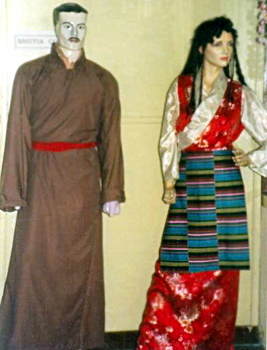
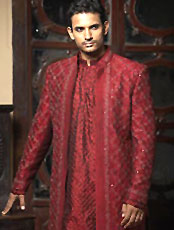
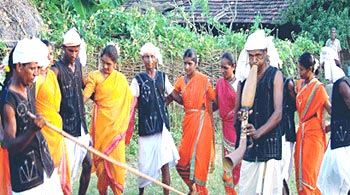
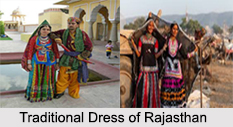
 The traditional dress of Rajasthan is exceptionally lively, reflecting the spirit of the people and the culture of the region. The clothes worn by the people of Rajasthan are designed keeping in mind the climate and conditions in which they live. The traditional dress and jewellery of these desert people are not mere ornaments for them. Everything from head-to-toe including the turbans, clothes, jewellery and even the footwear establish the identity, religion and the economic and social status of the population of Rajasthan.
Traditional Dress and costumes of Rajasthan for Men
The Pagri which is also known as the turban, Angarkha, Dhoti, Kamarbandh or Patka (waistband) form an integral part of a Rajasthani male"s attire.
Pagri: The turban or Pagri is a significant piece of costume. The style of the turban with its colour and the way in which it is worn holds a stature of special significance to the people of Rajasthan as it is symbolic of the caste and region to which a person belongs. Turbans of Rajasthan come in many different shapes, sizes and colours. Moreover, there are specific turbans for specific occasions as well. The shape and size of Pagris vary region to region. Pagris of Udaipur are flat, and men of Jodhpur wear safa which have a curved bend. In Jaipur, people prefer an angular Pagri.
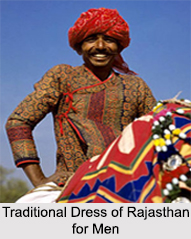 Angarkha: Angarkha, which can be loosely translated as "Body Protector", is a garment which is mostly made of cotton. When there are occasions of celebration and festivities in the region, people can be seen wearing printed Angarkhas of popular tie and dye method. The 2 principal kinds of Angarkhas which are common to Rajasthanis are, "Kamari Angarkha" and the "Long Angarkha". While the former type is styled like a frock and reaches till the waist the latter is longer and goes beyond the knees.
Dhoti: Dhotis are used to cover the lower part of the body. A dhoti is a piece of cloth which measures 4m by 1m and requires quite a bit of practice to be worn properly. The Dhotis are used as regular wears which are usually white in colour. However on special occasions people also wear silk Dhotis with zari border.
Patka: Patka was a garment worn by people of upper classes and royal families made out of cotton cloth which measured about 1.5 m by 1 m. It was traditionally kept on the shoulders or worn around the waist to tuck in the weapons during medieval times.
With changing times, the traditional style of dressing has also undergone a sea change. The Rajasthani man is often seen to dress in the urban garb of trousers and a shirt, or, sometimes, in an attractive combination of both urban and traditional garments teamed up together.
Traditional Dress of Rajasthan for Women
The traditional dress of Rajasthan for females includes Ghaghra-Choli and Odhni.
Ghagra: Most of the Rajasthani women wear the Ghagra which is a long skirt that reaches up to the ankle having a narrow waist which increases in width and flares towards the base. The width and the number of pleats in the Ghaghra are said to symbolise the wealth of a person.
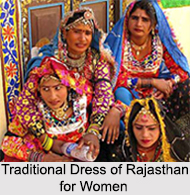 Odhni: The Odhni is a specialty of the traditional dress of Rajasthan. It is a long piece of cloth whose one corner of the Odhni is tucked in the skirt while the other end is taken over the head and right shoulder. The colours and motifs which are found on the Odhnis are particular to caste, type of costume and occasion. Both Hindu and Muslim women wear Odhnis. An Odhni with a yellow background and a central lotus motif in red called a "Pila" is a traditional gift of parent to their daughter on the birth of a son.
Nowadays, the traditional costume of the Rajasthani women is almost in a state of transition. The women are opting for new fabrics, designs and accessories.
Royal Traditional Dress of Rajasthan
The royal traditional dress of Rajasthan reflects the regal taste of the aristocratic hierarchy. The rich and luxurious dresses that were created for the royalty were made under the careful attention of special departments that were in charge of royal costume. The Rajput kings always dressed up in their most colourful and formal best.
Footwear of Rajasthan
The shoes, created from sheep, goat or camel skin are known as "Jootis" or "Mojaris". The shoes, for men and women, are crafted with delicate embroidery upon brocade or velvet, pasted on the exterior surface of the shoe.
Accessories of Rajasthan
The jewelleries of Rajasthan are uniquely styled and embellished with emeralds, diamonds and other precious stones. Amongst men, earrings, paired with gold chain or a pearl necklace or silver "Hansli", a thick bracelet worn around the neck is common. Earlier they used to wear brass jewellery, but now use silver or white metal ornaments.