





 Ayurveda is a traditional holistic health care system that has been practiced in India for more than 5000 years. With its origin deeply seated in the hinterlands of India, Ayurveda is an elaborated medical system and is regarded as the oldest form of health care in the world. Ayurveda is a traditional holistic health care system that has been practiced in India for more than 5000 years. With its origin deeply seated in the hinterlands of India, Ayurveda is an elaborated medical system and is regarded as the oldest form of health care in the world.
Etymology of Ayurveda Ayurveda is a Sanskrit term, made up of the words "Ayush" meaning life and "Veda" meaning knowledge or science. The term "Ayurveda" thus means the ‘knowledge of life’ or the ‘science of life’. According to the ancient Ayurvedic scholar Charaka, "ayu" comprises the mind, body, senses and the soul. It analyses the human body in terms of earth, water, fire, air and ether as well as the three bodily humours. Origin of Ayurveda In India, the origin of Ayurveda is as old as the religion, Hinduism. Ayurveda was a sub section attached to the Atharva Veda and is treated as Upaveda of Rig Veda and Antharveda (internal part) of Atharvana Veda. Myths and legends lace the origin of this traditional health care system. It is believed that Ayurveda was once communicated to the Indian saints and sages. Myths unfold that Dhanvantri, the physician of the gods in Hindu mythology, penned down Ayurveda and taught it to the sages. 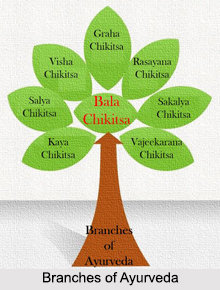 While according to another legend, the knowledge of healing, Ayurveda originated from Lord Brahma who taught it to Daksha, who further taught it to Lord Indra. It was the time of sheer restlessness; Human existence was under the lash of deaths and disease and it was then to offer human being a solution the great sages gathered together. During this meeting, saint Bharadvaja came forward and learnt the science of Ayurveda from Lord Indra. He then taught Ayurveda to Atreya who further carried it as a treatment procedure to the next level of maturity and transmitted this knowledge throughout world. Later it was Agnivesha, the disciples of Atreya who wrote "Agnivesha Samhita" which is still considered as the most comprehensive form of Ayurveda. However, in later days the classical texts, "Charaka Samhita" (Charaka), "Ashtanga Hridaya" (Vagbhata) and "Sushruta Samhita" (Susruta) formed the foundation of Ayurveda. While according to another legend, the knowledge of healing, Ayurveda originated from Lord Brahma who taught it to Daksha, who further taught it to Lord Indra. It was the time of sheer restlessness; Human existence was under the lash of deaths and disease and it was then to offer human being a solution the great sages gathered together. During this meeting, saint Bharadvaja came forward and learnt the science of Ayurveda from Lord Indra. He then taught Ayurveda to Atreya who further carried it as a treatment procedure to the next level of maturity and transmitted this knowledge throughout world. Later it was Agnivesha, the disciples of Atreya who wrote "Agnivesha Samhita" which is still considered as the most comprehensive form of Ayurveda. However, in later days the classical texts, "Charaka Samhita" (Charaka), "Ashtanga Hridaya" (Vagbhata) and "Sushruta Samhita" (Susruta) formed the foundation of Ayurveda.
Concept of Ayurveda Ayurveda, as a holistic treatment procedure thus represents the science of life and longevity originating in the Vedic traditions of India. Based on the principle of eternal life, Ayurveda has a vast body of knowledge which covers eight principal branches. The primary element of Ayurveda involves the eternal symbiosis of mind, body and spirit for a healthy living. Any imbalance in this symbiosis of body, spirit and mind indeed results in physical ailments. Ayurveda as a treatment concept thus re-establishes the harmony between the body and its habitat by creating optimum health environment. The whole science of Ayurveda is based on the ‘Five Great Elements’ known as Panchabhuta Theory. These five elements are earth (prithvi), water (jal), fire (agni), air (vayu) and ether or space (akash). In Ayurvedic tradition, the universe is made up of these five elements. According to Ayurveda, the origin of all aspects of existence is consciousness. Matter and Energy are one; however, matter is manifested in the Panchabhuta or the five elements. Ayurveda also perceives the body, mind and spirit likewise and therefore zero down specific methods for working on each to ensure healthy living. 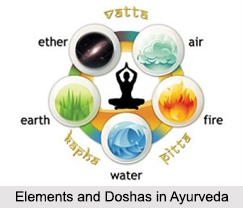 Doshas in Ayurveda Doshas in Ayurveda
Ayurveda recognizes three main energies that combine to form all things in the universe. When people become aware of these qualities within themselves, they take the first step toward creating a healthy life. By working with the body’s unique nature, true health can be created. Ayurveda names these basic energies as Vata (ether/air), Pitta (fire) and Kapha (water/earth). Vata rules mental mobility. Pitta or fire, governs digestion and assimilation on all levels from food to ideas. Kapha or water rules the form and substance and is responsible for weight, cohesion and stability. In the Ayurvedic approach to life and health, it is recognized how these energies work at each moment in people's bodies and minds. When these energies are recognized, countering the destructive forces with positive actions becomes possible. This further creates balance. Treatments in Ayurveda Ayurveda insists that any discordant note in the synthesis of the spirit, body and mind due to external or internal causes is a cause for concern. The ‘fault’ or dosha, the ‘tissue'’ or dhatu and the ‘impurity’ or mala should be in perfect harmony with each other, with all the components properly balanced and that is the secret of health as per Ayurveda. Therefore the treatment in Ayurveda also concentrates on the symbiosis of the spirit, mind and the body. Essentially Ayurveda holds the view that it is the Tridosha imbalance, which causes ‘Disease’. Other causes are the imbalance of digestive fire (agni), and accumulation of toxins (aama) formed by undigested nutrients and psychological experiences. The therapeutic measures in Ayurveda are therefore taken both to prevent diseases and also to cure them. Thus ayurvedic procedures are done either to detoxify the body or as a prelude to strengthen the immune system. Panchakarma is the most sought after detoxification therapy in Ayurveda which paves the way for the culmination of Ayurvedic treatment of healing whilst ensuring health. The legacy of Ayurveda as a treatment method which was initiated by the early Ayurvedic practitioners like the Sushruta, Charaka and Vagbhata is still regarded as one of the reigning alternative treatment methods in India. Ayurveda is the science of life which views a healthy individual as an integral synthesis of mind, body and spirit, living in harmony with fellow beings and environment. |
| ||||||||||||||||||||||||||||

